

How much is an 1879 silver dollar worth?
An 1879 silver dollar’s value depends mainly on its mint mark, condition and variety. For ordinary Philadelphia, O and S issues, the PCGS guide lists $92 at VF20; an 1879-CC is listed at $725 at the same grade. At MS63, the usual 1879-S is $110, compared with $9,500 for 1879-CC. These USD guide values were checked September 24, 2026.
Our HeriBase test shows how to begin that comparison: the app returned “1879-S-MS,” a $129 reference price and a details page with the coin’s denomination, silver fineness, diameter and weight. That gives a collector an identified issue to research and a starting estimate. Below, we connect that result with mint-mark photographs, grade-based prices, special-variety diagnostics and recorded auction sales.
The mint mark determines which issue you own.
The Reverse of 1878 needs its own comparison.
Wear, cleaning and mirror designations affect the match.
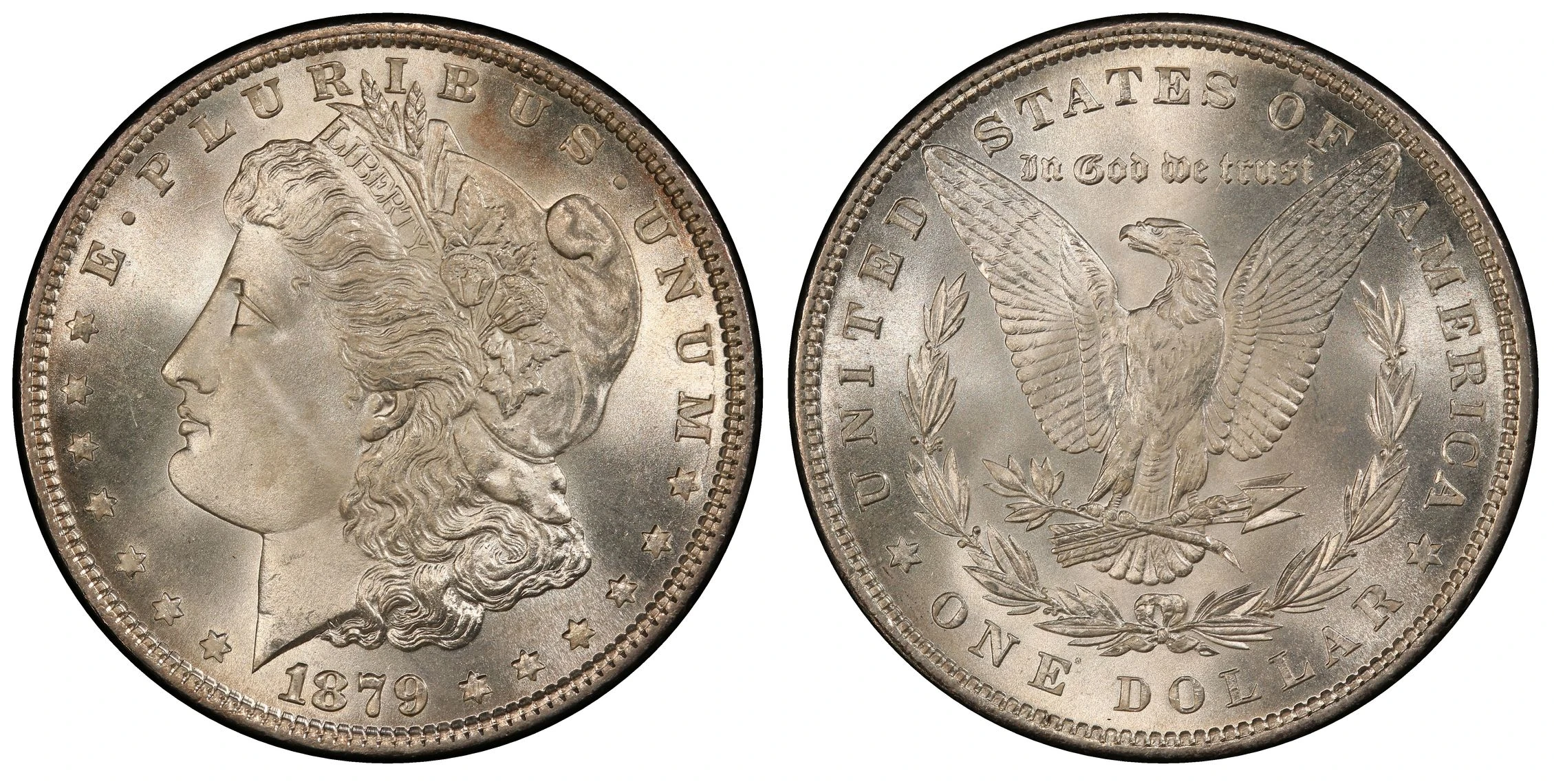
Where is the mint mark on an 1879 Morgan dollar?
Look just below the wreath bow on the reverse, above “DOLLAR.” A blank space means Philadelphia. O identifies New Orleans, S identifies San Francisco, and CC identifies Carson City. Catalogs may use “1879-P” for Philadelphia, but the coin itself has no P.
Regular-strike mintage: 14,806,000.
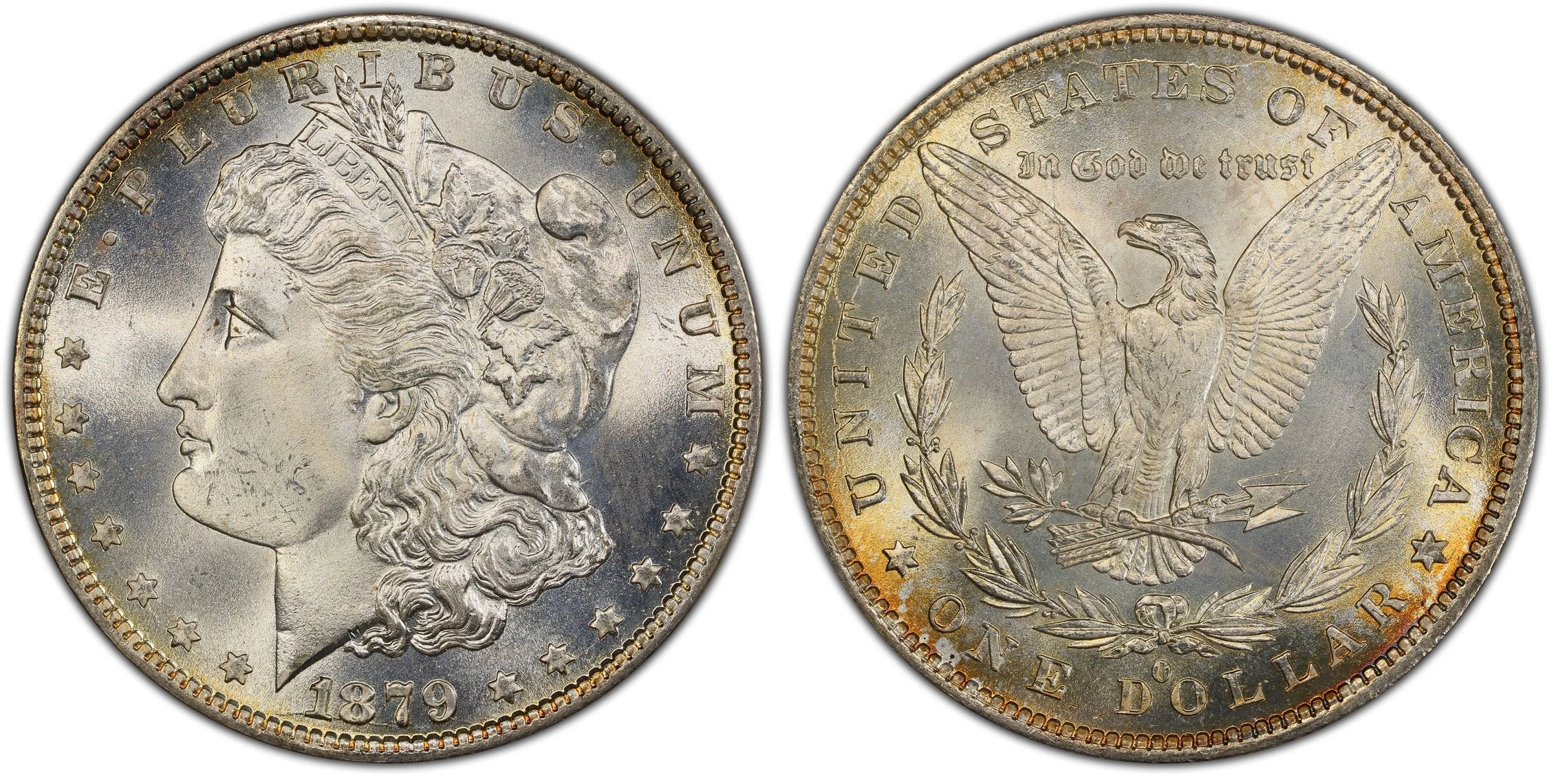
Regular-strike mintage: 2,887,000.
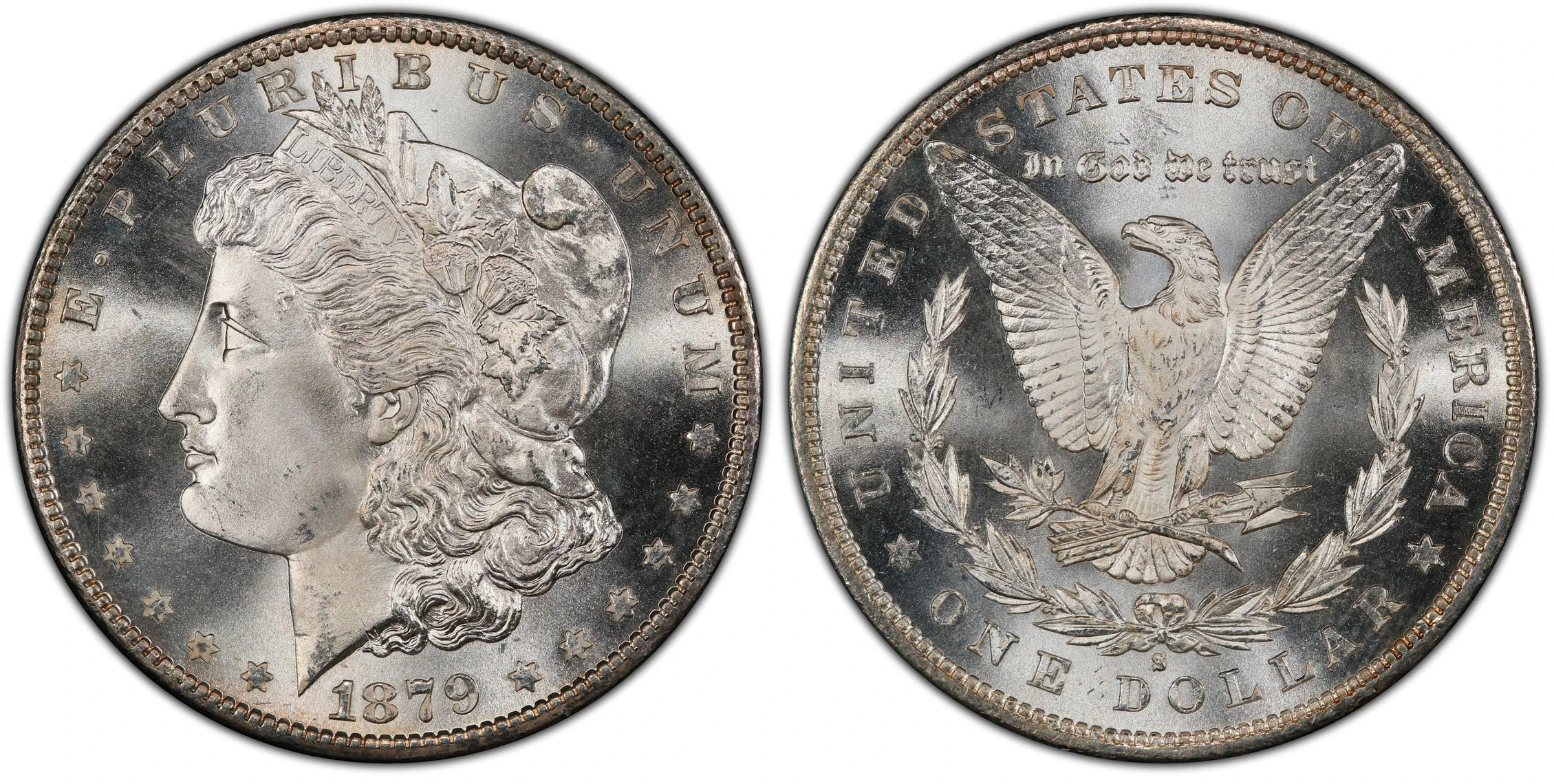
Total regular-strike mintage: 9,110,000, including both reverses.
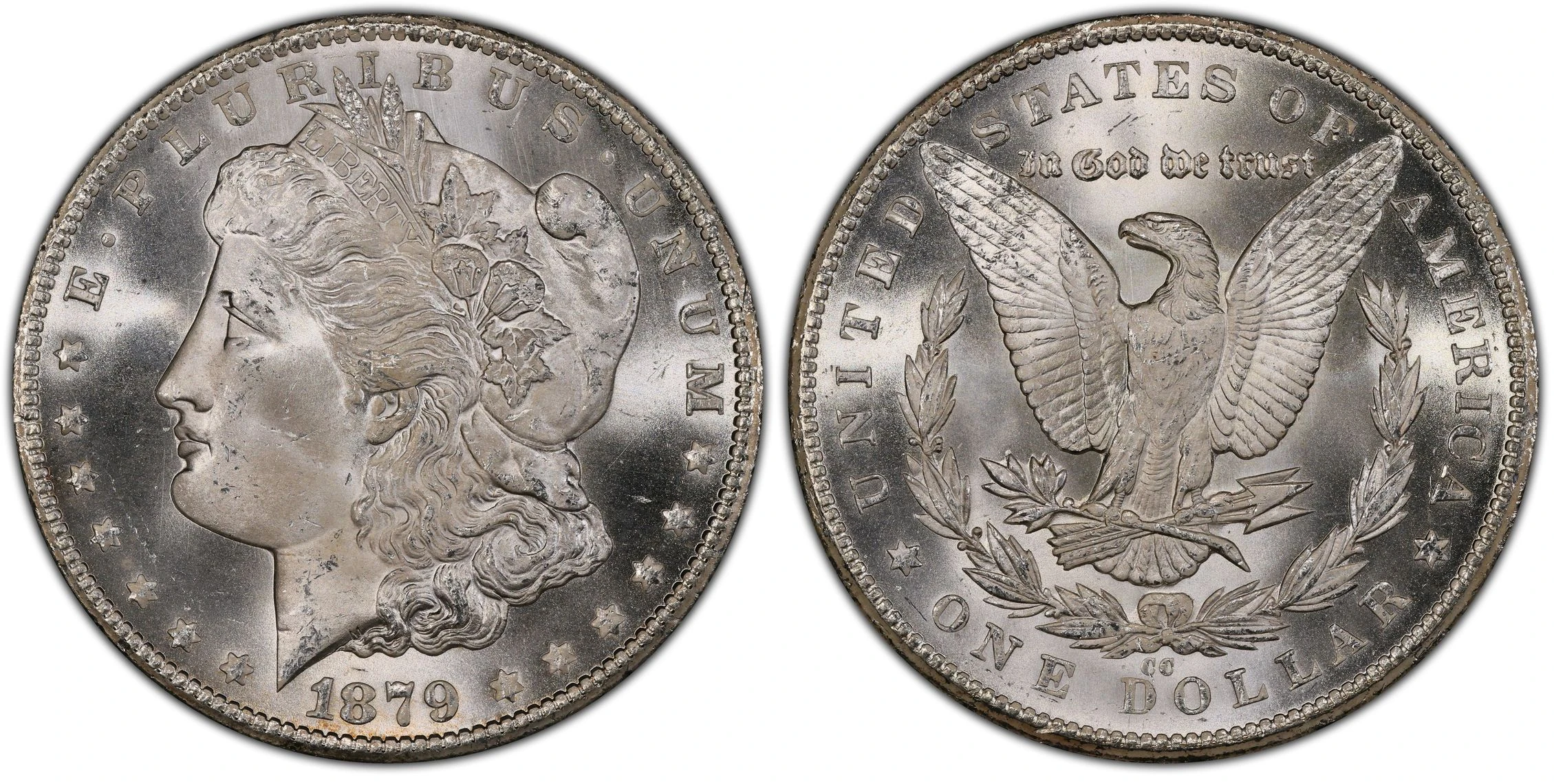
Total regular-strike mintage: 756,000, including Capped Die coins.
Is an 1879 dollar without a mint mark rare?
The missing mint mark is normal for Philadelphia, not a minting error. An ordinary worn example should be compared with other Philadelphia coins. Exceptional preservation, an attributed variety or a different strike category can change the comparison; the blank space by itself does not establish a premium.
1879 silver dollar value chart
Use the exact issue and grade. The figures below are selected PCGS regular-strike guide values, excluding PL/DMPL finishes and problem coins. They are reference estimates for the stated categories, not offers to buy an ungraded coin.
On a small screen, swipe the table sideways to see all columns.
| Issue / variety | VF20 | XF40 | AU50 | MS63 | MS65 |
|---|---|---|---|---|---|
| 1879 · no mint mark | $92 | $92 | $94 | $150 | $575 |
| 1879-O | $92 | $92 | $94 | $475 | $2,750 |
| 1879-S · usual reverse | $92 | $92 | $94 | $110 | $185 |
| 1879-CC · regular listing | $725 | $2,000 | $3,500 | $9,500 | $26,000 |
| 1879-S · Reverse of 1878 | $125 | $180 | $200 | $1,500 | $8,000 |
| 1879-CC · Capped Die | $700 | $1,750 | $3,000 | $10,000 | $45,000 |
Read the differences before choosing a number
A shared date and silver content do not make two issues equivalent. The O and usual S rows are close in circulated grades but diverge in Mint State. An S mint mark also does not settle the value until the reverse is identified. The Capped Die listing is not higher than the regular CC listing at every grade.
If the coin is ungraded, record a broad condition range first. Do not choose MS65 because a photo looks shiny, or average all six rows into one “1879 value.” For selling, compare recent completed sales and ask what fees will be deducted from the proceeds.
Which 1879 Morgan dollar varieties should you check?
1879-S Reverse of 1878: inspect the eagle
The scarcer Reverse of 1878 has a flatter eagle’s breast and a top arrow feather that runs parallel to the other feathers. The usual Reverse of 1879 has a rounded breast and a slanting top arrow feather. “Reverse of 1878” names the design used on the back; the front still carries the date 1879.
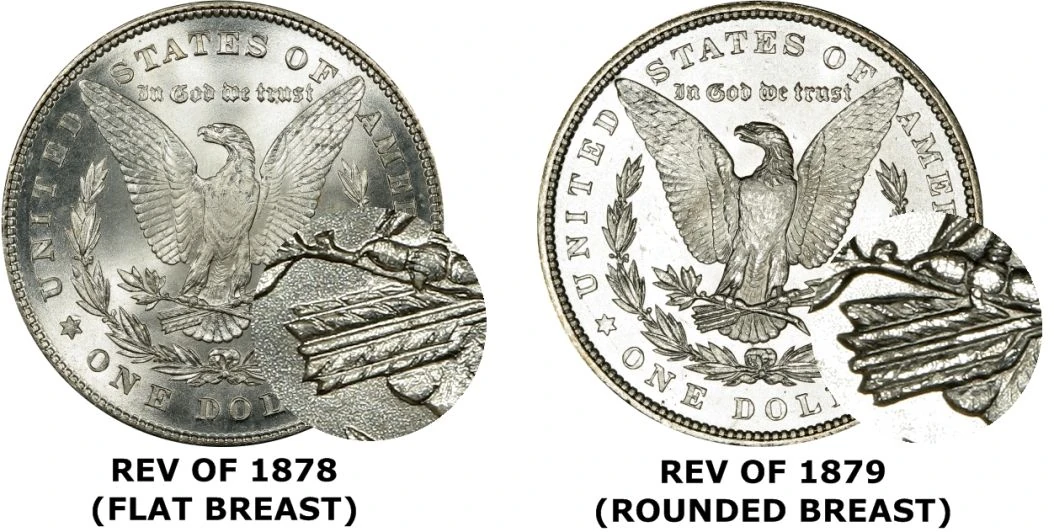
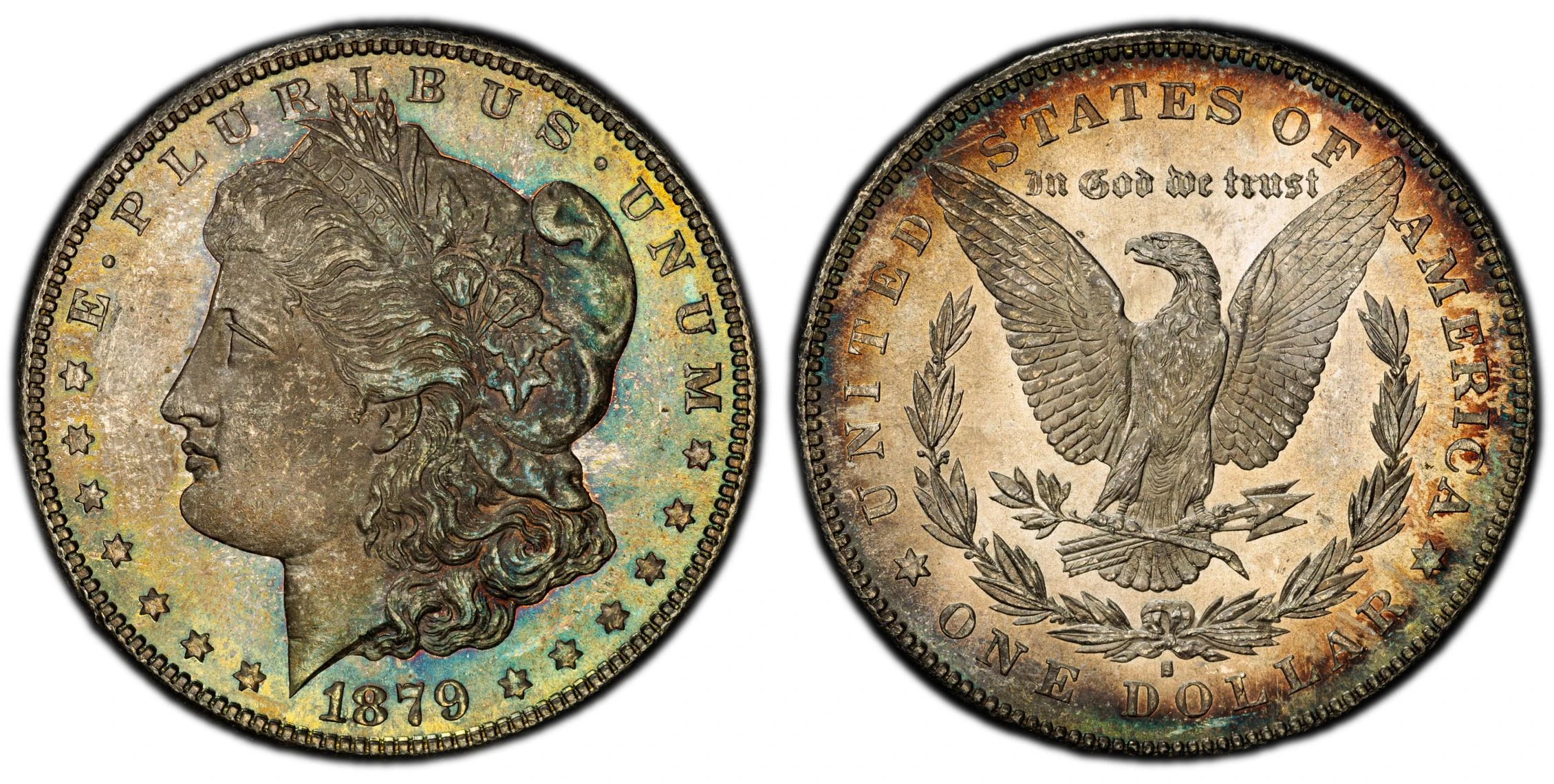
Wear can flatten design detail, so a flat-looking breast alone is not a reliable attribution. Take a focused reverse photograph and compare the feather geometry too. An unclear photograph is a reason to investigate, not a reason to price the coin as the scarce reverse.
1879-CC Capped Die: inspect the mint mark
PCGS lists Capped Die separately from the regular 1879-CC issue. Its illustrated comparison shows the rough, rusted-looking mint mark beside a clearer CC. This is an established die variety; an isolated scratch or dirt around the letters is not enough to identify it.
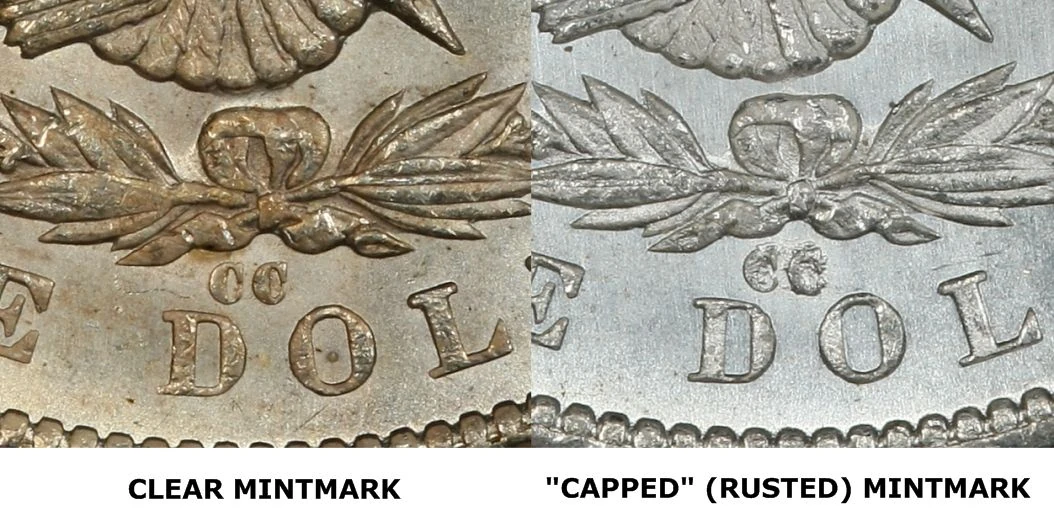
Keep the variety name exactly as an attribution service or reliable reference gives it. A VAM number identifies a cataloged Morgan or Peace dollar die variety, named for researchers Van Allen and Mallis; it is not a condition grade. A variety label and a grade answer different questions.
How does condition affect an 1879 silver dollar’s value?
Wear and surface quality determine which grade comparisons are useful. Examine the hair above Liberty’s ear, her cheek and the eagle’s breast under changing light. Weak striking and circulation wear can look similar in a single picture, so inspect both sides and the remaining luster.
VF / XF: visible circulation
Very Fine and Extremely Fine describe circulated coins with different levels of remaining detail. Compare worn examples with the circulated columns, even if someone has polished the coin bright.
AU: slight wear remains
Almost Uncirculated coins retain much detail but still show wear. An attractive AU coin does not become Mint State simply because it has fewer distracting marks than another coin.
MS: uncirculated, grades 60–70
Mint State describes the absence of circulation wear. Contact marks, luster, strike and eye appeal still separate grades. MS63 and MS65 are different comparisons.
Details: a problem needs disclosure
A coin described as Cleaned, Scratched or otherwise Details graded needs comparable problem-coin sales. Do not price an AU Details coin as a problem-free AU50.
Compare AU58 with MS60
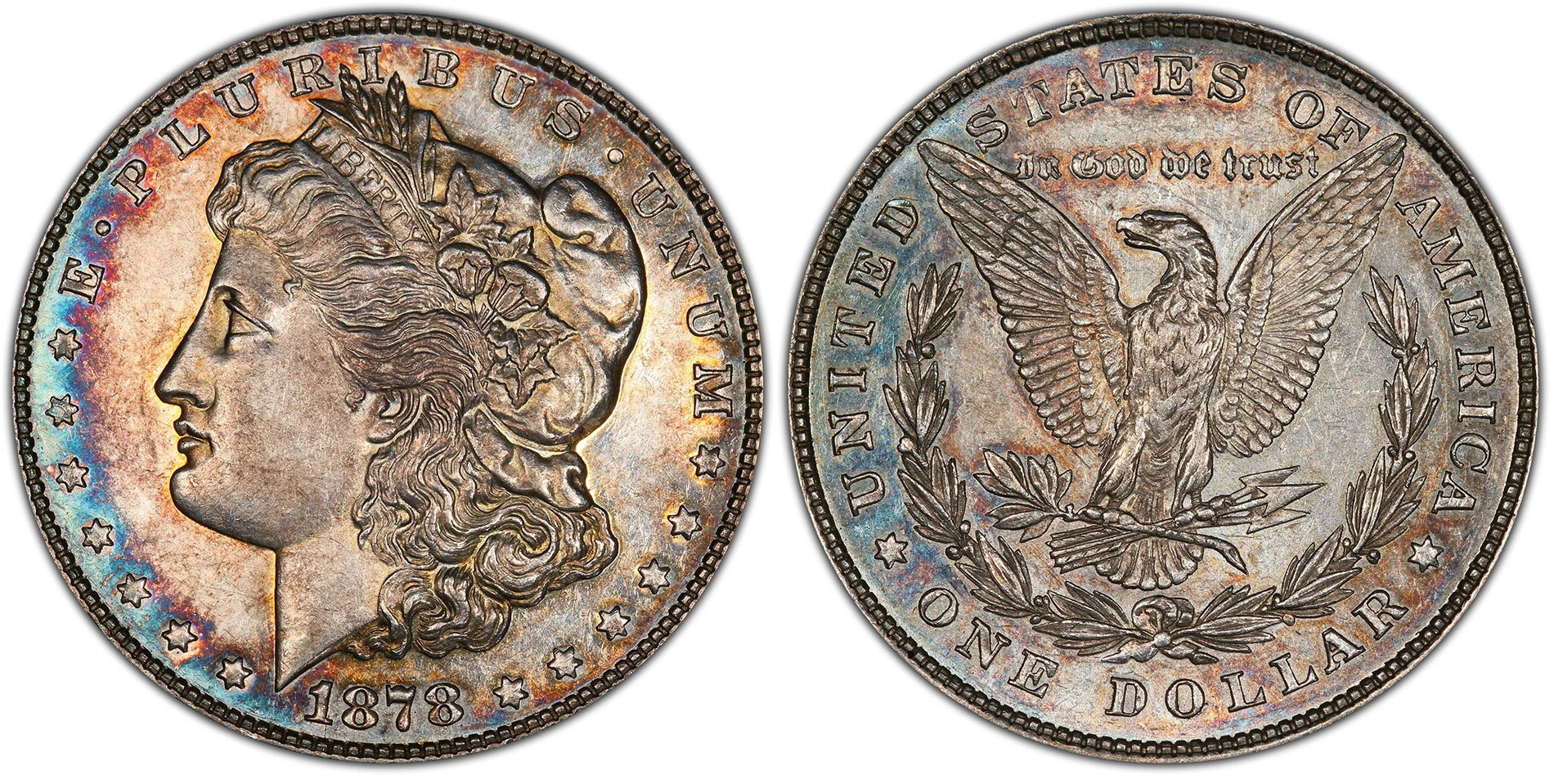
1878 8 Tailfeathers Morgan dollar.
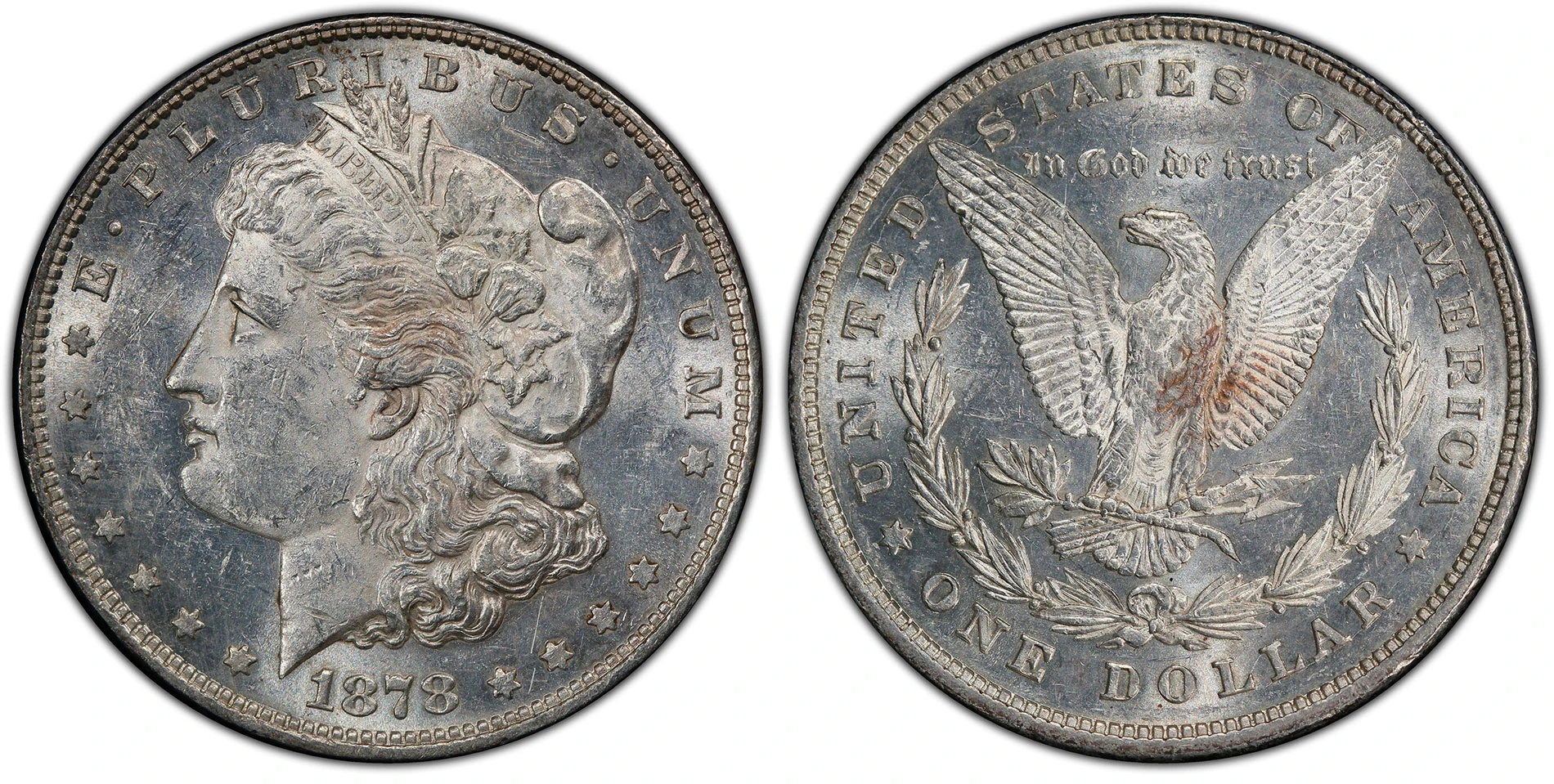
1878 8 Tailfeathers Morgan dollar.
These 1878 Morgan dollars illustrate the wear boundary for the same coin type; they are not 1879 price examples. The AU58 coin can look more attractive than the MS60 coin, whose contact marks do not by themselves establish circulation wear. Inspect Liberty’s high points and the remaining luster under changing light.
PL means prooflike; DMPL means deep mirror prooflike in PCGS terminology. These describe qualifying reflective surfaces on regular strikes. They do not make the coin a proof, and a polished surface is not proof of either designation. Proof coins require a separate price comparison.
Leave the surfaces as found. Cleaning can remove evidence and reduce collector appeal. Use the coin grading scale to understand grade terminology and the cleaned-coin guide to examine possible surface alteration.
What have 1879 silver dollars actually sold for?
Completed sales put guide prices in context. These PCGS auction records identify particular certified coins, not every coin with the same date.
On a small screen, swipe the table sideways to see all columns.
| Coin | Auction / date | Lot / certification | Reported sale |
|---|---|---|---|
| 1879-S · PCGS MS64 | Stack’s Bowers August 2026 | 95172 / 56985297 | $124 |
| 1879-S · PCGS MS64 OGH Generation 3.0 | Stack’s Bowers August 2026 | 94058 / 01366224 | $149 |
| 1879-CC · PCGS MS66+ | Heritage Auctions January 15, 2023 | 3776 / 36608661 | $192,000 |
The two S-mint coins share the same numerical grade but sold for different amounts. The second listing also identifies an older PCGS holder, abbreviated OGH. Two sales alone do not prove what caused the difference; compare photographs, surfaces, holder details and sale conditions before drawing a conclusion.
The CC result illustrates the market for an exceptional MS66+ specimen. It is not a useful price anchor for an ordinary worn dollar. Nor should a 2023 record be treated as a current offer. Reported auction prices are not seller net proceeds; check the original auction’s buyer’s premium, commissions and other charges before comparing costs or deciding where to sell.
How much silver does an 1879 Morgan dollar contain?
The standard specification is 26.73 grams, 38.1 mm in diameter and 90% silver with 10% copper. That represents approximately 0.7734 troy ounce of fine silver before allowance for wear.
At a hypothetical silver price of $60 per troy ounce, the calculation is about $46.40. This example is not a live silver quote.
Use the current metal price for a fresh calculation. Do not add this amount to a guide price: a collector price already includes the coin’s metal. Conversely, a silver-only calculation does not capture the premium of a scarce mint, confirmed variety or well-preserved specimen.
Does the correct weight prove it is genuine?
No. Weight and diameter are screening checks, not authentication. If a coin appears to be a valuable CC or scarce variety, compare the design and mark closely and obtain physical examination when authenticity is uncertain. An app photograph cannot measure alloy composition.
HeriBase test: from identification to a value reference
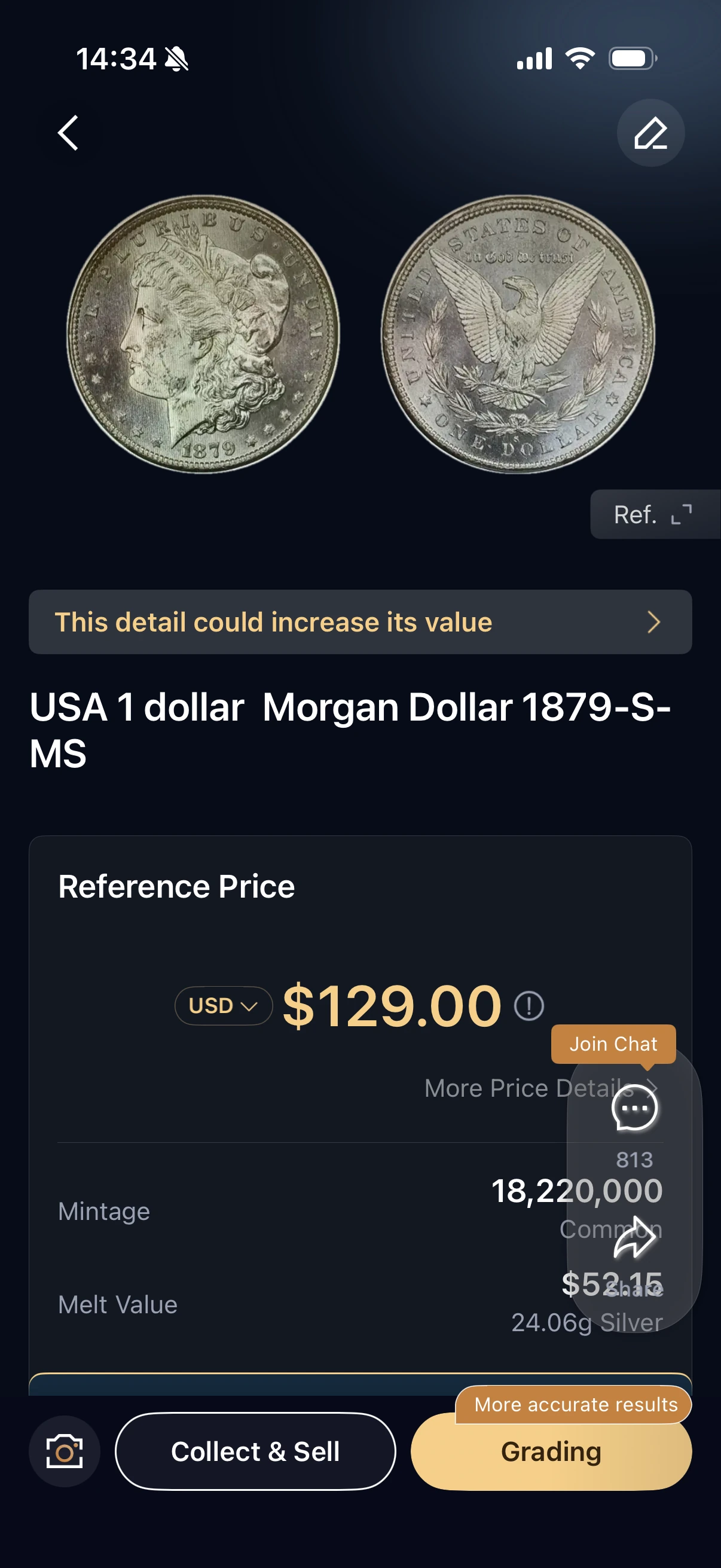
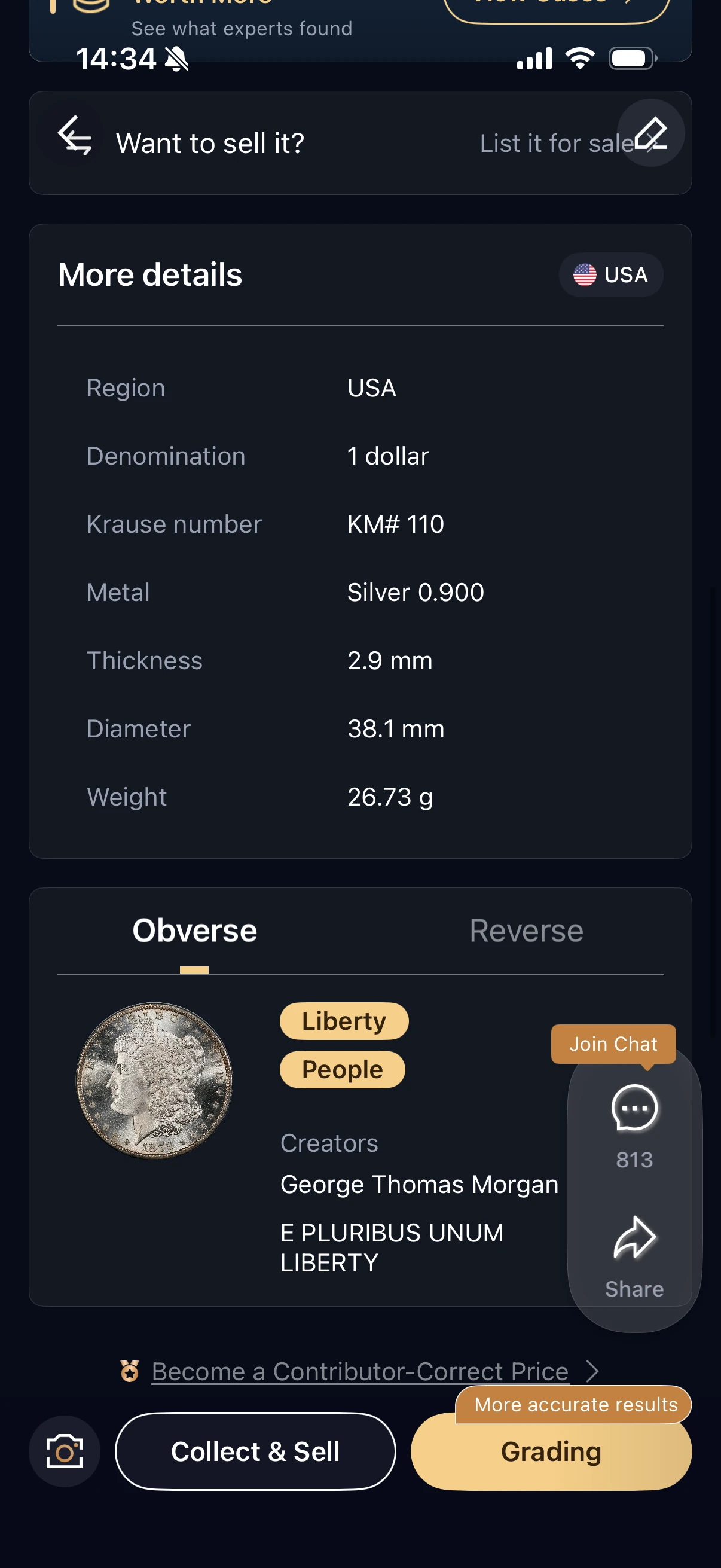
In this test, HeriBase returned “USA 1 dollar Morgan Dollar 1879-S-MS” and a $129 reference price. The two screenshots show the result page and its expanded coin details, connecting an identification with information a collector can use for the next comparison.
An 1879-S result in HeriBase
What the test gives the collector
- A specific issue to look up. The result names the Morgan dollar, 1879 date and S mint, narrowing the search from a general silver-dollar value to the San Francisco issue.
- A starting price reference. The displayed $129 provides a concrete amount to investigate. This article’s two 1879-S MS64 auction examples sold for $124 and $149. The app figure falls between them, although the screen’s broader “MS” label does not establish an MS64 grade or an exact price match.
- Useful identification details in one view. The details screen lists a one-dollar denomination, silver fineness of 0.900, a 38.1 mm diameter and a 26.73 g weight. These are reference specifications to compare with the coin.
- Visible next steps. Collect & Sell and Grading are available from the result screen, providing entry points for continuing beyond identification.
For someone starting with an unfamiliar coin, the practical benefit is a named issue, a reference amount and a set of specifications to carry into further research. Next, check the S reverse variety and the coin’s condition against the illustrated sections above to refine that starting estimate.
1879 silver dollar FAQ
Is an 1879 silver dollar worth more than one dollar?
A genuine 1879 Morgan dollar normally has both silver value and potential collector value above its face amount. The mint, condition, authenticity and variety determine the relevant comparison; a damaged or counterfeit piece cannot be priced as a problem-free certified example.
Why is an 1879-CC more expensive than an 1879-S?
They are separate collector issues with different availability. Carson City struck far fewer 1879 dollars than San Francisco, and preserved CC examples command a substantial premium in the cited guide. A grade-matched comparison is more useful than comparing only their identical silver content.
Does every 1879-S have the Reverse of 1878?
No. The usual 1879-S has the Reverse of 1879. Check the eagle’s breast and top arrow feather against the illustrated comparison; the S mint mark alone does not establish the scarcer reverse.
Should I clean an 1879 dollar before selling it?
No. Leave the surfaces as they are and photograph them clearly. Polishing or abrasive cleaning can harm collector appeal and complicate grading. Disclose known damage when seeking an offer.
Can a coin app give an exact selling price?
An app can provide a starting identity and reference information, but an exact sale depends on verified attributes, condition and the buyer. Check comparable completed sales and obtain an actual offer; use physical examination when photographs cannot resolve authenticity or grade.
Turn an identification into a useful value estimate
For an 1879 Morgan dollar, identify the mint first, then compare the variety and condition. Ordinary Philadelphia, O and S coins belong in different comparisons from a scarce CC or an S with the Reverse of 1878. Wear, surface problems and the numerical grade then determine which prices and sales are relevant.
The HeriBase test makes that process tangible: the result identified an 1879-S Morgan dollar, displayed a $129 reference price and brought together its specifications and collection or grading entry points. The two documented MS64 sales of $124 and $149 give readers market examples to investigate alongside that result; they do not establish the test coin’s numerical grade.
Start with the app result to organize what you have, use the photographs to check the mint and reverse, and narrow the estimate with condition-matched sales. For a potentially scarce variety or a coin whose condition remains uncertain, a focused expert assessment is the next step. The result is a clearer basis for deciding whether to keep, sell or submit the coin for grading.
Sources and image creditsOpen references
Research checked September 24, 2026. Guide values and auction results are different kinds of evidence. Photographs illustrate attributed reference coins; they do not authenticate a reader’s specimen.
App-data check: the test screen displays a mintage of 18,220,000. The 1879-S issue total used in this guide is 9,110,000, from PCGS CoinFacts. App reference prices and melt values are recorded as displayed, not as completed sales.
- PCGS Morgan Dollar Price Guide: selected standard-grade values, USD.
- PCGS CoinFacts: 1879, 1879-O, 1879-S and 1879-CC: mintages, specifications and reference images.
- Varieties: PCGS Reverse of 1878, PCGS Capped Die, Stack’s Bowers reverse guide and Coin World VAM background.
- Grading: PCGS standards and NGC scale.
- Individual sales: 1879-S MS64, lot 95172; 1879-S MS64, lot 94058; 1879-CC MS66+, lot 3776.