

Whether you want to identify a coin, get a sense of its value, or organize your collection, a coin identifier app can be a useful starting point. Choosing one means looking beyond identification alone: How many scans are free? What does a subscription cost? And does the app have the collection and trading features you need?
This guide compares HeriBase, CoinSnap, CoinIn, and Coin Value. We tested three of them on the same 12 coins and compared their free access, pricing, and features. Start with the quick picks below, then explore the comparisons that matter to you. We also include our test method, PCGS references, and all 36 identification screenshots so you can check the results for yourself.
Which Coin Identifier App Fits Your Needs?
| Your priority | App to consider | What to know |
|---|---|---|
| Ongoing free scans, collection management, and trading | HeriBase | Three free scans a day, with more available by watching ads. Includes bulk import, free marketplace browsing, and current collection values. Completed transactions carry a percentage-based service fee. Historical values and expert appraisals cost extra.See comparison |
| Fast identification and flexible exports | CoinSnap | Fastest average in our test at 7.745 seconds. Exports all coins or individual sets. Includes 10 free scans total; no trading or collection value tracking.See comparison |
| A lower annual price or lifetime access | Coin Value (Marbles Labs) | Offers $19.99/year or $29.99 for lifetime access. We compared pricing only and did not verify identification performance.See comparison |
How We Chose and Tested These Apps
How we built the shortlist
We started with download counts and store ratings, then compared identification using the same coins. Because the Apple App Store does not publish cumulative download counts, we used the download tiers shown on Google Play. These are Android figures, not combined iOS and Android totals.
We searched Google Play for “coin identifier,” “coin scanner,” and “coin identification,” focusing on apps whose main function is identifying coins from photos. We took the top 10 by download tier, then selected four by user rating. Review count broke ties within a download tier; download tier and then review count broke ties in ratings.
That gave us CoinSnap, HeriBase, Coin Value (Marbles Labs), and CoinIn. Downloads and ratings determined the shortlist, not the accuracy ranking. Our identification findings come from the tests and screenshots below.
Store data for the selected apps
Checked September 17, 2026. Google Play figures are from the top of the English-language U.S. listings. U.S. App Store ratings are included for context and did not affect selection. All ratings are out of 5.
| App | Google Play downloads | Google Play rating | App Store rating (U.S.) |
|---|---|---|---|
| CoinSnap | 10 million+ | 4.5 / 5 | 4.7 / 5 |
| HeriBase | 5 million+ | 4.7 / 5 | 4.7 / 5 |
| Coin Value (Marbles Labs) | 5 million+ | 4.4 / 5 | No iOS app |
| CoinIn | 1 million+ | 4.6 / 5 | 4.7 / 5 |
Google Play reports cumulative download tiers, not exact counts, and excludes iOS downloads. Ratings and review counts change over time and vary by region. This is a snapshot of the selected apps, not a new ranking of the entire candidate pool.
How we selected the coins
We asked AI to suggest 12 coins for testing identification apps, covering different countries, varieties of the same coin type, and a worn coin. We also asked for a PCGS reference page for each coin so we could check the results.
We used the recommended list directly: eight U.S. coins and one each from China, Japan, the United Kingdom, and Canada. The coins, selection reasons, and PCGS links are in thesample list. AI helped select the samples; we checked the identification results against the reference information.
We used publicly available coin photos from the AI-recommended sample list. This helps reveal differences in identifying specific types and varieties, but does not represent every coin or predict results from real-world photos with poor lighting or blur. We also used the 1850 large cent to observe whether the default scan assessed wear. Grading was not included in identification accuracy.
Test date, app versions, and evaluation
We tested identification on September 16, 2026. HeriBase, CoinSnap, and CoinIn were tested on iOS; Coin Value was tested on Android.
We recorded the first automatic identification result from each app and kept the original screenshots without making any changes. We then compared the country, denomination, date, coin type, and other details with the reference information. The app output was the result being evaluated, not the answer key. A longer name or description did not automatically count as more accurate.
| App | Version tested |
|---|---|
| HeriBase | 1.3.6 |
| CoinSnap | 2.25.0 |
| Coin Value (Marbles Labs) | 21.7 |
| CoinIn | 1.38.0 |
Identification findings are based on the original screenshots and PCGS references. Timing figures are averages of 12 runs after removing the fastest and slowest. Pricing and feature tables reflect our usage records. The grading and expert appraisal section compares available services; we did not separately test their grading or authentication accuracy.
How we verified the identification results
We checked each result against the sample’s linked PCGS page. We recorded both whether the basic coin type was correct and whether the result matched the target variety. A result that did not correctly distinguish the target variety did not count as a complete match. Accuracy means the number of correct type-and-variety matches divided by 12; it does not measure valuation or grading accuracy.
Free Scans and Subscription Pricing
Before scanning, it helps to know what you can use without a subscription. The four apps take different approaches: daily allowances, a one-time pool of free scans, or payment to view the full result.
The table reflects the free access and paid plans recorded during our review. All prices are in U.S. dollars. We recorded CoinIn’s seven-day subscription, but did not confirm an annual plan. Coin Value also offers lifetime access. Prices may vary by region, version, or promotion, so check the in-app offer before purchasing.
| App | Free identification | Free scan limits | Annual subscription | Other plans |
|---|---|---|---|---|
| HeriBase | Yes | 3 free scans per day; watch ads to continue scanning for free | $39.99/year | — |
| CoinSnap | Yes | 10 free scans total; subscription required after that | $39.99/year | — |
| CoinIn | Yes | 5 free scans total; subscription required after that | Not confirmed | $10.99 every 7 days |
| Coin Value (Marbles Labs) | No | Payment required to view full results, even after watching ads | $19.99/year | $29.99 lifetime access |
Coin Value is not included in the identification results below.In Android version 21.7, we encountered frequent ads. Even after watching them, the coin name, date, and other result details remained blurred behind a paywall. We did not pay to unlock them, so the accuracy, speed, and post-scan value comparisons cover HeriBase, CoinSnap, and CoinIn only.
Identification Accuracy: Coin Type vs. Variety
We compared the three apps using the same samples, looking first at whether each identified the basic coin type, then at whether it matched the target variety.
Accuracy is the number of correct type-and-variety matches divided by 12. A correct coin type with the wrong variety counts as an incorrect result. Wear assessment and grading are excluded.
| App | Correct coin type | Correct type and variety | Variety errors | Accuracy in this test |
|---|---|---|---|---|
| HeriBase | 12/12 | 10/12 | 2 | 83.33% |
| CoinSnap | 12/12 | 9/12 | 3 | 75.00% |
| CoinIn | 12/12 | 7/12 | 5 | 58.33% |
All three apps identified the basic coin types in our sample. The differences appeared when distinguishing varieties, which is why a matching name or date alone is not enough to establish a complete identification.
With only 12 samples, the selection can affect the outcome: one coin changes the percentage by about 8.33 points. HeriBase and CoinSnap performed similarly in this test. HeriBase got one more coin right, but that does not establish better performance across all coins.
In our regular-strike and Proof examples, HeriBase leaned toward Proof: it correctly identified the1963 Proof nickelbut also labeled theregular-strike 1964 Kennedy half dollaras Proof. CoinSnap leaned toward regular strikes, correctly identifying the half dollar but treating the 1963 Proof nickel as a regular strike. This describes these samples, not a proven tendency across all coins.
HeriBase also correctly distinguished both VDB varieties, while CoinSnap and CoinIn did not. HeriBase, in turn, mislabeled theYuan Shih-kai dollaras the variety with added Kansu characters. All three identified the basic coin types in our test, but checking the exact variety against a reference remains useful.
See results for each coin·View all 12 samples and screenshots
Identification Speed
Accuracy is only part of everyday use; waiting time matters, too. During the same test, we timed each app from the completion of the two photos to the appearance of the result.
We recorded 12 runs per app, removed the fastest and slowest, and averaged the remaining 10. Network and device conditions can affect timing, so these figures indicate the approximate speed we experienced.
| App | Average time (fastest and slowest runs excluded) |
|---|---|
| HeriBase | 8.92 seconds |
| CoinSnap | 7.745 seconds |
| CoinIn | 10.32 seconds |
All three averaged roughly 8–10 seconds. CoinSnap was fastest in our records, followed by HeriBase, while CoinIn returned a result in about 10 seconds. If you regularly scan several coins in a row, consider speed alongside free scan limits and collection tools.
Coin Value Estimates After Identification
Once a coin is identified, the next question is often what it is worth. All three apps show value information, but in different formats: HeriBase generally gives a single reference amount, while CoinSnap and CoinIn more often show a range.
The table compares the apps’ displayed values with reference listings we found on eBay. We looked for the same variety where possible; differences in the listing’s scope are noted in the table. Open the listing screenshot next to an amount to see the source.
Even the same variety can have different prices on eBay. We tried to choose listings with recent sales activity or a Best Offer option. Best Offer means the seller accepts offers; the displayed amount is not necessarily the final sale price.
Condition, holders, and professional grading can also affect the price of the same variety. The eBay amounts here are reference points.
| Coin | eBay asking price | HeriBase | CoinSnap | CoinIn |
|---|---|---|---|---|
| 1964 Kennedy half dollar | $100.00Listing screenshot ↗ | $49.00 Single amount | $23 – $9,810 Price range | $1.00 – $1,000.00 Price range |
| 1943 Lincoln steel cent | $29.95Listing screenshot ↗ | $2.80 Single amount | $1.38 – $2,530 Price range | $0.10 – $2,057.00 Price range |
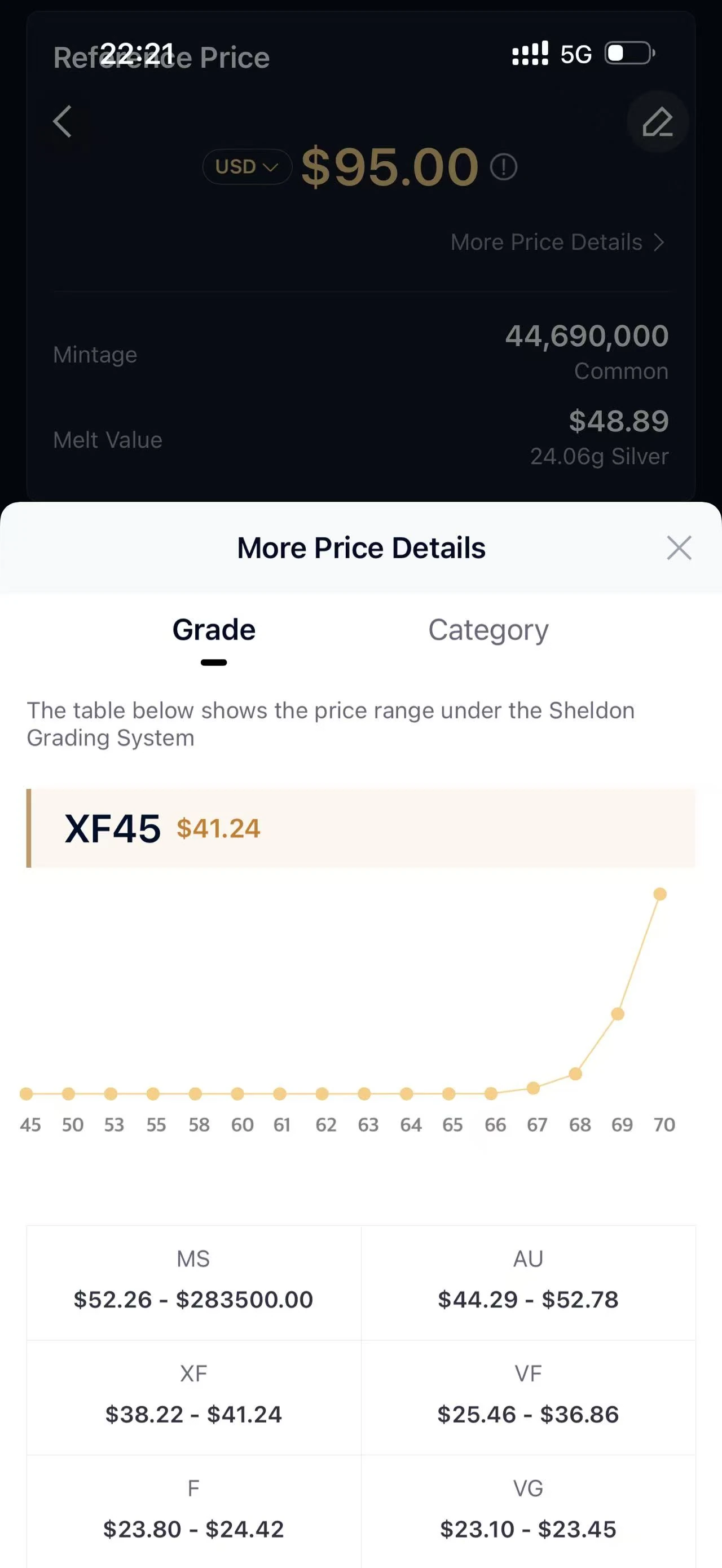
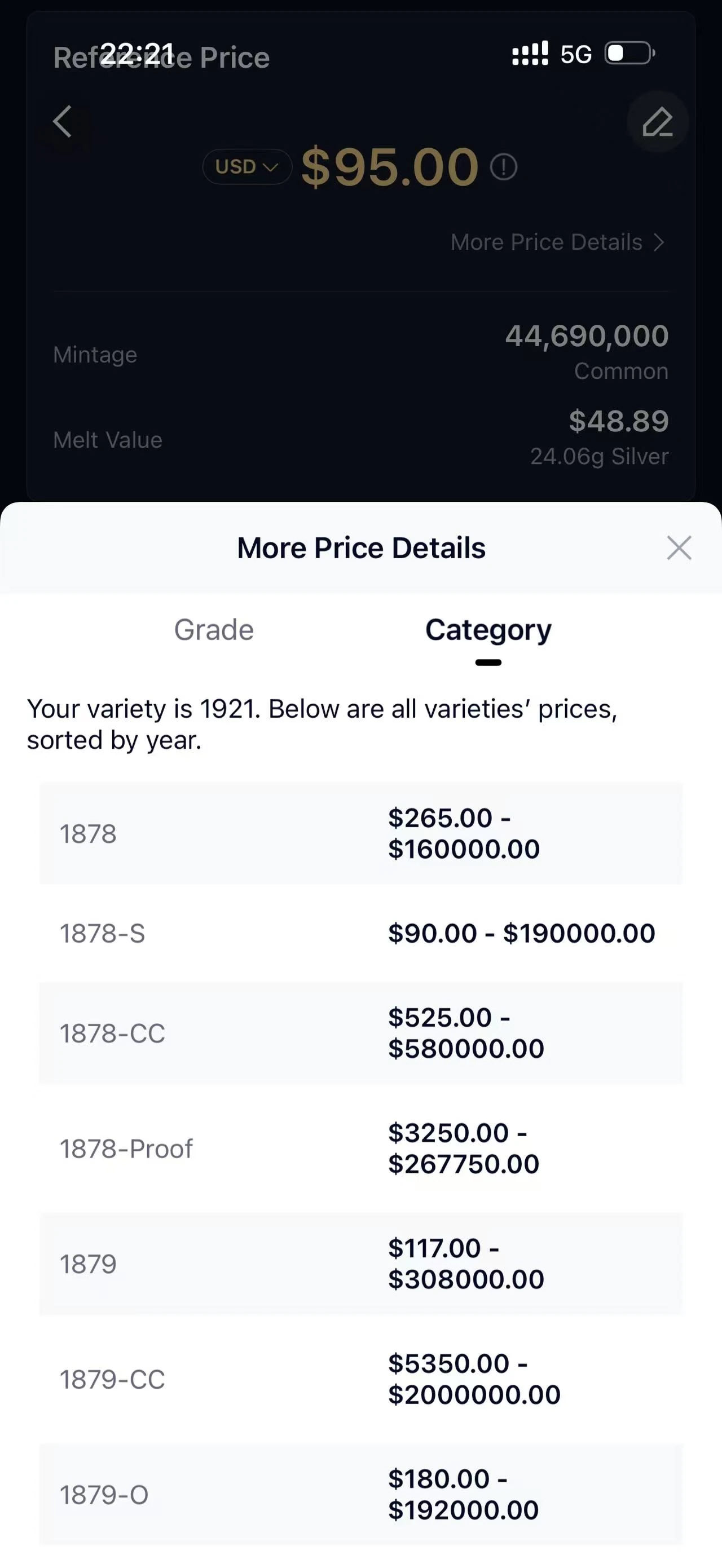
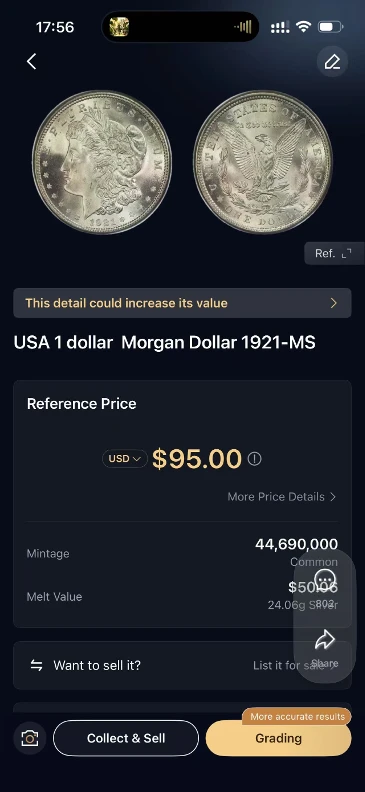
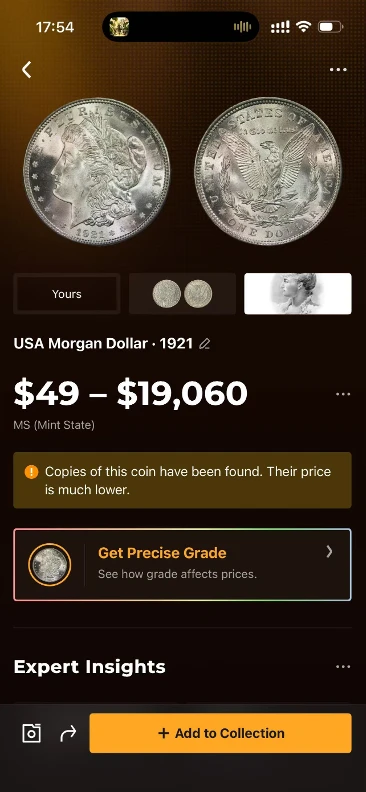
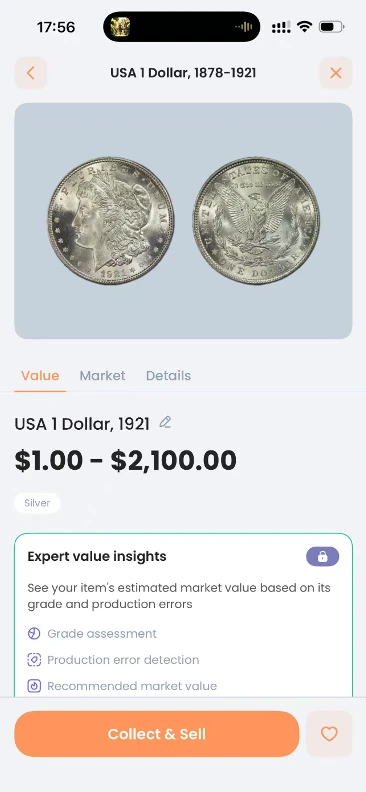
| 1921 Morgan dollar | $65.03Listing screenshot ↗ Seller lists 1921 P, D, or S; a specific mint is not guaranteed. | $95.00 Single amount | $49 – $19,060 Price range | $1.00 – $2,100.00 Price range |
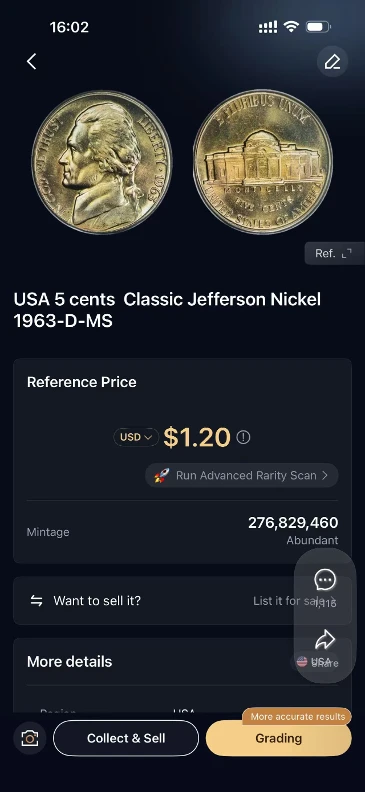
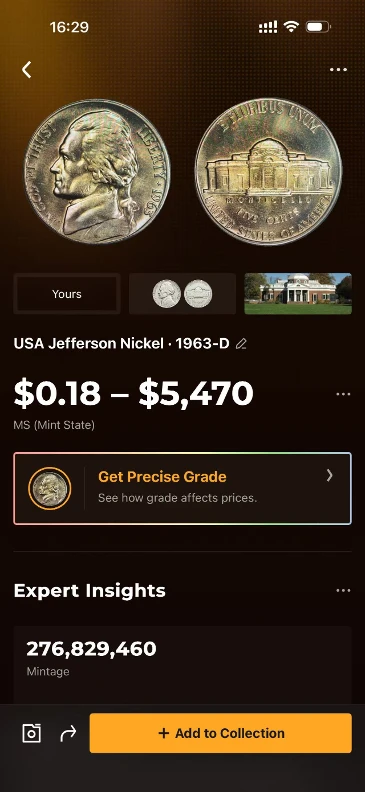
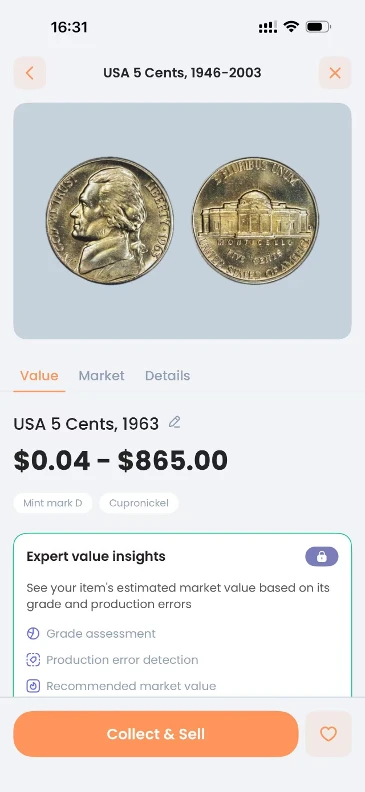
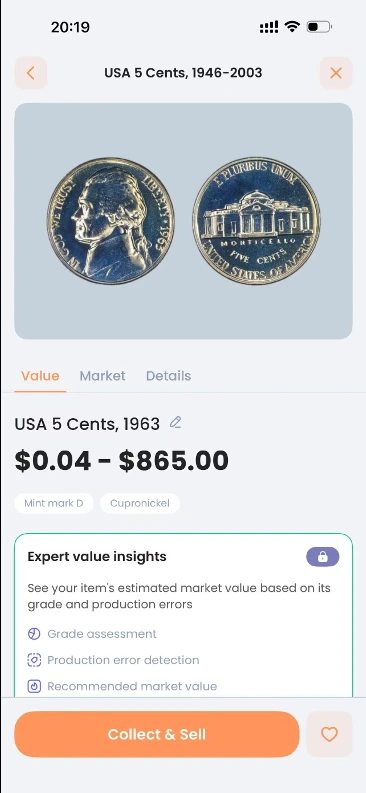
| 1963-D Jefferson nickel | $2.69Listing screenshot ↗ | $1.20 Single amount | $0.18 – $5,470 Price range | $0.04 – $865.00 Price range |
| 1963 Jefferson nickel (Proof) | $18.99Listing screenshot ↗ | $2.30 Single amount | $0.18 – $3,470 Price range | $0.04 – $865.00 Price range |
| 1909 VDB Lincoln cent | $13.00Listing screenshot ↗ | $65.00 Single amount | $13 – $2,310 Price range | $0.01 – $2,150.00 Price range |
| 1909-S VDB Lincoln cent | $2,249.00Listing screenshot ↗ | $6.00 Single amount | $276 – $17,750 Price range | $0.01 – $2,150.00 Price range |
| 1914 (Year 3) Yuan Shih-kai dollar | $159.00Listing screenshot ↗ | Not shown in screenshot Not shown | $49 – $145 Price range | $50.00 – $2,000.00 Price range |
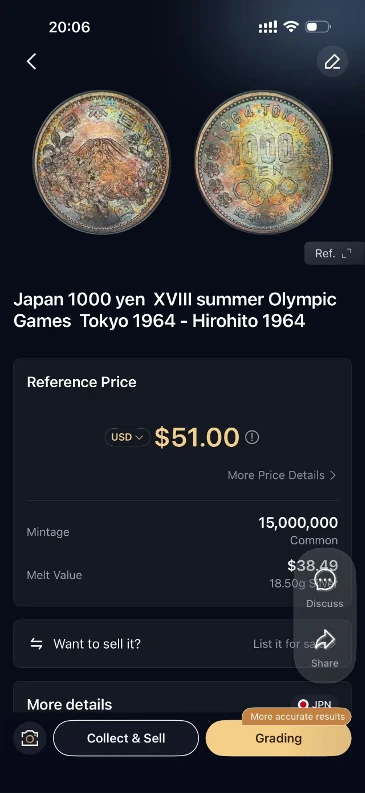
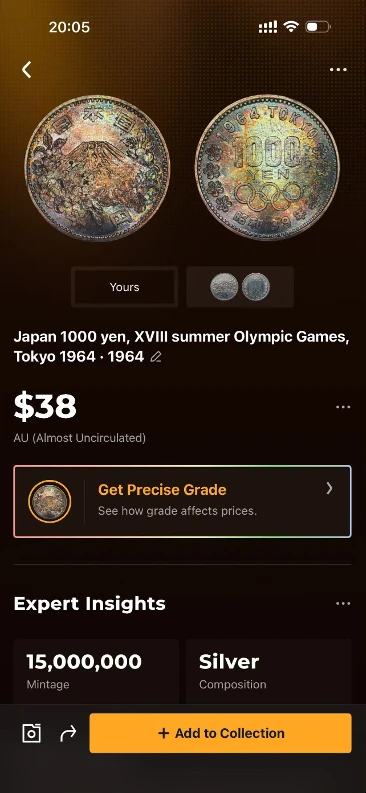
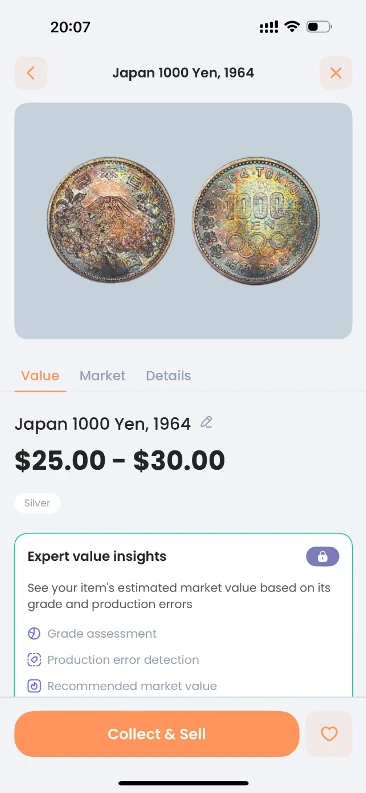
| 1964 Tokyo Olympics 1,000 yen | $65.99Listing screenshot ↗ | $51.00 Single amount | $38 Single amount | $25.00 – $30.00 Price range |
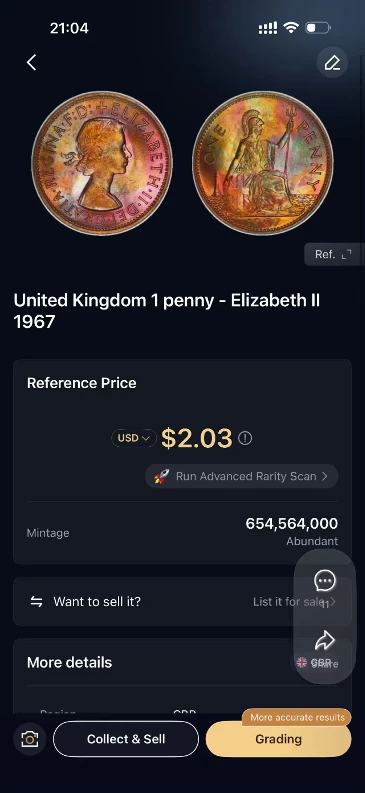
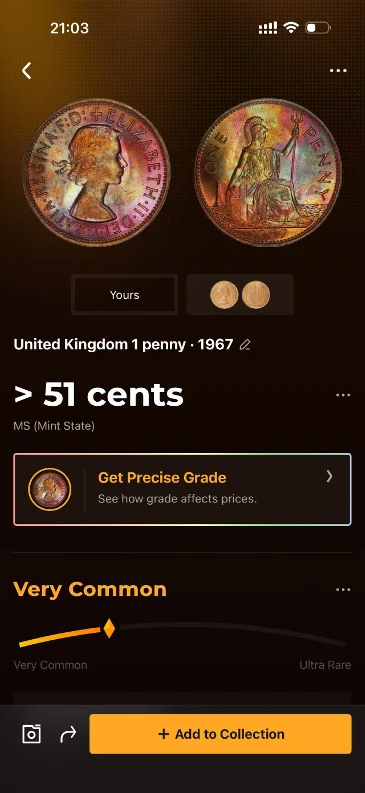
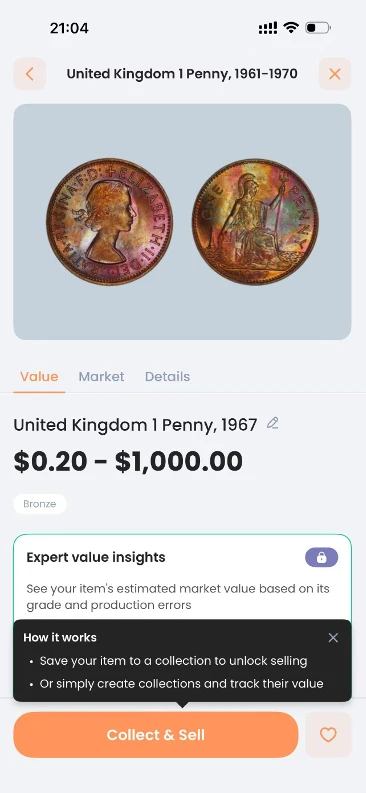
| 1967 British penny | $40.42Listing screenshot ↗ | $2.03 Single amount | > 51 cents Lower bound only | $0.20 – $1,000.00 Price range |
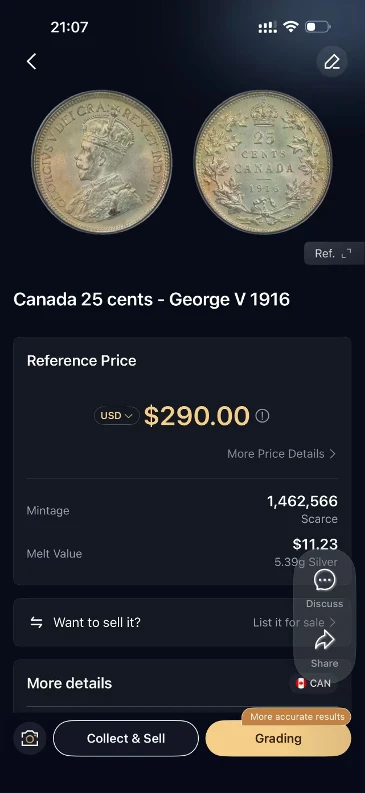
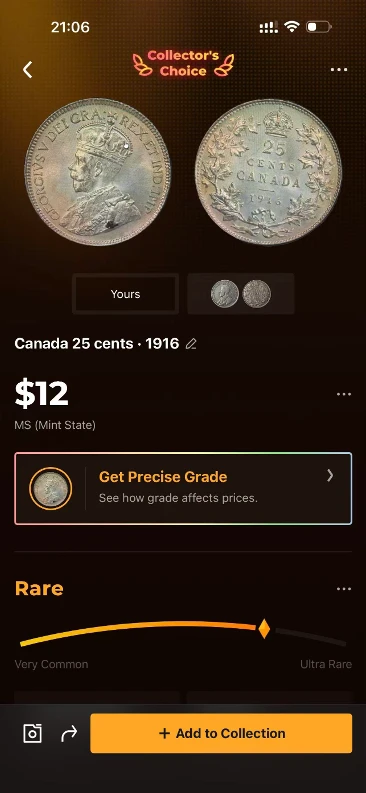
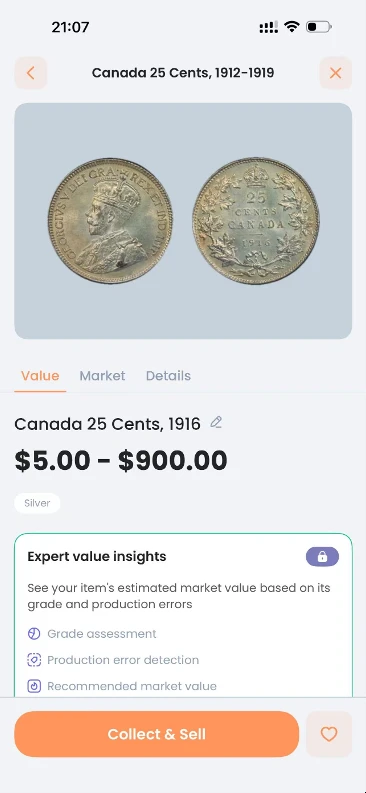
| 1916 Canadian quarter | $27.00Listing screenshot ↗ | $290.00 Single amount | $12 Single amount | $5.00 – $900.00 Price range |
| 1850 Braided Hair large cent | $49.00Listing screenshot ↗ | $460.00 Single amount | $204 – $7,660 Price range | $1.00 – $2,000.00 Price range |
Two approaches to showing value
The apps use two different approaches. HeriBase filters and processes the pricing data it gathers to present a reference amount intended to give users a useful starting point. CoinSnap and CoinIn take a broader approach, displaying ranges that span different conditions.
A range can help show how widely prices vary. For the 1964 Kennedy half dollar, CoinSnap displayed $23–$9,810 and CoinIn displayed $1–$1,000. With ranges that wide, you still need to consider the coin’s condition and exact variety to narrow down where it might fall.
HeriBase also provides a “More Price Details” link next to its reference price. The Grade tab shows prices by condition, while Category shows prices for different dates, mint marks, and varieties. This gives users a quick reference amount and a way to explore the underlying detail.
Collection Management
After identifying a coin and checking its reference value, you may want to keep it in your collection. That calls for an easy way to organize and find your records. Here we compare sets, imports and exports, and collection value tracking.
Sets, imports, and exports
| App | Create your own sets | Built-in set catalog | Export | Export options | Bulk import |
|---|---|---|---|---|---|
| HeriBase | Yes | Yes | Yes | Individual sets | Yes |
| CoinSnap | Yes | Yes | Yes | All coins or individual sets | No |
| CoinIn | Yes | No | No | — | No |
For a small collection, all three apps let you group coins into your own sets. HeriBase’s bulk import is useful when moving existing records into the app. CoinSnap lets you export your entire collection. HeriBase and CoinSnap also offer built-in set catalogs to help organize coins around a theme.
Tracking your collection’s value
| App | Value tracking | Features and cost |
|---|---|---|
| HeriBase | Yes | Current coin values are free; daily historical values cost $29.99/year |
| CoinSnap | No | — |
| CoinIn | Yes | Current coin values are free; historical values are not available |
HeriBase and CoinIn both let you view current values for your collected coins for free. HeriBase also offers daily historical values for $29.99/year.
Buying and Selling Coins
As your collection grows, you may want to fill gaps in a set or sell a few coins. HeriBase and CoinIn both include trading features alongside identification and collection management.
| App | Trading supported | Marketplace access and fees | Community features |
|---|---|---|---|
| HeriBase | Yes | Free to browse; a percentage-based service fee applies to completed transactions | Comments, favorites, and sharing |
| CoinSnap | No | — | — |
| CoinIn | Yes | Paid access required | Favorites and sharing |
HeriBase lets you browse marketplace listings for free and supports comments, favorites, and sharing. A percentage-based service fee applies when a transaction is completed; check the order breakdown for the applicable fee. CoinIn requires paid access to trading and also supports favorites and sharing. This compares marketplace access and features, not sales volume or how quickly a coin will sell.
Grading and Expert Appraisals
Before keeping or selling a coin, you may want a closer assessment of its condition or an expert opinion on authenticity and value. These services are separate from automatic identification, so we compare their scope and cost here.
| App | Service | What it includes | Cost |
|---|---|---|---|
| HeriBase | Expert appraisal | Choose an expert for authentication, condition assessment, and a value estimate, with a digital report | Standard service: $29.99 per coin. Selected experts set their own fees; most charge $39.99 per coin. |
| CoinSnap | Photo-based grading | Estimates wear, detail, and surface condition from photos and returns grades such as AU or MS; does not authenticate coins | Included with a paid subscription at no additional charge |
CoinSnap’s subscription includes photo-based grading for an initial condition estimate. HeriBase offers expert appraisal for authentication, condition and value assessment, and a digital report. Our default identification test did not separately verify the accuracy of either service.
Our Recommendations
Taken together, the results suggest choosing based on what you plan to do after identification, as well as identification itself. HeriBase brings more of the collecting and trading process into one app. CoinSnap is worth considering if your focus is identification, organization, and exports. Here is how each fits.
HeriBase: For identification, collecting, and trading in one app.Its main strength is how the features work together. You can identify a type and variety, check a reference price, then choose an expert to assess authenticity, condition, and value and provide a digital report. Collection management, value tracking, and buying and selling are available in the same app. That is appealing for new collectors who want fewer tools to juggle. Identification remains free through daily scans and additional scans earned by watching ads, and marketplace browsing is free. Completed transactions carry a percentage-based service fee. Historical values and expert appraisals cost extra.
CoinSnap: For identification, collection organization, and flexible exports.Its identification performance was close to HeriBase’s in our test, with slightly faster results. A useful distinction is the ability to export either an individual set or all your coins. A subscription also includes photo-based grading. If identifying, organizing, and exporting are your main needs, CoinSnap is worth a look. You will need a subscription after the free scans run out, and separate tools for trading or tracking collection values.
CoinIn: Identification, collections, and trading in one place.It identified the basic type of every coin in our test and supports custom sets, free access to current values, and favorites and sharing for listings. You can identify and organize coins in the same app, then pay for trading access if you want to buy or sell. Use the earlier tables to decide whether its variety identification and import/export options meet your needs.
Coin Value: Annual or lifetime access.We recorded a price of $19.99/year or $29.99 for lifetime access. The lifetime option offers an alternative for users who prefer not to renew a subscription. It does not offer free use, and we did not unlock full identification results, so our comparison covers pricing only.
Alongside our hands-on testing, we includeBrandon on Tech’s CoinSnap App Review on YouTubeas an additional user perspective on the app. Our identification results and current pricing comparisons are based on our own test records.
All 12 Test Coins and Original Screenshots
The identification findings above come from these 12 coins. Below are the complete sample list, PCGS references, individual verdicts, and all 36 original screenshots. Select a coin in the results table to jump to its evidence.
Sample list and PCGS references
| Coin | Country | Why we chose it / what we checked | PCGS reference |
|---|---|---|---|
| 1964 Kennedy half dollar | United States | Check the half-dollar denomination and date, including whether the app adds an incorrect mint mark or Proof designation. | View on PCGS |
| 1943 Lincoln steel cent | United States | Check the steel-cent issue and date, including possible confusion over composition or mint mark. | View on PCGS |
| 1921 Morgan dollar | United States | Check for a specific Morgan dollar identification, rather than just a U.S. dollar. | View on PCGS |
| 1963-D Jefferson nickel | United States | Check the date, denomination, and D mint mark against the Proof sample from the same year. | View on PCGS |
| 1963 Jefferson nickel (Proof) | United States | Check whether the app distinguishes a Proof from a regular strike. | View on PCGS |
| 1909 VDB Lincoln cent | United States | Pair with the 1909-S VDB to check recognition of the VDB initials. | View on PCGS |
| 1909-S VDB Lincoln cent | United States | Check for both the S mint mark and VDB initials, not just the date. | View on PCGS |
| 1914 (Year 3) Yuan Shih-kai dollar | China | Check Chinese inscriptions, the Republic-era date, denomination, and any additional variety designation. | View on PCGS |
| 1964 (Showa 39) Tokyo Olympics 1,000 yen | Japan | Check the Japanese date, denomination, and Olympic commemorative design. | View on PCGS |
| 1967 Elizabeth II penny | United Kingdom | Check the pre-decimal penny type and avoid confusion with a decimal penny. | View on PCGS |
| 1916 George V quarter | Canada | Check the country, portrait, date, and denomination, including possible confusion with a U.S. quarter. | View on PCGS |
| 1850 Braided Hair large cent | United States | Check the Braided Hair large cent type and whether the app assesses wear and assigns a grade. | View on PCGS |
Results for each coin
The results follow the sample list order. We checked all 12 coins individually.
| Coin | HeriBase | CoinSnap | CoinIn | Finding |
|---|---|---|---|---|
| 1964 Kennedy half dollar | ✕ Incorrect Correct coin type, but incorrectly identified as Proof. | ✓ Correct | ✕ Incorrect Correct coin type, but incorrectly identified as 1964-D 50C. | CoinSnap was correct. HeriBase and CoinIn identified the right type but the wrong variety. |
| 1943 Lincoln steel cent | ✓ Correct | ✓ Correct | ✕ Incorrect Correct coin type, but incorrectly identified as 1943-S 1C. | HeriBase and CoinSnap were correct. CoinIn identified the right type but the wrong mint mark. |
| 1921 Morgan dollar | ✓ Correct | ✓ Correct | ✓ Correct | All three apps were correct. |
| 1963-D Jefferson nickel | ✓ Correct | ✓ Correct | ✓ Correct | All three apps were correct. |
| 1963 Jefferson nickel (Proof) | ✓ Correct | ✕ Incorrect Correct coin type, but incorrectly identified as a regular-strike 1963 5C. | ✕ Incorrect Correct coin type, but incorrectly identified as 1963-D 5C. | HeriBase was correct. CoinSnap and CoinIn identified the right type but the wrong variety. |
| 1909 VDB Lincoln cent | ✓ Correct | ✕ Incorrect Correct coin type, but identified as 1909 1C Lincoln, BN rather than VDB. | ✕ Incorrect Correct coin type, but identified as 1909 1C Lincoln, BN rather than VDB. | HeriBase was correct. CoinSnap and CoinIn identified the right type but did not correctly distinguish the VDB variety. |
| 1909-S VDB Lincoln cent | ✓ Correct | ✕ Incorrect Correct coin type, but identified as 1909-S 1C Lincoln, BN rather than S-VDB. | ✕ Incorrect Correct coin type, but identified as 1909-S 1C Lincoln, BN rather than S-VDB. | HeriBase was correct. CoinSnap and CoinIn identified the right type and S mint mark but did not correctly distinguish the VDB variety. |
| 1914 (Year 3) Yuan Shih-kai dollar | ✕ Incorrect Correct coin type, but incorrectly identified as the variety with added Kansu characters. | ✓ Correct | ✓ Correct | CoinSnap and CoinIn were correct. HeriBase identified the right type but incorrectly added the Kansu variety designation. |
| 1964 (Showa 39) Tokyo Olympics 1,000 yen | ✓ Correct | ✓ Correct | ✓ Correct | All three apps were correct. |
| 1967 Elizabeth II penny | ✓ Correct | ✓ Correct | ✓ Correct | All three apps were correct. |
| 1916 George V quarter | ✓ Correct | ✓ Correct | ✓ Correct | All three apps were correct. |
| 1850 Braided Hair large cent | ✓ Correct | ✓ Correct | ✓ Correct | All three identified the coin correctly; the default results did not show a grade based on its wear. |
The original screenshots and verdicts follow the sample order. Select any screenshot to open the full-size image in a new tab.
1964 Kennedy half dollar
Reference:PCGS coin page(used to verify the result)
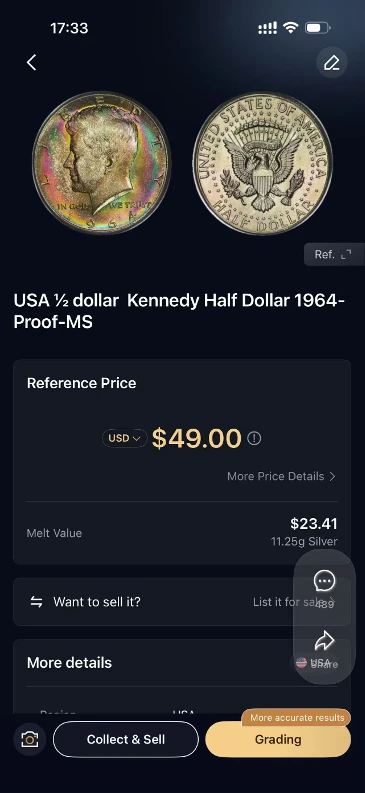
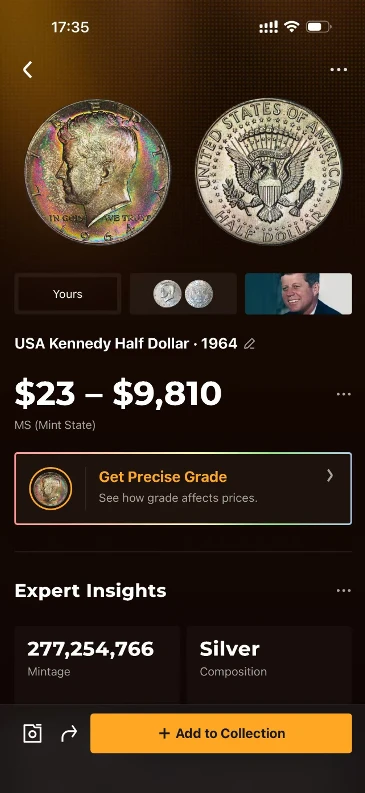
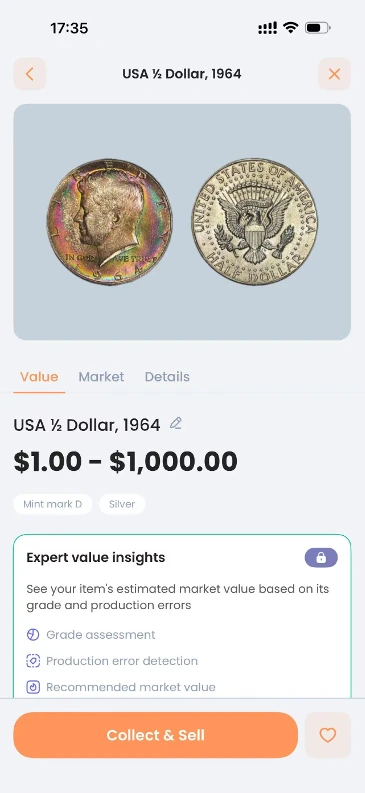
Correct coin type, but incorrectly identified as Proof.
Correct coin type, but incorrectly identified as 1964-D 50C.
Why the distinction matters.PCGS catalogs the1964 Philadelphia regular strike,1964-D Denver regular strike, and1964 Proofseparately. Our reference is the Philadelphia regular strike, so adding either D or Proof changes the issue being identified. TheU.S. Mint explains that Proof is a specialized minting process, rather than simply a description of an unworn coin.
1943 Lincoln steel cent
Reference:PCGS coin page(used to verify the result)
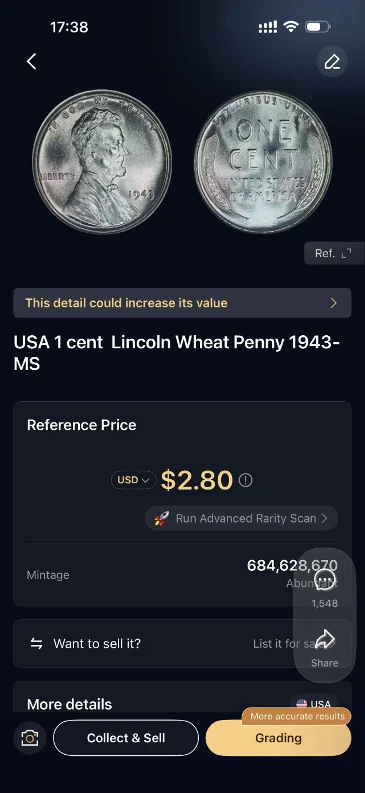
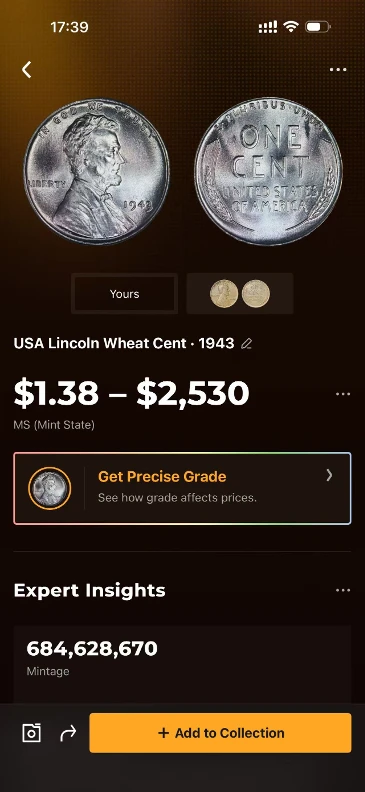
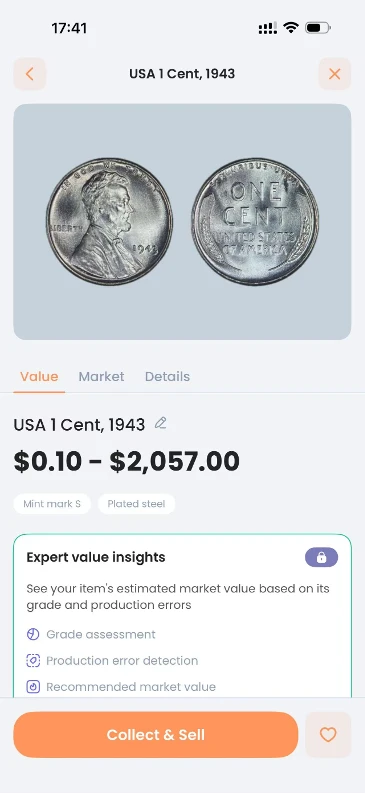
Correct coin type, but incorrectly identified as 1943-S 1C.
Why the distinction matters.PCGS lists the1943 Philadelphia steel centand1943-S San Francisco steel centas separate issues. Both are zinc-coated steel cents, but the S identifies a different mint. Matching the year and steel composition does not resolve that mint-mark difference.
1921 Morgan dollar
Reference:PCGS coin page(used to verify the result)
1963-D Jefferson nickel
Reference:PCGS coin page(used to verify the result)
1963 Jefferson nickel (Proof)
Reference:PCGS coin page(used to verify the result)
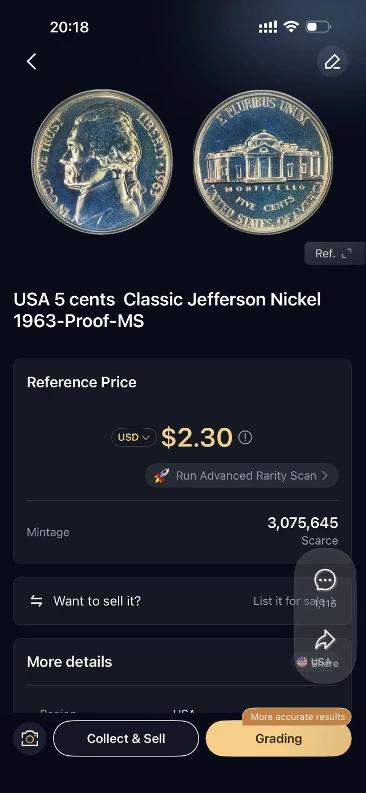
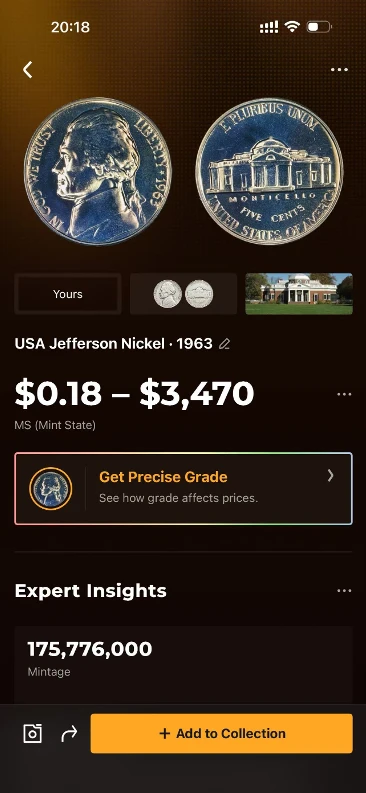
Correct coin type, but incorrectly identified as a regular-strike 1963 5C.
Correct coin type, but incorrectly identified as 1963-D 5C.
Why the distinction matters.PCGS has separate entries for the1963 Proof nickel,1963 regular-strike nickel, and1963-D regular-strike nickel. These share the Jefferson nickel design and year, but differ in strike type or mint. For this Proof sample, the year and denomination alone are not a complete match.
1909 VDB Lincoln cent
Reference:PCGS coin page(used to verify the result)
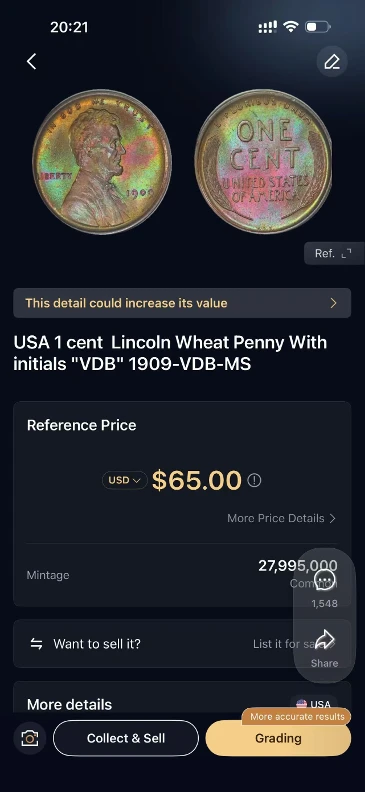
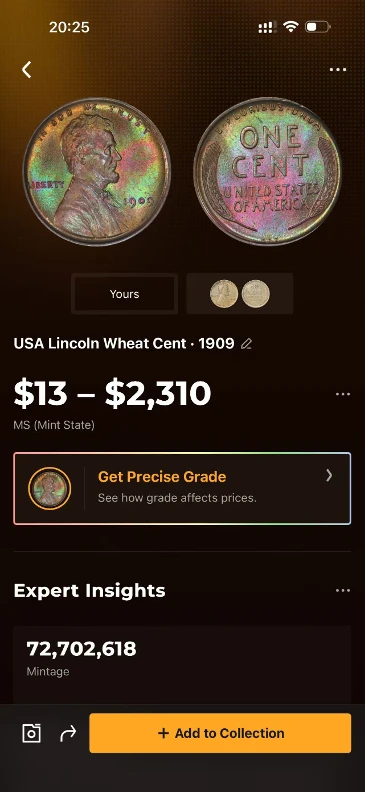
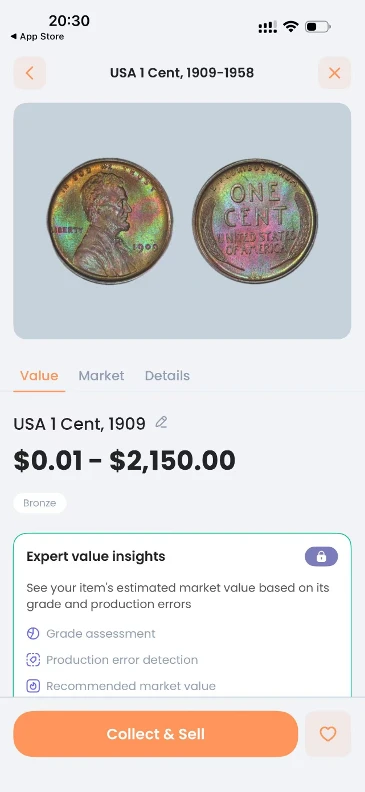
Correct coin type, but identified as 1909 1C Lincoln, BN rather than VDB.
Correct coin type, but identified as 1909 1C Lincoln, BN rather than VDB.
Why the distinction matters.NGC: Face Value — 1909 Lincoln Centsdistinguishes the Philadelphia 1909 VDB cent from the 1909 cent without VDB. The initials identify designer Victor David Brenner and were removed from the reverse during 1909;PCGS explains the design change. They belong to the same Lincoln cent series but are distinct issues. The displayed name “1909 1C Lincoln, BN” does not explicitly identify VDB; BN describes brown color, not the presence of the initials. CoinSnap also displays a mintage of 72,702,618, which conflicts with the 27,995,000 recorded for the VDB issue in thePCGS Lincoln cent guide. This additional mismatch supports recording its result as a variety misidentification, rather than merely an abbreviated name.
1909-S VDB Lincoln cent
Reference:PCGS coin page(used to verify the result)
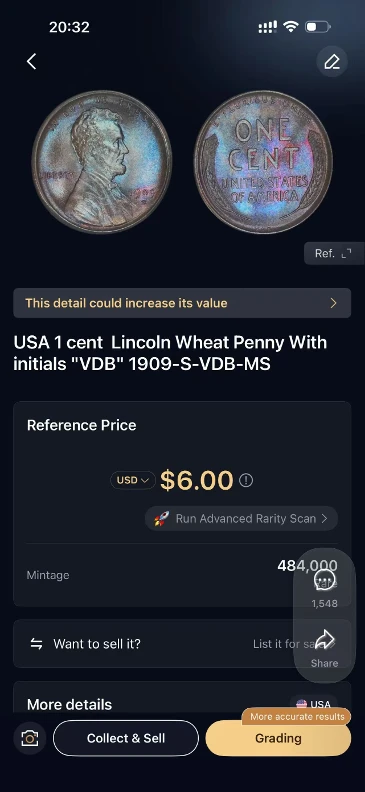
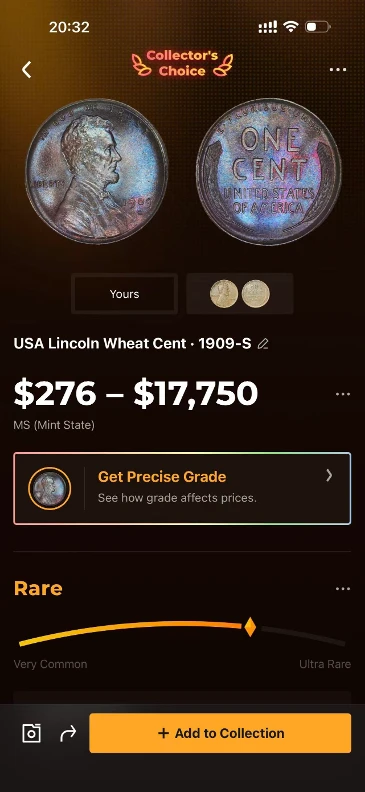
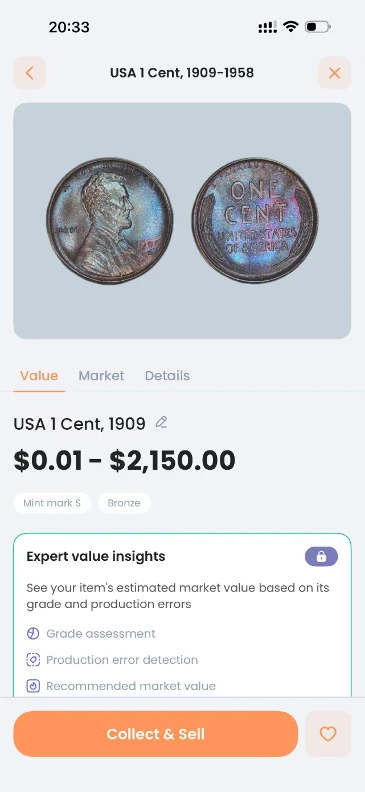
Correct coin type, but identified as 1909-S 1C Lincoln, BN rather than S-VDB.
Correct coin type, but identified as 1909-S 1C Lincoln, BN rather than S-VDB.
Why the distinction matters.NGC: Face Value — 1909 Lincoln Centsseparately illustrates and discusses 1909-S VDB and 1909-S without VDB. Both have the San Francisco S mint mark; the reverse VDB initials distinguish the two issues. An S designation alone therefore does not identify the S-VDB issue. The displayed “1909-S 1C Lincoln, BN” result does not explicitly confirm VDB, which is the distinction assessed here.
1914 (Year 3) Yuan Shih-kai dollar
Reference:PCGS coin page(used to verify the result)
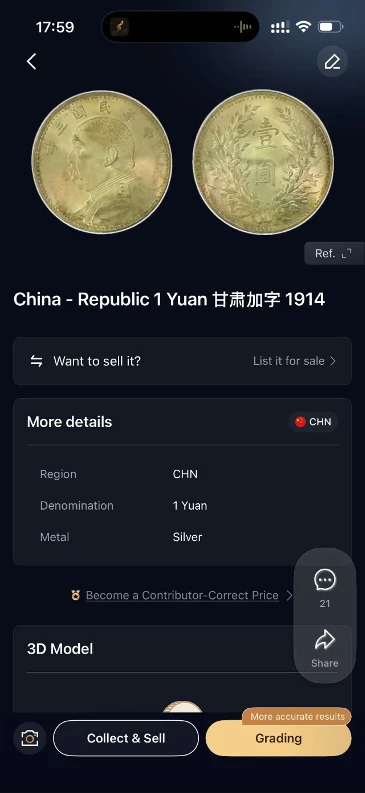
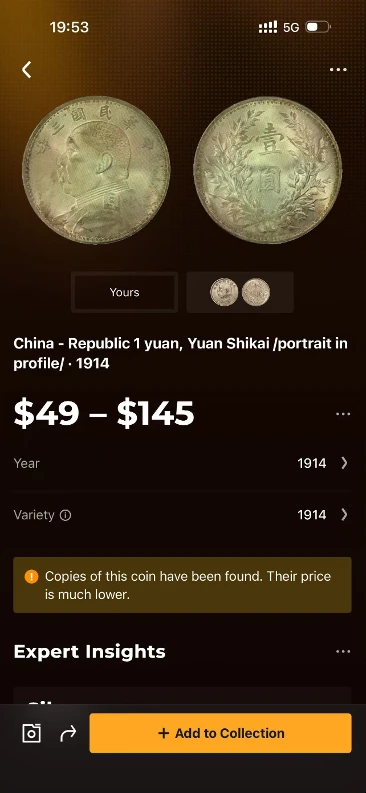
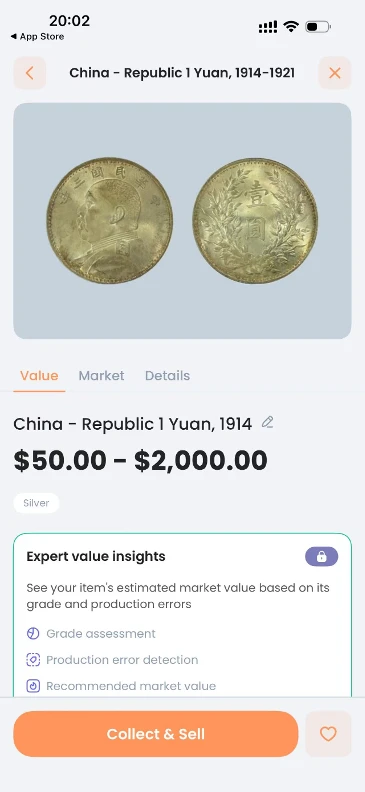
Correct coin type, but incorrectly identified as the variety with added Kansu characters.
Why the distinction matters.NGC’sYear 3 (1914) Kansu Yuan Shih-Kai L&M-617 Dollar referenceexplains that this version has two additional characters flanking the portrait to indicate Kansu Province. That is a specific design difference from the Y-329 / L&M-63 reference used for our sample. Recognizing Yuan Shih-kai and the Year 3 date does not by itself justify identifying the added-character version.
1964 Tokyo Olympics 1,000 yen
Reference:PCGS coin page(used to verify the result)
1967 British penny
Reference:PCGS coin page(used to verify the result)
1916 Canadian quarter
Reference:PCGS coin page(used to verify the result)
1850 Braided Hair large cent
Reference:PCGS coin page(used to verify the result)
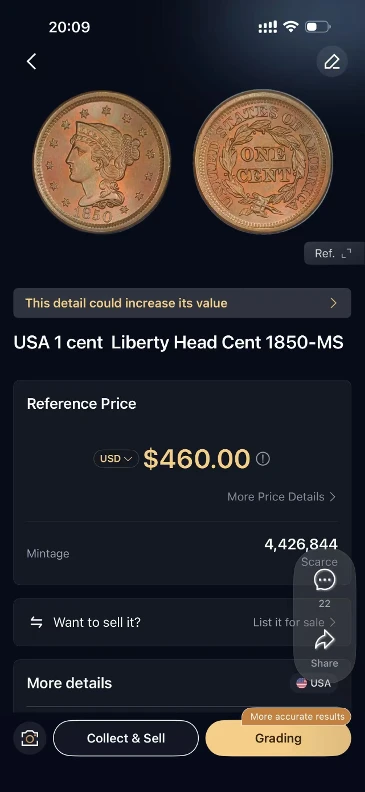
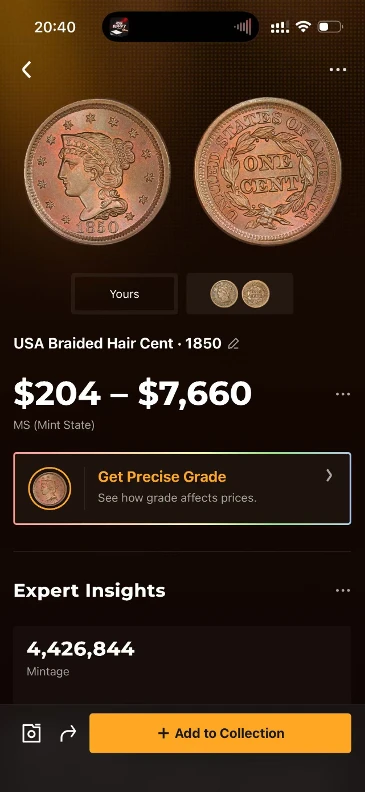
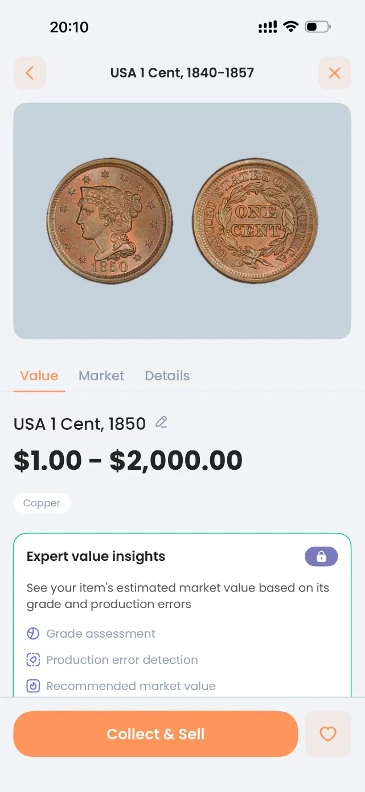
Wear and grading:None of the three apps graded this coin based on its wear in the default identification flow. Looking at earlier results from HeriBase and CoinSnap, coins appear to be labeled MS by default. Our conclusion is that, in this test, the default identification flows did not assess the coins’ condition.
Frequently asked questions
What coins should a beginner collect?
Start with circulating coins you already have, coins brought home from a trip, or commemoratives that interest you. Then choose a small theme, such as a country, date, denomination, or design. Learning one series and its dates and varieties is an easier starting point than chasing expensive rarities.U.S. Mint guide to getting started.
How should a beginner choose a coin identifier app?
Try a few coins you already know. Check whether the results are easy to understand and whether the free allowance fits your needs. For occasional identification, focus on scans and pricing. For a growing collection, look at sets, exports, and value information. Compare trading or expert services if you need them. The tables above can help you choose based on how you collect.
How should I photograph a coin for identification?
Follow the app’s instructions and take clear photos of both sides, one coin at a time. Use a plain background and bright, even lighting. Avoid glare, blur, and fingers covering the coin. Keep the full coin in the frame, with the date, lettering, and mint mark as clear as possible, then check those details against the result.
What information should I keep for each coin?
Save photos of both sides, the country or issuing region, date, denomination, mint mark, and variety. Add when and where you obtained it and what you paid. Organize coins into sets by country, year, or theme, and keep app estimates separate from your purchase price so you can compare them later.
Which app lets me keep identifying coins for free?
HeriBase lets you keep identifying coins for free: the first three scans each day are free, and you can watch ads for additional scans without subscribing. CoinSnap offers 10 free scans total and CoinIn offers five; both require a subscription after that. Coin Value does not offer free use.
Does identifying the coin type mean the variety is correct?
No. All three apps identified the basic types of our 12 coins, but their results differed on Proof issues, VDB initials, and mint marks. That is why we recorded basic identification separately from a complete variety match.
How do identification, photo grading, and expert appraisal differ?
Identification determines a coin’s country, date, denomination, and variety. Photo grading estimates its condition. The HeriBase expert service described here also assesses authenticity, condition, and value and provides a digital report. A correct default identification does not mean a coin has been graded or authenticated.
Do these accuracy rates apply to all coins?
No. The 83.33%, 75.00%, and 58.33% figures represent 10, nine, and seven complete matches out of our 12 samples. The coins were recommended by AI based on our test requirements, and we used public photos. The findings do not establish accuracy across every country, variety, or real-world photo condition.