

How much is a 1900 silver dollar worth?
A 1900 Morgan silver dollar’s value depends chiefly on its mint, condition and variety. For ordinary Philadelphia and New Orleans examples, the PCGS guide lists $92 at VF20 and $110 at MS63. At the same MS63 grade, a 1900-S is listed at $900 and an attributed 1900-O/CC at $1,400, as checked September 18, 2026.
All these issues share the same standard silver content. The larger premiums reflect collector demand for particular issues and well-preserved or attributed examples. First learn what distinguishes your coin, then use the grade-matched price table and recorded sales to assess its value.
No mark, O or S; inspect an O closely for O/CC.
Metal value and collector value are different comparisons.
A label reading only “MS” is not enough to select MS63 or MS65.
No mint mark, O or S: where to look
Look below the wreath bow on the reverse, above the letters in “DOLLAR.” No mint mark means Philadelphia; O means New Orleans; S means San Francisco. “P” is a catalog shorthand here, not a letter stamped on the coin.
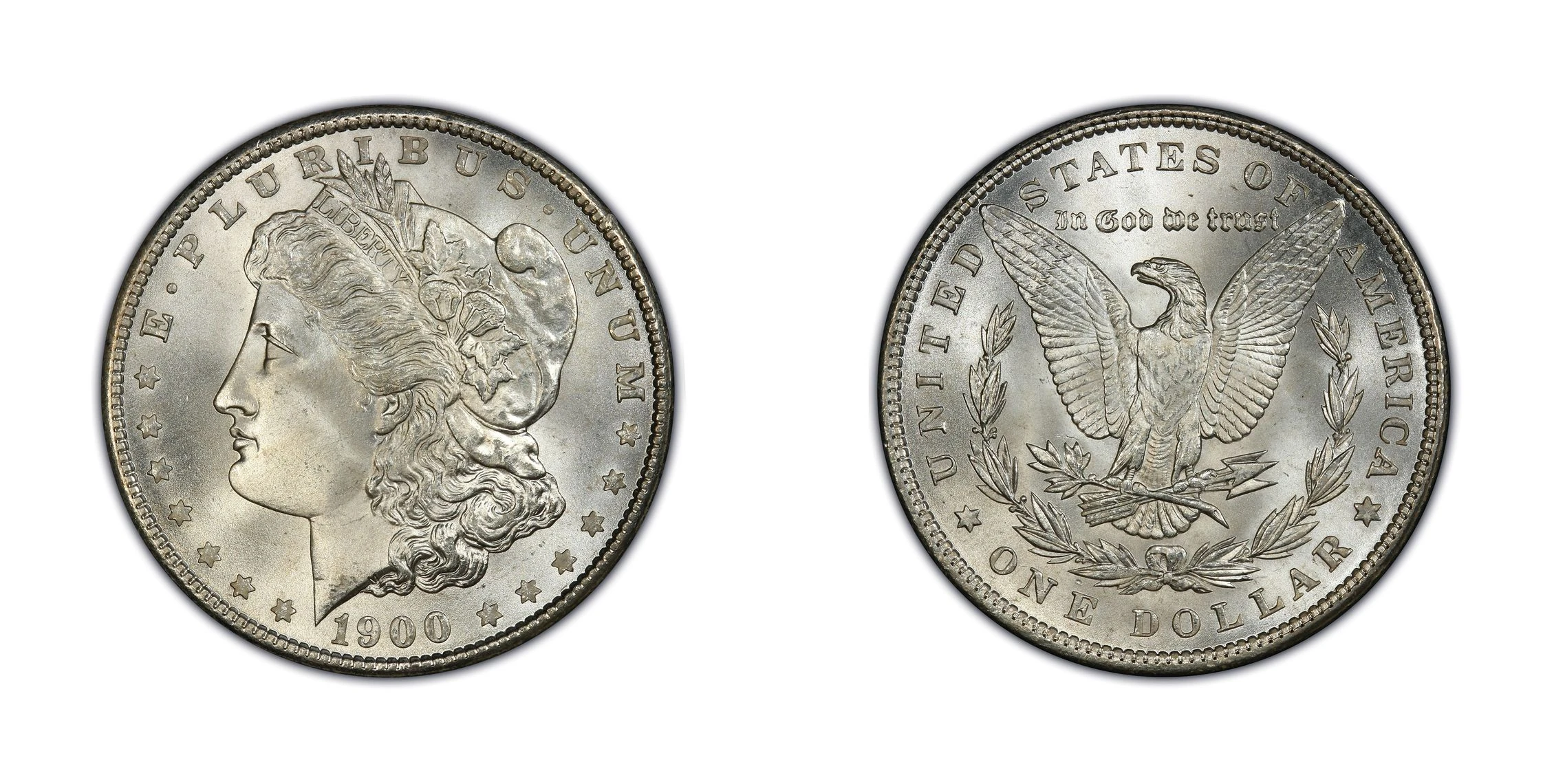
Regular-strike mintage: 8,830,000.
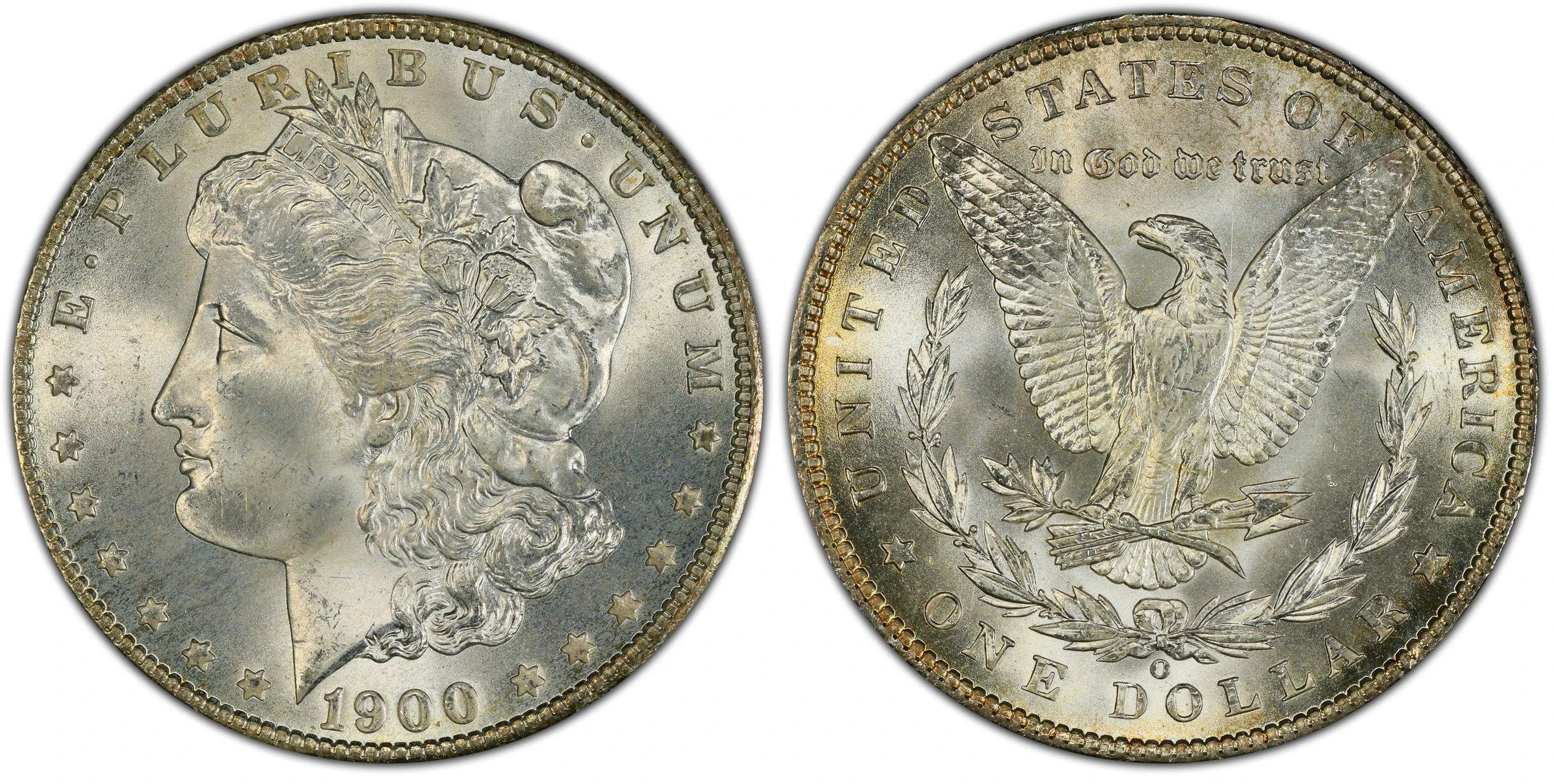
Regular-strike mintage: 12,590,000.
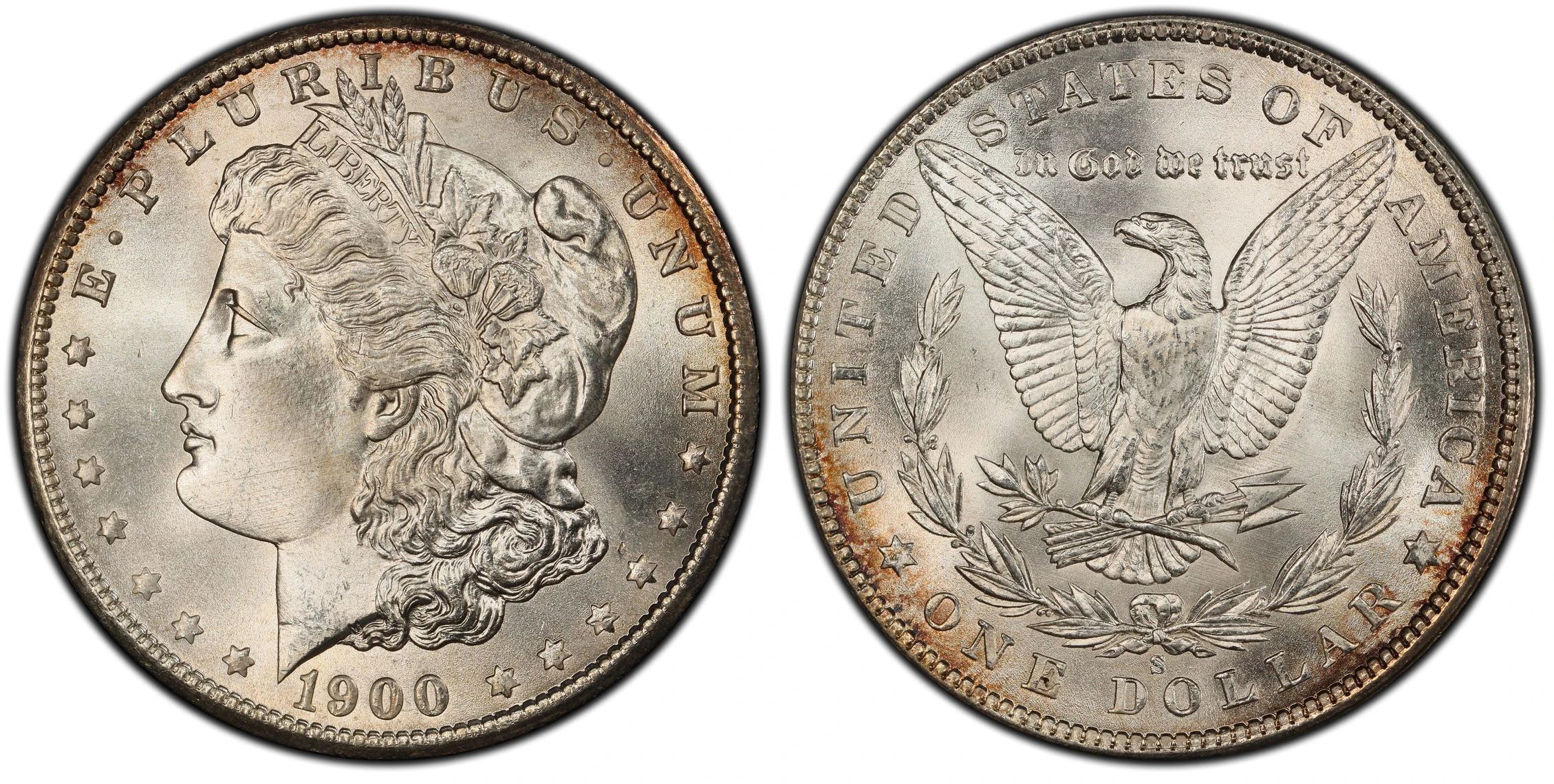
Regular-strike mintage: 3,540,000.
What does the mint tell you about value?
The 1900-S had the lowest regular-strike mintage of the three mints, but its premium is especially visible at higher grades. At VF20, the guide lists all three regular issues at $92; at MS65, it lists Philadelphia at $260, New Orleans at $185 and San Francisco at $1,650. This is condition rarity: availability at a particular preservation level matters more than the number originally struck.
Why condition can change the price so much
Before judging a coin’s shine, look for wear, contact marks and altered surfaces. On a Morgan dollar, compare the hair above Liberty’s ear, her cheek and the eagle’s breast. A soft strike can leave weak detail even without circulation wear. Check whether weak high points also show friction and a break in the original luster; detail alone cannot separate a weak strike from wear.
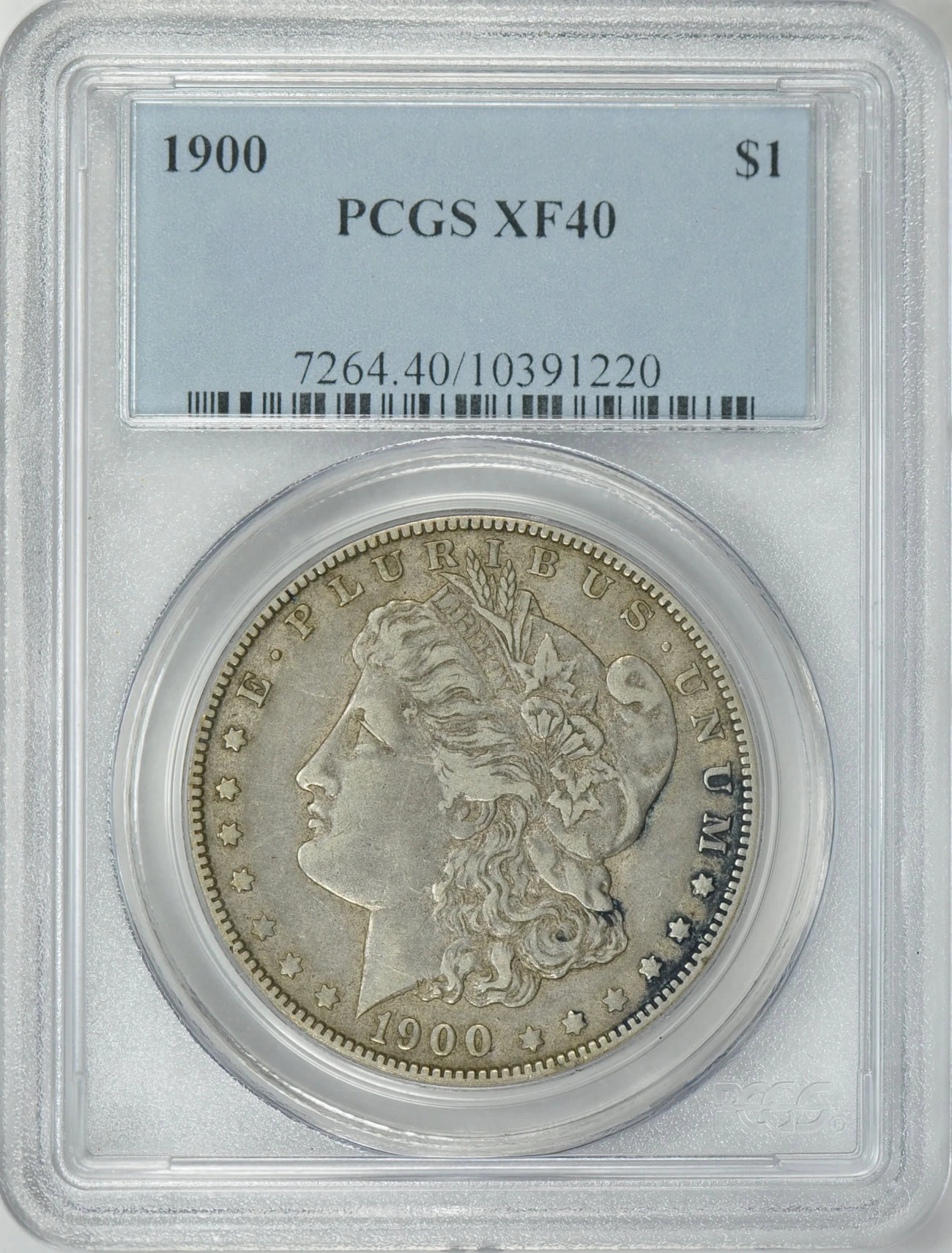
VF / XF · Circulated
VF means Very Fine; XF means Extremely Fine. Both show wear, with more design detail remaining at XF. Use circulated comparisons, even if the coin has been polished until it looks bright.
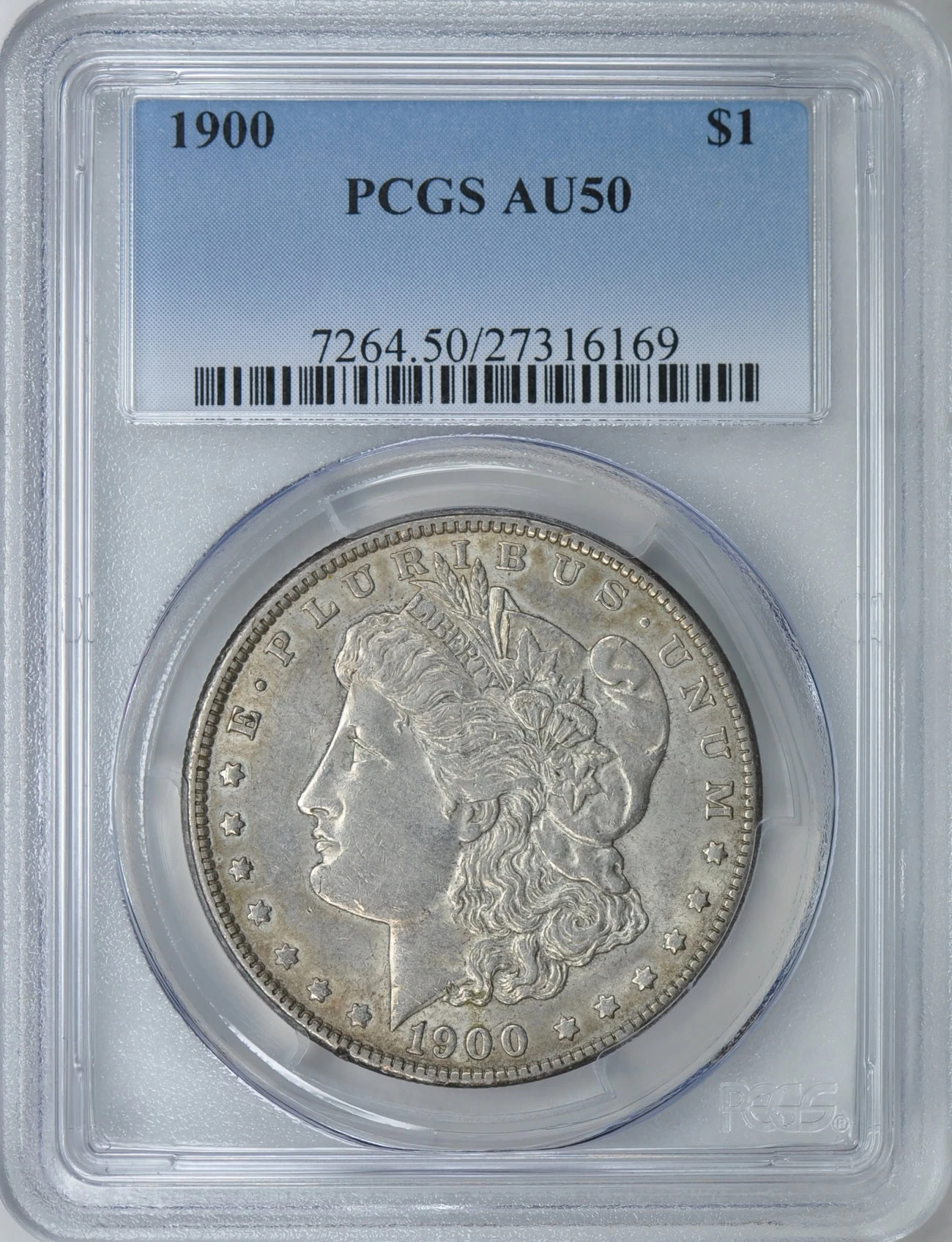
AU · Almost Uncirculated
Some wear remains on the high points. An attractive AU coin can look cleaner than a heavily marked Mint State coin; appearance alone does not put it in the MS range.
MS · Mint State
Grades 60–70 describe uncirculated coins. Marks, luster, strike and overall preservation still differ. MS60, MS63 and MS65 should not be treated as interchangeable.
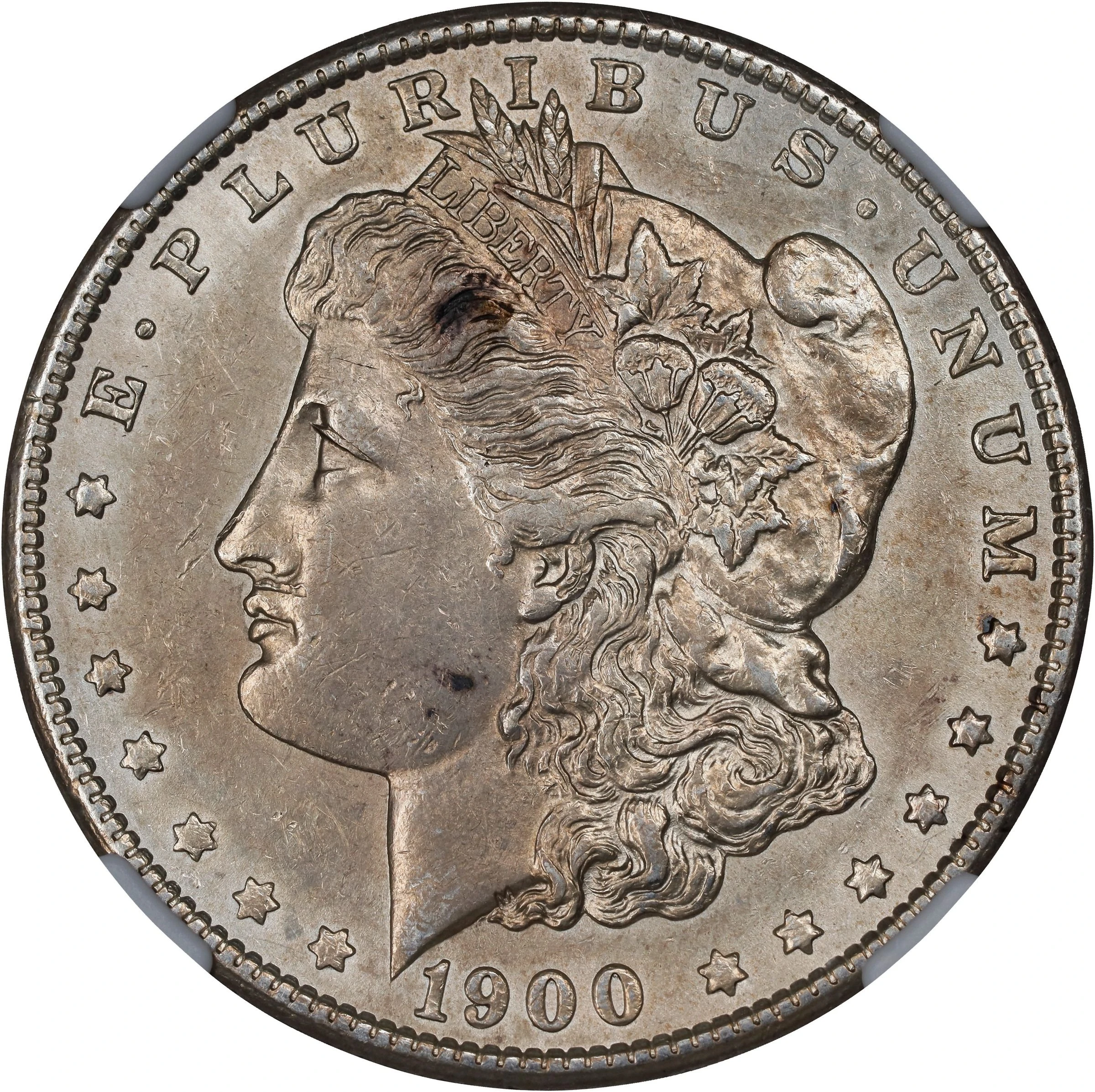
Details · Surface problems
Details is a problem designation, not the next step above Mint State. Cleaning, damage or other problems may prevent a numerical grade. A holder marked “AU Details” does not make the coin equivalent in value to a problem-free AU50.
Proof, prooflike and polished are different
A proof is a specially manufactured collector coin. PCGS records 912 proofs for 1900. PL (prooflike) and DMPL (deep mirror prooflike) describe qualifying reflective surfaces on regular-strike Morgan dollars; they do not turn a circulation strike into a proof.
Use the matching category on a professional reference or holder. A bright reflection in a photo may come from lighting or polishing, so it is not enough to assign a proof or mirror designation.
Do not clean the coin to improve its appearance before assessment. Photograph the surfaces as they are and handle it by the edge.
What is a 1900-O/CC Morgan dollar?
O/CC describes an O mint mark punched over a CC mark on the die. It is a New Orleans issue, not a 1900 dollar struck at Carson City. PCGS notes that Carson City silver-dollar production ended after 1893.
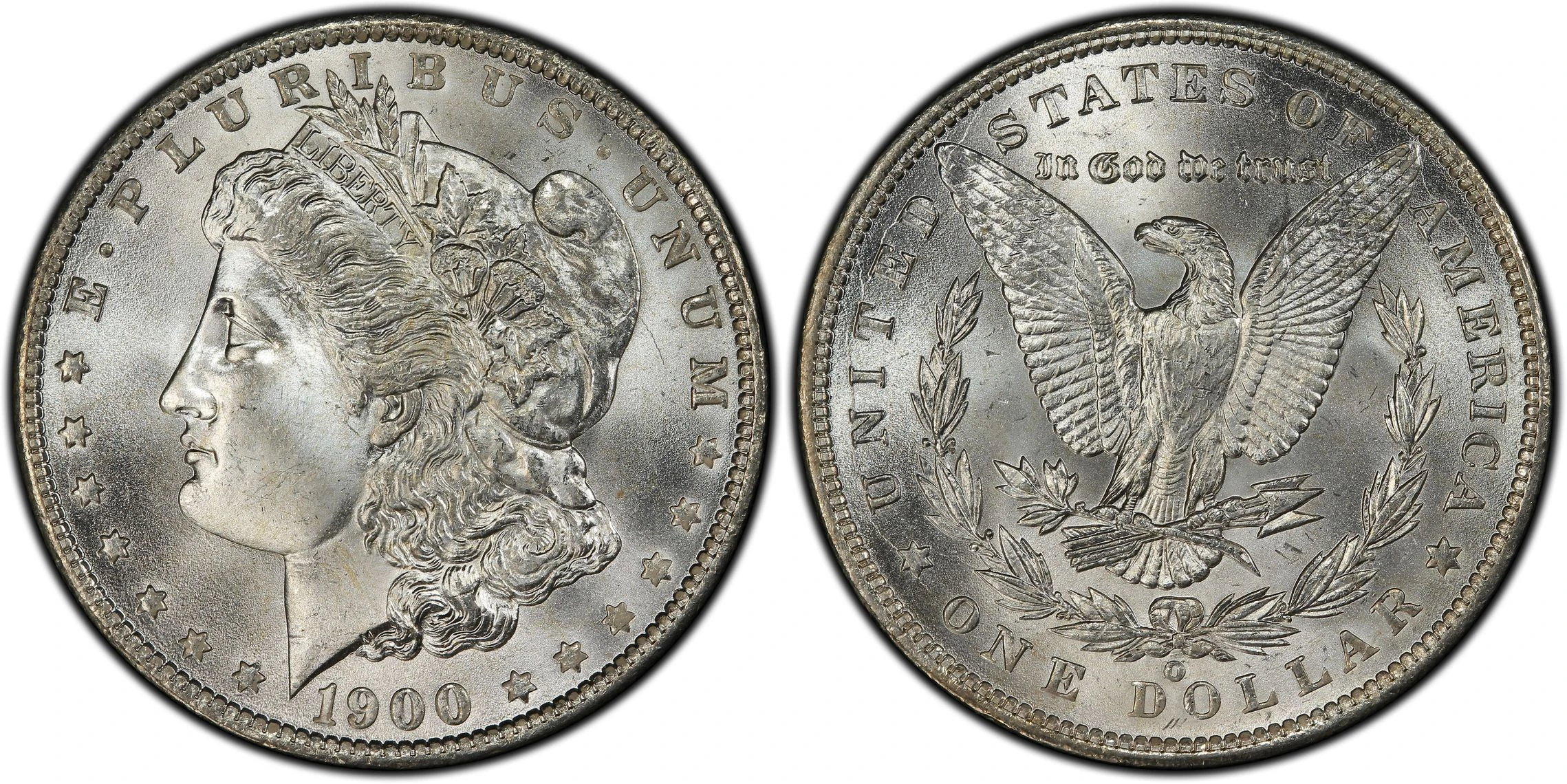
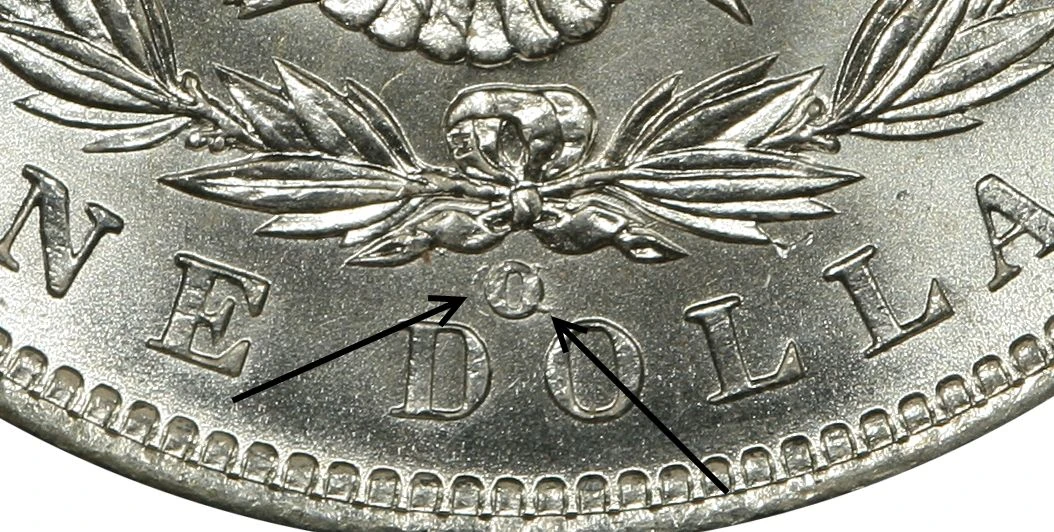
Under magnification, compare the surviving CC features around the O with attributed reference images. More than one die is associated with this overmintmark, so use the diagnostics for the specific attributed variety.
How to check a possible O/CC
- Take a sharp close-up of the mint mark and surrounding field, plus full photographs of both sides.
- Compare the shape and position of the remnants, not just whether the mark looks doubled.
- Ask for attribution when wear, reflections or damage obscure the feature. A scratch beside the O does not establish a recognized variety.
How much silver is in a 1900 dollar?
The standard Morgan dollar weighs 26.73 g and contains 90% silver, or approximately 0.7734 troy ounce of fine silver. Its diameter is 38.1 mm, and the edge is reeded.
At a hypothetical $60 per troy ounce, the metal-only calculation is approximately $46.40.
Use a current silver quote when you calculate your own comparison. Do not multiply the full 26.73 g by the price of pure silver: part of the alloy is copper. A buyer’s offer can also reflect transaction costs and the coin’s condition.
Correct weight does not prove authenticity
NGC documented a counterfeit 1900-O that weighed about 26.7 g but tested at 94% silver instead of 90%. It also showed problems in the lettering and design details. A coin can contain silver and still be counterfeit.
Use weight and diameter as screening checks. If the design, mint mark or surfaces raise questions, obtain professional examination before valuing it as a genuine collector coin.
1900 Morgan silver dollar value by mint and grade
Compare within the same row and column. These PCGS guide prices apply to regular strikes at the stated grades, with O/CC listed separately. Proofs, PL/DMPL coins and Details coins require their own comparisons; guide prices are not purchase offers.
| Issue | VF20 | XF40 | AU50 | MS60 | MS63 | MS65 |
|---|---|---|---|---|---|---|
| 1900 · no mint mark | $92 | $92 | $94 | $95 | $110 | $260 |
| 1900-O | $92 | $92 | $94 | $95 | $110 | $185 |
| 1900-S | $92 | $92 | $185 | $485 | $900 | $1,650 |
| 1900-O/CC | $210 | $300 | $415 | $650 | $1,400 | $2,700 |
How should you use these numbers?
- Identify before pricing. Record the date and mint mark exactly. Do not use the O/CC row simply because the O looks unusual.
- Use the certified grade when available. For an ungraded coin, start with a broad condition assessment rather than assigning a precise MS number from one photograph.
- Check recent comparable sales. Match grading service, finish, surfaces and variety. Include buyer’s fees when comparing auction totals.
- Separate selling proceeds from retail references. Dealer margins, auction commissions, shipping and insurance can change what you receive.
What have 1900 silver dollars actually sold for?
These four records show both variation within one issue and sales of the higher-value San Francisco and O/CC issues. Each row identifies the grade, sale date, lot and certification number.
| Coin | Sale date / lot / certification | Sale price incl. buyer’s premium (USD) | Comparison |
|---|---|---|---|
| 1900 · PCGS MS63 | August 2026 Lot 92472 Cert. 56424527 | $170.80 | Philadelphia regular strike |
| 1900 · PCGS MS63 | August 2026 Lot 95255 Cert. 59474796 | $124.00 | Same issue and grade; different specimen |
| 1900-S · PCGS MS65 | August 2025 Lot 95474 Cert. 26407670 | $1,560.00 | Higher-grade San Francisco issue |
| 1900-O/CC · PCGS MS63 | June 2025 Lot 5328 Cert. 84787516 | $1,080.00 | Attributed O/CC overmintmark |
The two Philadelphia MS63 coins sold for $124 and $170.80. The attributed O/CC MS63 sold for $1,080: the same numerical grade does not make different issues interchangeable. The 1900-S MS65 sale at $1,560 also documents the market for a higher-grade San Francisco example, although its grade differs from the MS63 rows.
These are individual sales from different dates, not a controlled measure of the premium. For your own comparison, match issue, grade, finish and surface condition, then check the sale date and use the same fee basis. The prices above include the buyer’s premium and are not the seller’s net proceeds.
Identify a 1900 Morgan dollar with HeriBase
Photograph both sides with HeriBase (Heritcoin) to view a suggested coin identity and its catalog details. This submitted record shows the fields available in the identification result.
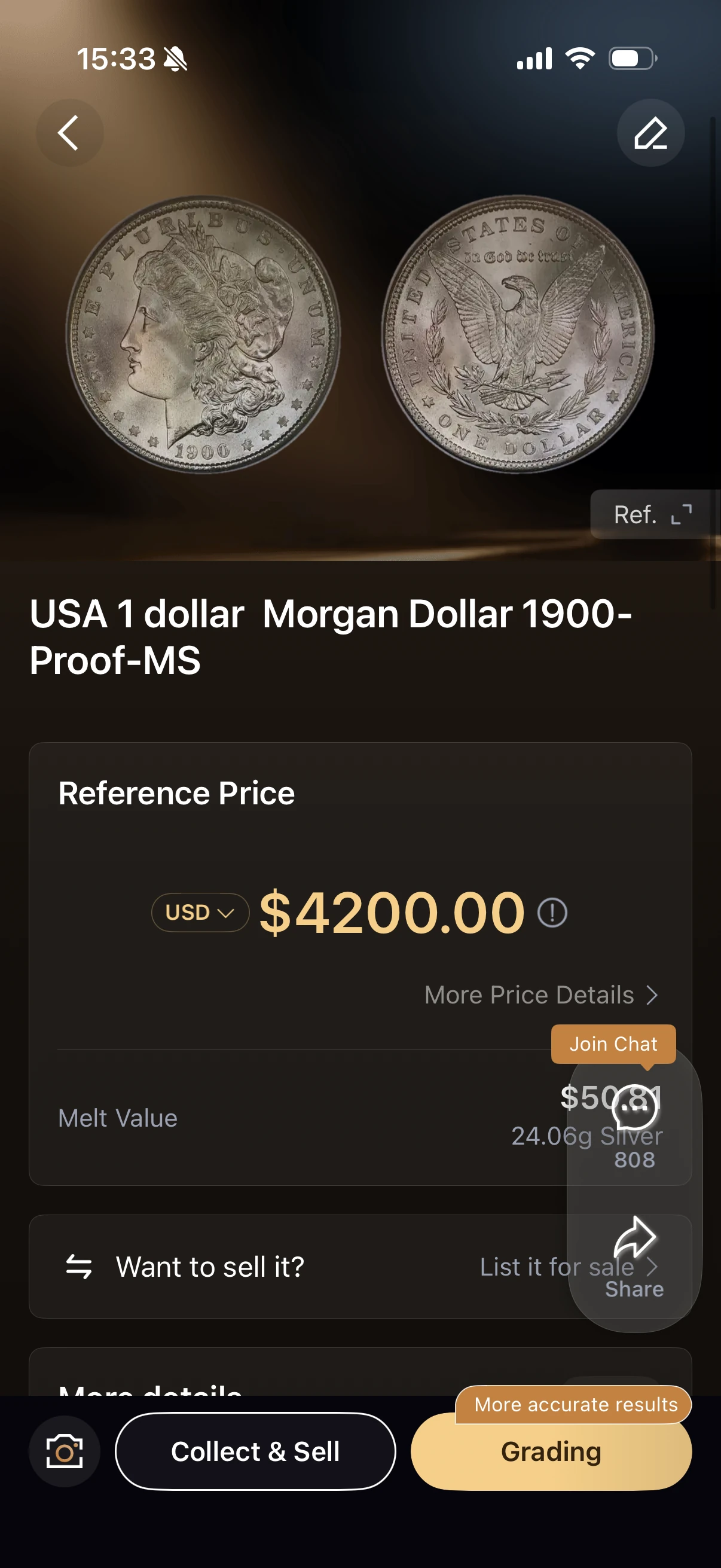
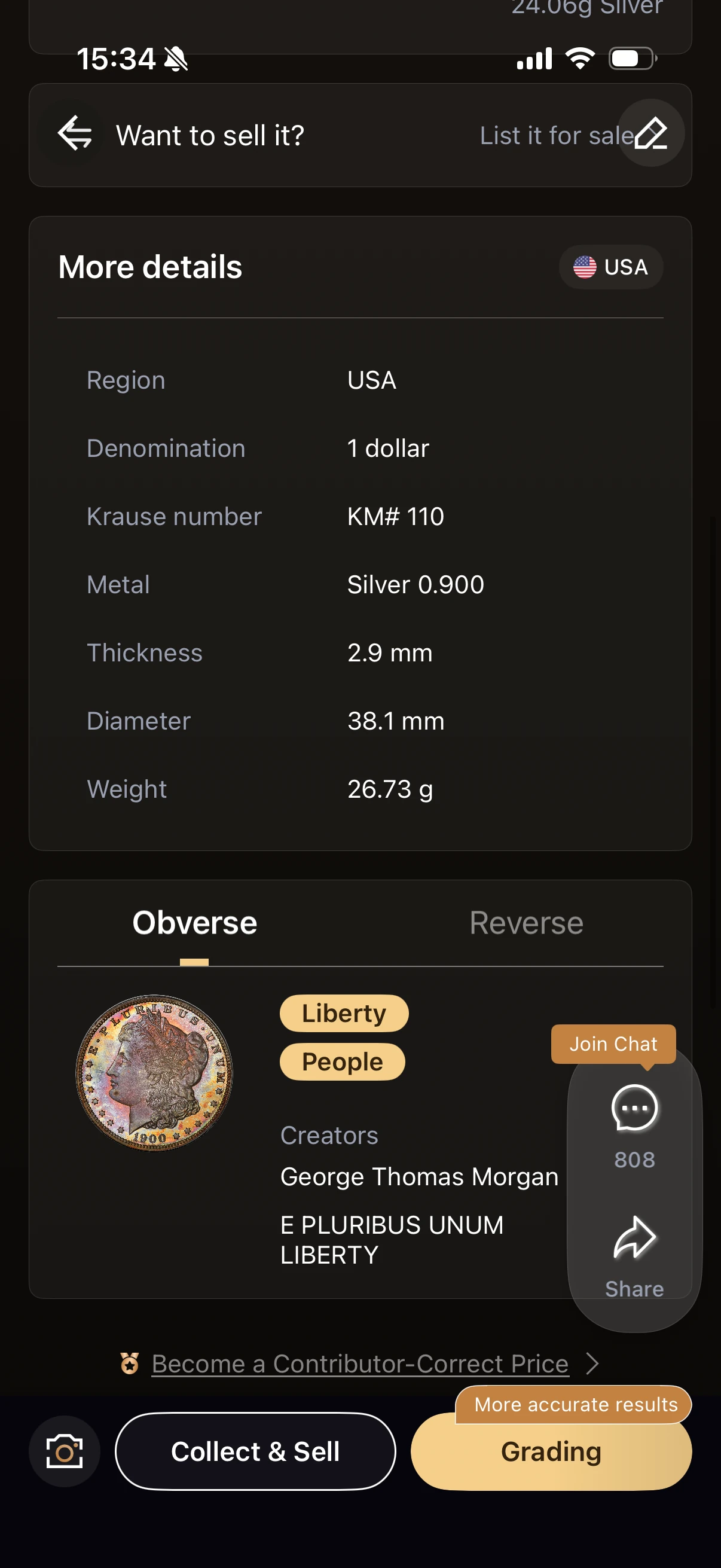
Fields shown in this identification record
- Result name
- USA 1 dollar Morgan Dollar 1900-Proof-MS
- Country / denomination
- USA / 1 dollar
- Catalog number
- KM# 110
- Metal
- Silver 0.900
- Diameter / weight
- 38.1 mm / 26.73 g
- Designer
- George Thomas Morgan
- App reference price
- USD 4,200
The “Proof-MS” classification is unconfirmed; $4,200 is an app reference price only.
Photograph both sides
Use even light and a plain background. Keep the date, rim and reverse mint mark in focus. Compare the suggested date, design and mint with the physical coin.
Ask a human expert
For an unclear mark or surface, choose Heritcoin’s Expert Appraisal Service and include close-ups with a specific question. Check the selected expert’s service scope and fee.
Arrange examination
If photos leave authenticity, composition or grading unresolved, submit the actual coin to a qualified professional or an appropriate grading service.
1900 silver dollar value: frequently asked questions
Is a 1900 silver dollar with no mint mark an error?
No. Philadelphia Morgan dollars normally have no mint mark. Identify the grade and surfaces before comparing prices; the missing letter is not an error premium.
Is every 1900-O dollar an O/CC?
No. O/CC is a specific overmintmark attribution. A normal O identifies New Orleans without establishing the CC remnants required for that variety.
Why can a 1900-S be worth more?
Market value depends on availability in the required condition, not just the date. The price table shows that the S-mint premium becomes significant in higher grades. Compare the same grade and finish.
Is there a 1900 Peace dollar?
No. A genuine U.S. silver dollar dated 1900 uses the Morgan design. Peace dollars began in 1921; a coin combining a 1900 date with the Peace design needs closer examination.
Is a shiny 1900 Morgan dollar a proof?
Not necessarily. Regular strikes can have reflective fields, and polishing can also create shine. Proof manufacture, a PL/DMPL designation and altered surfaces require different comparisons.
Can Heritcoin confirm the O/CC variety?
Use AI identification to narrow the issue, then compare a sharp mint-mark photograph with attributed references. If the result does not resolve the detail, request human expert review. Physical examination may still be needed.
Should I use melt value or collector value?
Calculate the silver content separately, then compare the exact issue, grade and surfaces with recent sales. A confirmed collectible premium can exceed the metal value; neither figure automatically equals a buyer’s offer.
The premium is in the issue and condition
A 1900 date does not make every Morgan dollar rare. The largest differences in this guide come from higher-grade 1900-S coins and confirmed O/CC varieties. Original surfaces and an appropriate grade comparison matter; shine alone does not establish either.
Start with the mint mark and surface condition, match the coin to the correct price row, then compare recent sales of equivalent specimens. Use HeriBase to narrow the identity, human expert review to resolve uncertain details, and physical examination when photographs cannot settle authenticity or grading. That sequence gives you a defensible value comparison before you buy, sell or submit the coin.
Sources and editorial method
Prepared by the Heritcoin Team, which provides coin-identification services. References and price rows checked September 18, 2026. Values use the regular-strike PCGS guide category; the four sales are separately documented transactions. Under thePCGS auction-results convention, reported prices include the final bid and any buyer’s premium.
- Issue specifications and guide prices: PCGS CoinFacts for 1900, 1900-O, 1900-S, 1900-O/CC and the 1900 proof issue.
- Grading and metal content: NGC’s grading scale and U.S. silver coin specifications.
- Authentication example: NGC’s 1900-O counterfeit examination.
- MS63 sale records: PCGS auction records for lot 92472 ($170.80) and lot 95255 ($124), Stack’s Bowers, August 2026.
- Additional issue-specific sales: PCGS records for1900-S MS65, lot 95474 ($1,560, August 2025) and1900-O/CC MS63, lot 5328 ($1,080, June 2025).