

How do I check whether my penny is worth more than one cent?
Scan both sides of your penny in HeriBase to get a suggested identification and available reference price. Check the date, mint mark, variety and condition against your coin. If you disagree with the price, request a human appraisal in the app.
Human appraisal is a separate paid service. Reference prices are starting points, not guaranteed sale prices. This guide focuses on Lincoln Wheat and Memorial cents; photo identification takes place in the app.
| What you have | What to do first | What would justify more research? |
|---|---|---|
| An ordinary-looking circulated cent | Record the date, mint mark and reverse design. | A specific date-and-mint combination, attributable variety or other documented distinction. |
| A Wheat cent or a potentially important date | Match the full issue, not just “old penny.” | Comparable sales for the same issue and similar wear. |
| A strange color, doubled letter or unusual weight | Photograph the detail and check a recognized reference. | Diagnostics consistent with an established variety or mint error. |
| A coin in a graded holder | Record the entire label, including BN, RB or RD. | Sales matching the grade, color, variety and surface status. |
First, recognize the U.S. Lincoln penny
A U.S. penny is a one-cent coin: its face value is $0.01. The Lincoln cent features Abraham Lincoln on the front, called the obverse. The reverse helps place it in a series: two wheat ears on 1909–1958 cents, the Lincoln Memorial on 1959–2008 cents, four commemorative designs in 2009, and the Union Shield design introduced in 2010.
This guide focuses on Wheat and Memorial cents. On the examples below, find the date beside Lincoln, inspect the mint-mark area below it, then turn the coin over to read ONE CENT and examine the reverse design. Those details identify the comparison group before you consider price.
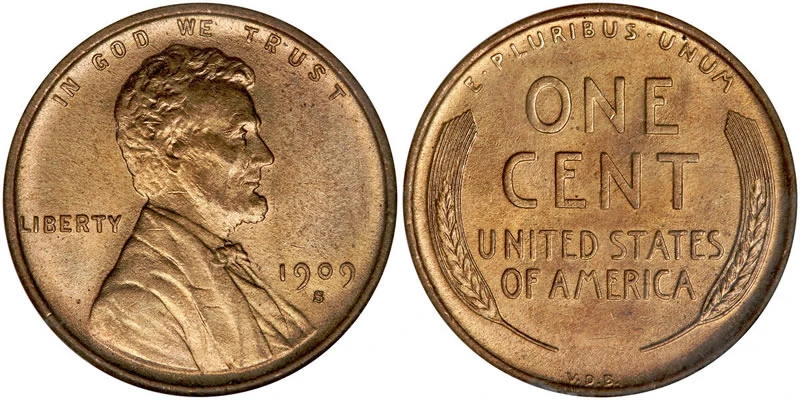
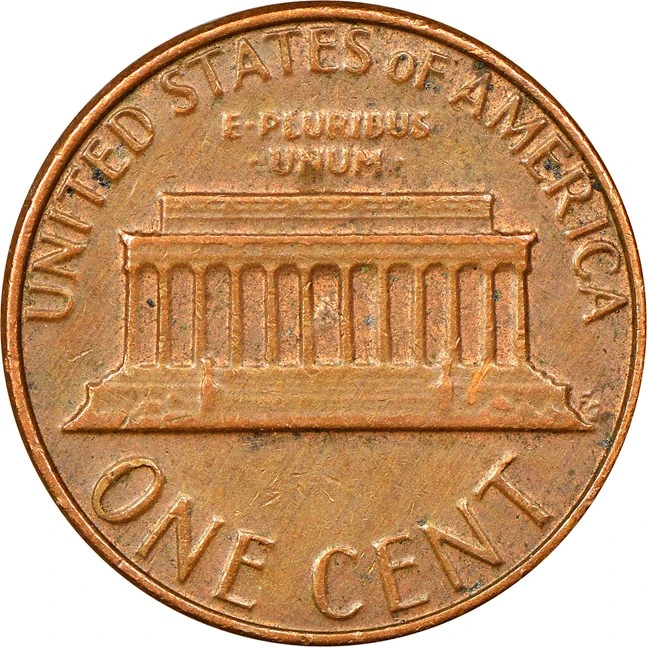
What information does a useful penny value check need?
Collect five details: the issue, mint mark, variety, condition and the kind of price you want. Keep the coin unchanged while you investigate. Cleaning it to make the date or color look better can damage the evidence you need.
- Identify the country and design. Read the denomination and both sides. Do not apply Lincoln-cent prices to a different series.
- Read the date and mint mark. For the Lincoln cents discussed here, look below the date for a mint mark. “No mint mark” is a description to research, not an error diagnosis.
- Record the distinguishing detail. Examples include VDB initials, Small Date versus Large Date, or the spacing of AM in AMERICA.
- Describe the surfaces. Note wear, corrosion, scratches and possible cleaning. Use the full certified grade when one is present.
- Define the price. A seller’s asking price, an app reference, a completed auction price and a dealer’s cash offer answer different questions.
Use a magnifier, even light and clear photographs. A scale can help with composition questions; it cannot establish authenticity on its own. Record uncertainty rather than assigning the most valuable possible variety.
Which penny dates and features should I check?
Use the year to find the right diagnostic, not to choose a price. This focused checklist covers the seven cases below; it is not an exhaustive list of valuable pennies.
| Reference view | Date / issue | Check this detail | Common mistake |
|---|---|---|---|
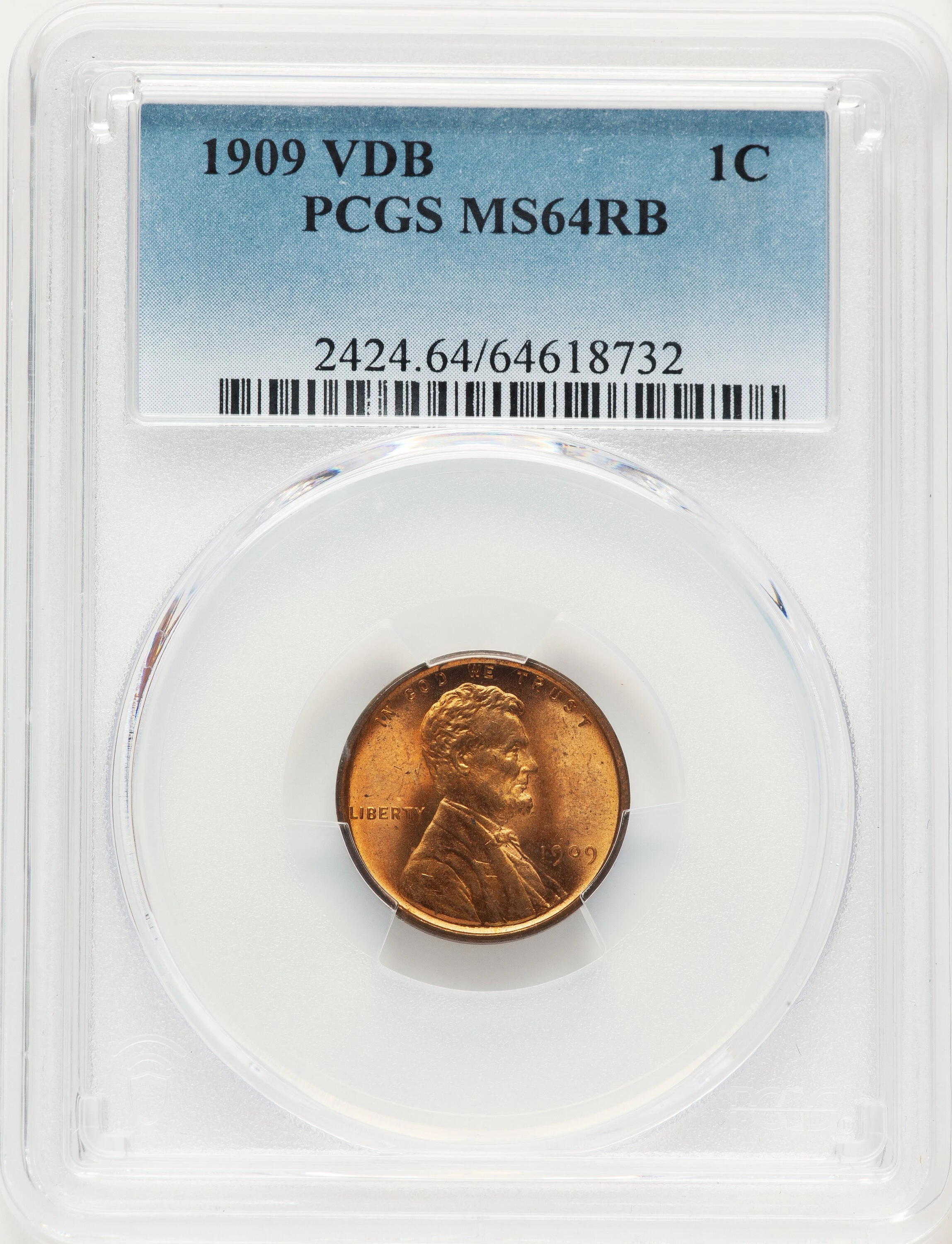 | 1909 VDB | VDB initials on the reverse; presence or absence of S on the obverse. | Using 1909-S VDB prices for a Philadelphia VDB cent. |
| 1909-S VDB | Both S and VDB, then authenticity and condition. | Assuming every 1909 cent shares its low mintage. |
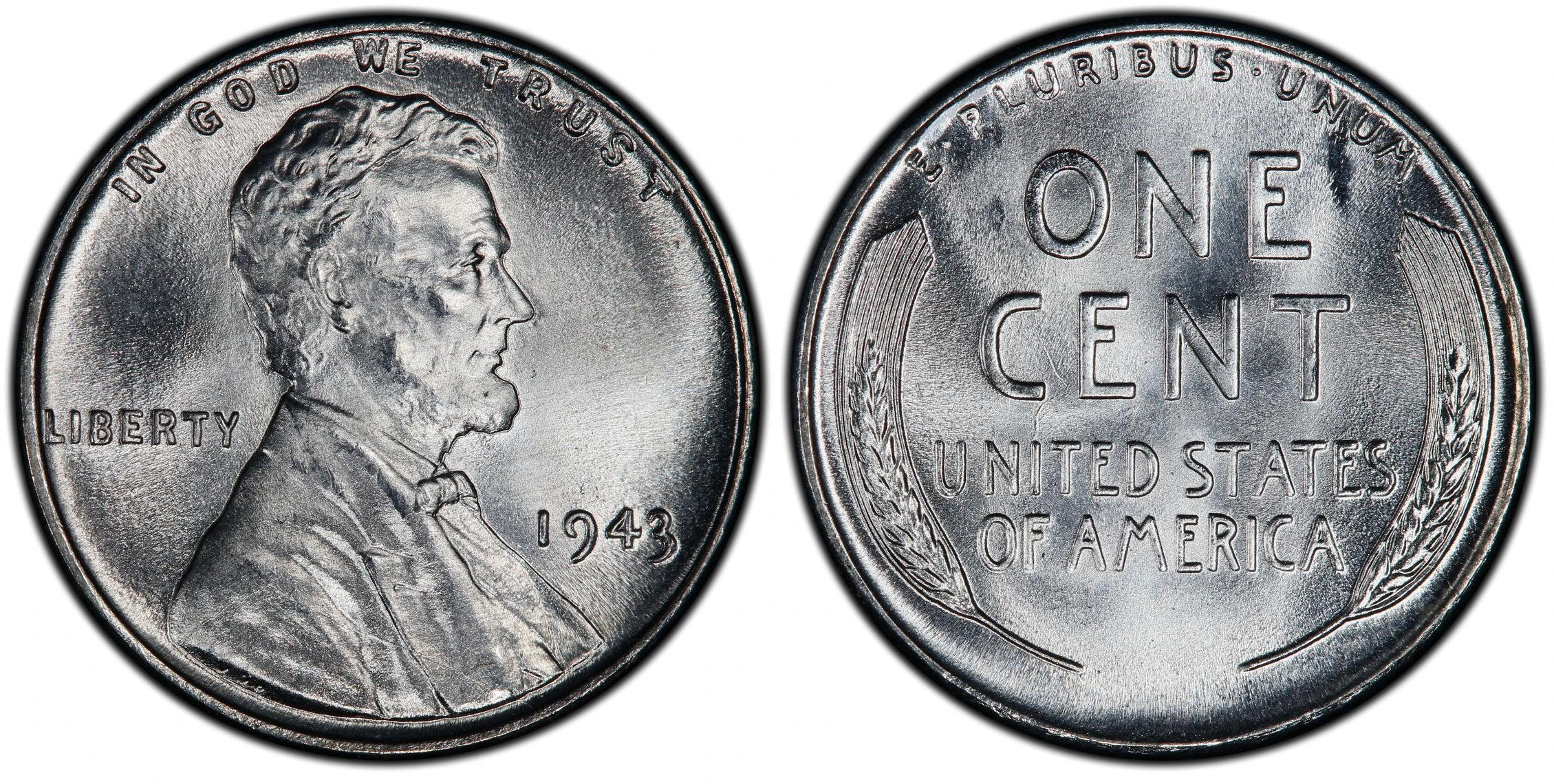 | 1943 | Steel versus a suspected bronze planchet; date integrity. | Calling copper-colored plating a bronze error. |
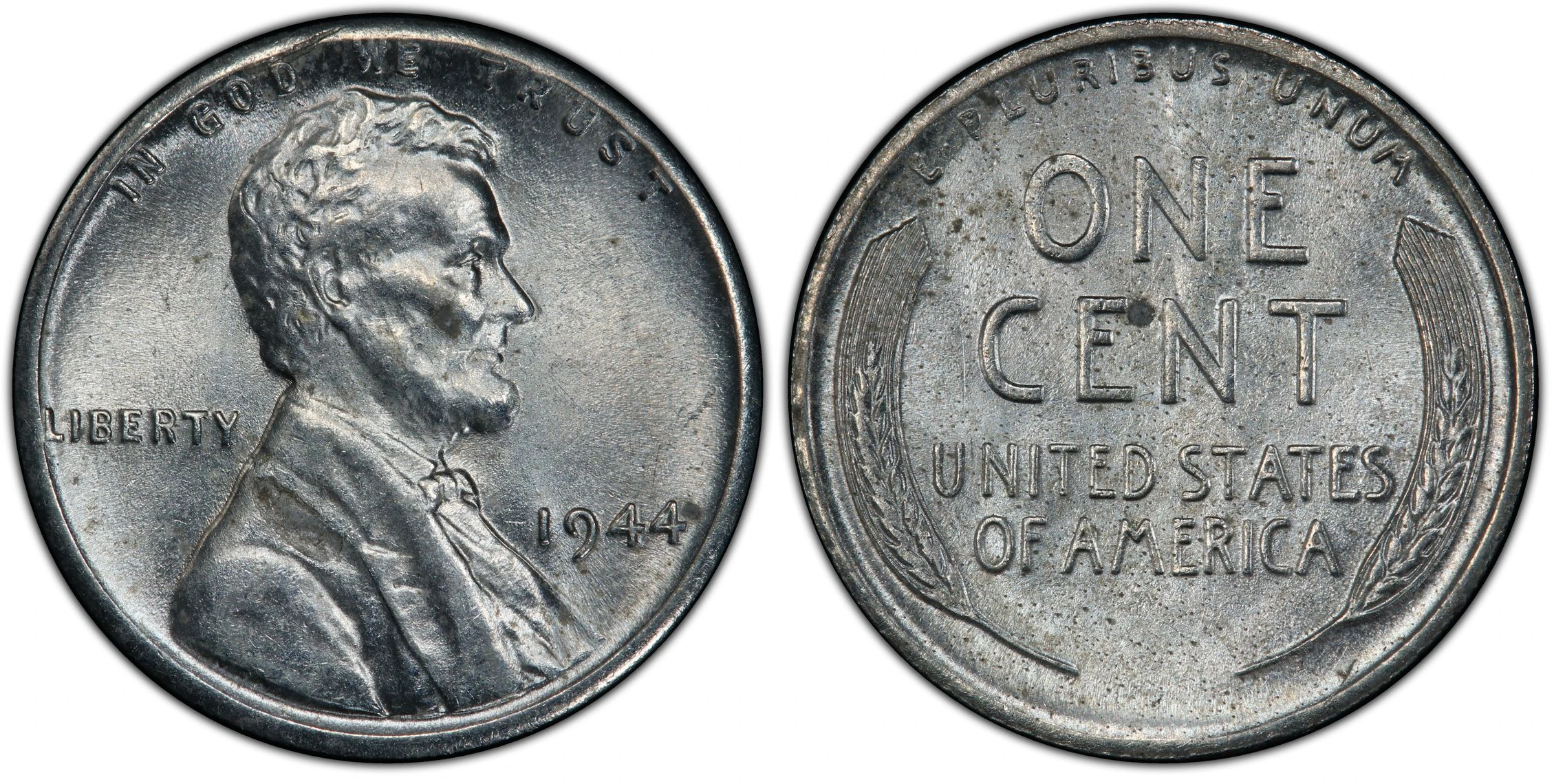 | 1944 | A suspected steel planchet requires authentication. | Applying rare steel-error prices to ordinary 1944 cents. |
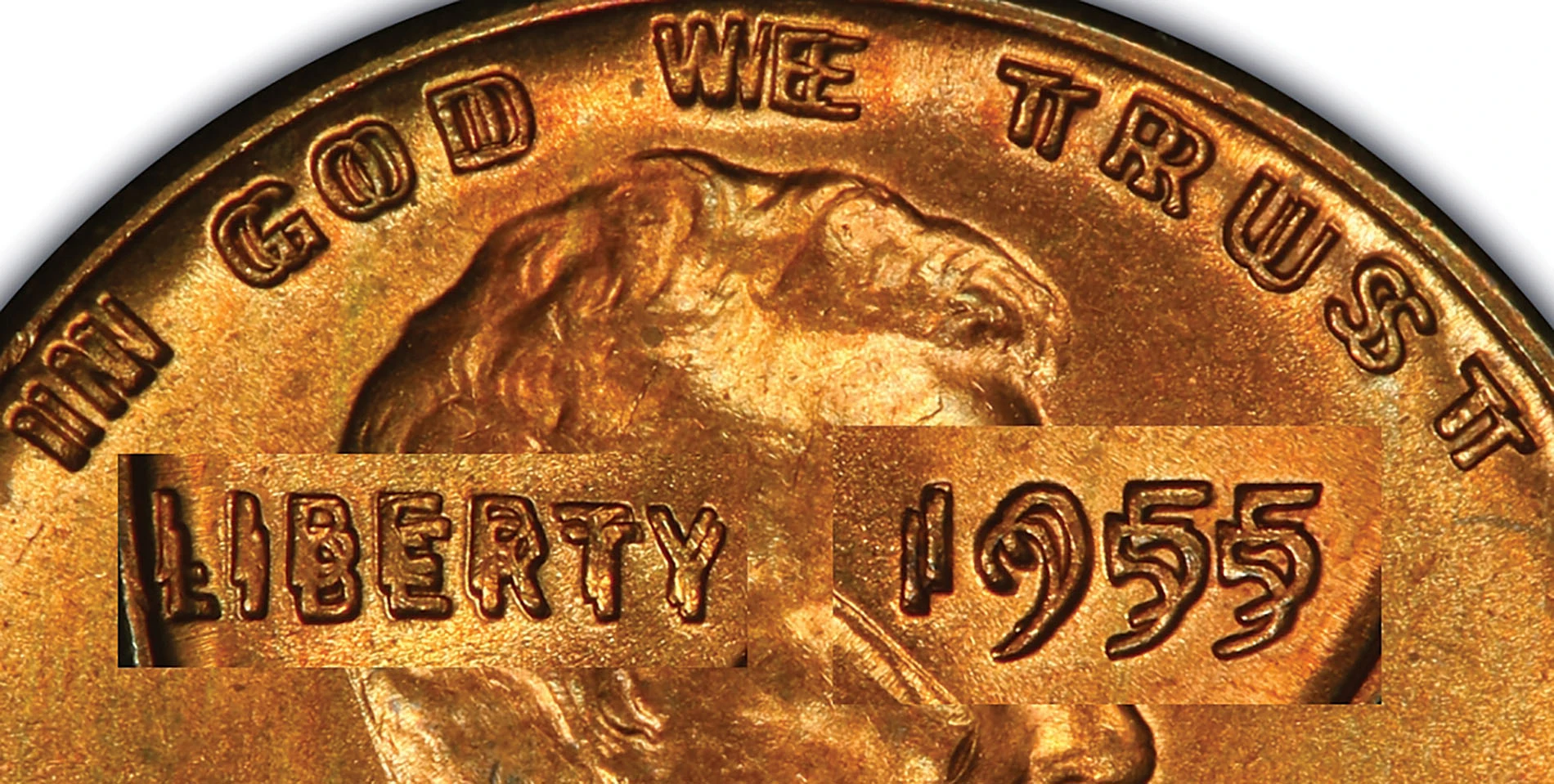 | 1955 Doubled Die Obverse | Strong doubling of the date, LIBERTY and motto. | Equating every doubled-looking edge with the famous variety. |
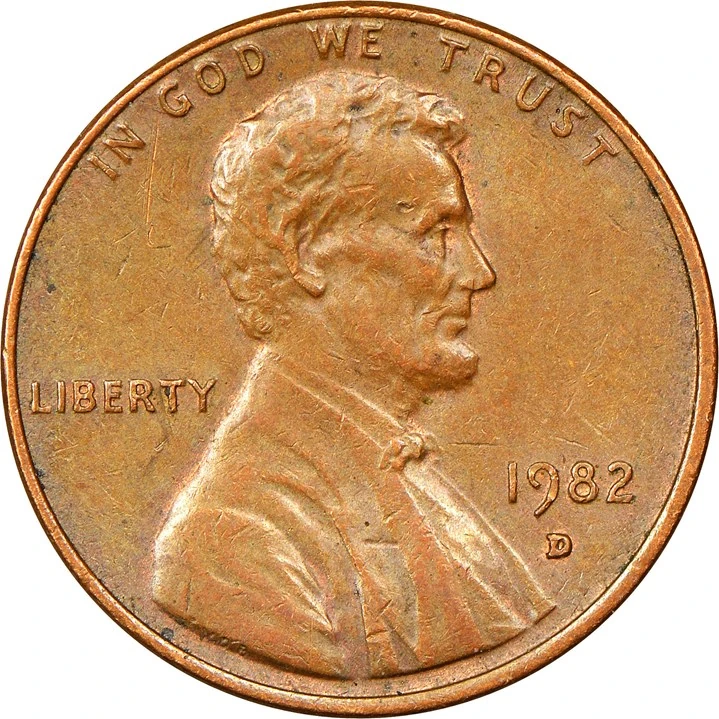 | 1982 / 1982-D | Mint mark, date size and composition together. | Treating every heavier 1982 cent as a rare error. |
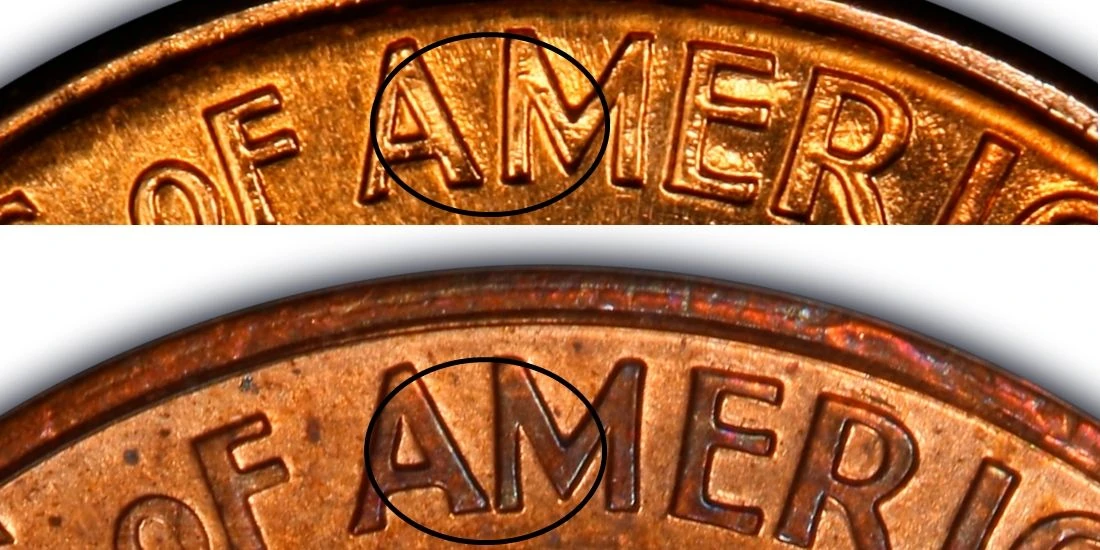 | 1992 Close AM | Spacing between A and M on the reverse. | Assuming Close AM is rare for every date. |
Why can similar pennies need very different price comparisons?
1. A 1909 VDB penny is not automatically a 1909-S VDB
Read a certified label: MS means Mint State, with no circulation wear, and uses grades 60–70 on the 1–70 scale. AU means About Uncirculated and uses grades 50–58 for coins with slight wear. Higher numbers describe better preservation, not a price multiplier. The suffix records copper color: BN = Brown, RB = Red Brown, RD = Red. Thus MS65RB combines a grade of 65 with a Red Brown designation; AU58BN describes an About Uncirculated 58 coin with a Brown designation. Proof (PF or PR) describes a special method of manufacture, not a higher grade than MS. Compare the same strike type. For an ungraded coin, record visible wear and surface problems instead of assigning a certified grade; see the grading and surface-check guide.
The mint mark changes the comparison group. Check below the obverse date and the initials near the bottom of the reverse. A VDB cent without an S must not be valued from a listing for the San Francisco issue. Even within the Philadelphia issue, the same numerical grade can produce different results when the copper color classification differs; see the documented sales below.
Your next step: save separate close-ups of the mint-mark area and VDB initials. Search using the complete identification, then add grade and color where known.
2. A 1909-S VDB: mintage helps, but identity comes first
PCGS records a mintage of 484,000 for the 1909-S VDB. That figure belongs to this specific issue. It describes original production, not the number surviving today. A coin must match the S mint mark and VDB reverse before that entry is relevant, and a suspicious mark needs examination before a key-date price is assigned.
Your next step: compare the exact issue and condition, then seek specialist review if the mint mark or initials are uncertain. Our documented HeriBase mintage example shows the same 484,000 field; it is a catalog check, not authentication of the physical coin.
3. A 1943 penny: silver color is expected on a steel cent
The normal 1943 cent was zinc-coated steel; bronze examples are a different, rare category. A copper-colored 1943 coin may be a plated steel cent. PCGS also describes altered 1948 dates made to resemble 1943. Steel is attracted to a magnet, while bronze is not, but a nonmagnetic result alone does not authenticate the date or the coin.
Your next step: record the magnet response without scraping the surface, photograph the date closely and obtain an in-hand assessment for a credible bronze candidate. Do not borrow a bronze auction record to price an ordinary steel cent.
4. A 1944 penny: the unusual composition is steel
A rare 1944 steel cent is a separate error issue, not the standard for all 1944 pennies. A silver-colored surface is only a clue. Check the date, mint mark and material rather than assuming that a bright appearance proves a valuable error.
Your next step: retain photographs, weight and any magnet observation. If these suggest a steel candidate, arrange authentication before listing it as a mint error.
5. A 1955 penny: look beyond a doubled-looking digit
The famous 1955 Doubled Die Obverse has pronounced doubling across the date and lettering. PCGS identifies the date, LIBERTY and IN GOD WE TRUST as key areas. A blurry photograph or a small extra edge on one feature is insufficient to make that attribution.
Your next step: photograph all three areas in focus and compare the diagnostic pattern. If it appears consistent, request a variety review before using prices for the attributed coin.
6. A 1982 penny: weight, date size and mint mark work together
A heavier 1982 cent is not automatically rare. The change in composition produced ordinary bronze and plated-zinc varieties. The important candidate discussed here is the combined identification1982-D Small Date bronze. NGC’s 2017 discovery report describes a certified example weighing 3.08 grams; the report’s “only known” wording describes knowledge at that time, not a current population claim.
How to distinguish the 1982 dates: on a Small Date, the tops of 1, 9, 8 and 2 line up, and the descending stroke of the 2 has a slight curve. On a Large Date, the 9 and 8 rise above the 1 and 2, and the 2 has a straight descending stroke. Check both features in a sharp close-up against the PCGS 1982 Small Date / Large Date comparison. If wear or blur hides them, leave the date size unresolved.
Your next step: confirm the D, distinguish Small Date from Large Date and record an accurate weight. Do not use the rare-error sale below for a 1982 bronze cent without the matching diagnostics. A scale result is a screening observation, not a certification.
7. A 1992 penny: check the AM on the reverse
The Close AM designation refers to the relationship between the A and M in AMERICA. PCGS recognizes a 1992 Close AM variety. The year and issue must stay attached to the diagnostic: letter spacing cannot be treated as a universal rarity rule for all Lincoln cents.
Your next step: photograph the reverse lettering together with the full obverse. Compare the precise date’s reference, then obtain attribution if the spacing appears to match. Wear or an unclear image can prevent a reliable decision.
What do documented penny sales actually show?
A sale belongs to one described coin, on one date. These historical records illustrate comparison choices, not current values for ungraded pocket change. Amounts are U.S. dollars; NGC states that its Auction Central figures include the hammer price and the auction house’s commission. They are not seller proceeds or a tax-and-shipping total.
| Issue | Full grade | Sale date | Heritage sale / lot | Price including commission |
|---|---|---|---|---|
| 1909 VDB, Philadelphia | PCGS MS65RB | April 24, 2024 | 132418 / 21055 | $84 |
| 1909 VDB, Philadelphia | PCGS MS65RD | April 24, 2024 | 132418 / 21060 | $180 |
| 1909 VDB, Philadelphia | PCGS MS66RD | April 24, 2024 | 132418 / 21062 | $360 |
| 1982-D Small Date bronze error | NGC AU58BN | April 25, 2019 | 1294 / 3684 | $10,800 |
The first three records keep the issue and sale date aligned while distinguishing color or grade. They demonstrate why “1909 penny” is too broad a price query; they do not establish a fixed multiplier for RD or one grading point. The 1982-D record applies to the attributed bronze error.
Why do grade, copper color and cleaning change the comparison?
Two cents with the same date and mint can still belong in different price groups. Wear and surface quality matter, and copper coins can carry a color designation: BN means Brown, RB means Red Brown and RD means Red. Read the designation on a certified label rather than assigning it from photographic brightness.
Case: same 1909 VDB, same MS64, different color labels
These two PCGS-certified cents are separate Heritage lots, 25052 and 25053 from sale 132620. Both are MS64, but one is RB and the other RD. Compare the fields beside Lincoln and the coat; lighting can make parts of the RD photograph look darker. The certified designation is more informative than screen brightness.
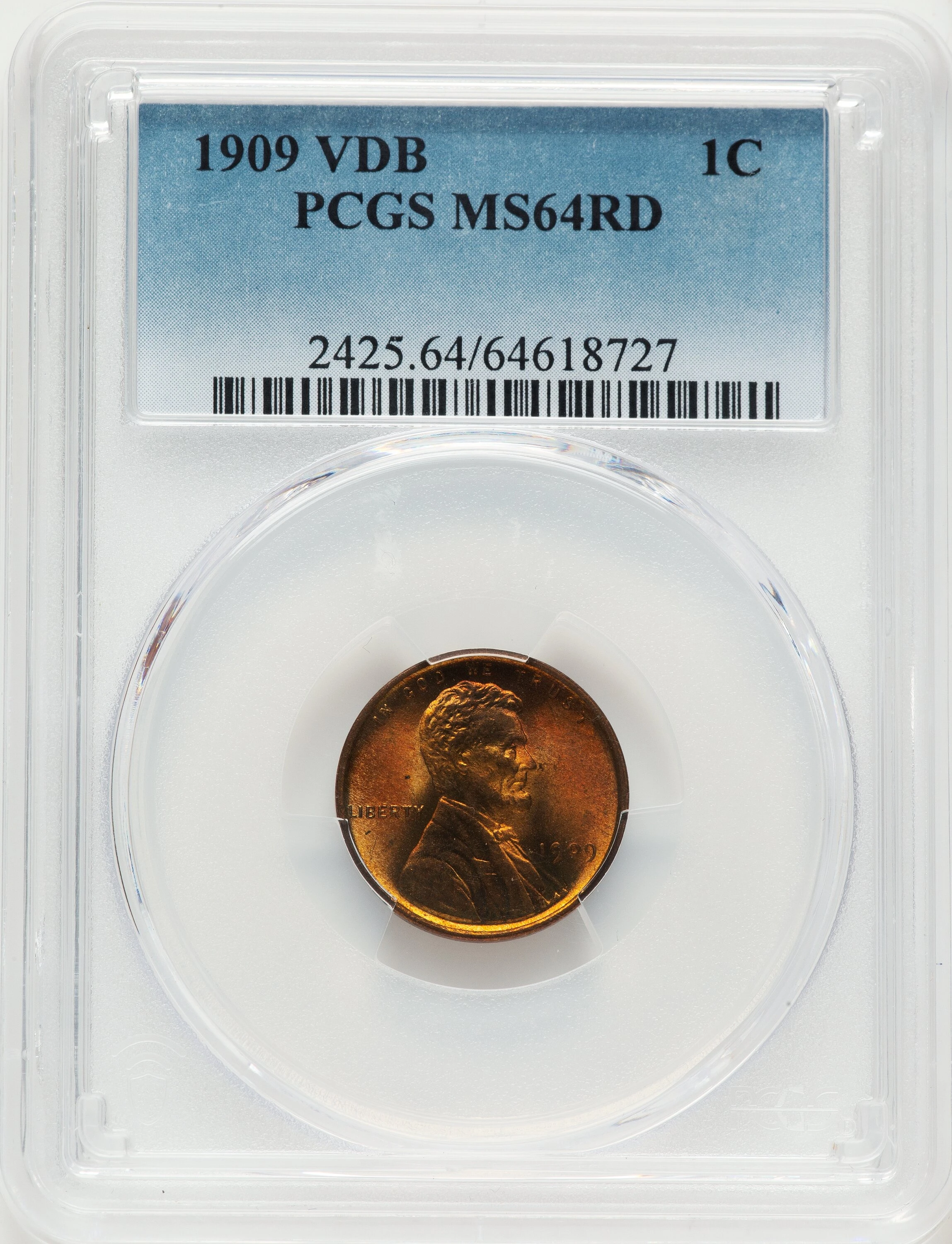
These are color-reference specimens, not the MS65 and MS66 coins in the 2024 sale table. Open either image to inspect the full holder and label. The pair illustrates why color belongs in a complete description; it does not isolate a fixed color premium.
Cleaning: do not mistake a brighter surface for a better grade
A coin with cleaning or other surface problems should not be priced as an undamaged numerical-grade example. A Details assessment describes remaining detail alongside a problem; it is not interchangeable with a straight grade at the same apparent wear level. Do not polish a brown penny in an attempt to turn it into an RD coin.
How do I turn identification into a useful estimate?
Compare several closely matched completed sales and retain the uncertainty in your coin’s condition. Do not average unlike coins simply because their dates match.
- Write a complete search description. For example: “1909 VDB, no mint mark, PCGS MS65RB.” For an ungraded coin, describe observed wear instead of borrowing a certified grade.
- Filter out unsuitable comparisons. Exclude different mints, varieties, Proofs, color categories or problem-free coins when yours has a surface issue.
- Check the actual lot. Confirm the pictures, grade, quantity and whether it sold. A mixed lot or unsold listing is not a direct single-coin comparison.
- Keep the accounting consistent. Record sale date, currency and commission. Separate shipping and taxes when disclosed.
- Use a range and a research date. If only one relevant sale exists, call it one historical result. Do not present it as a current market range.
For selling, request an actual offer after completing the identification. Your net proceeds can differ from a retail comparison because of selling fees and the buyer’s costs. Before paying for grading, weigh the likely benefit against the full submission expense and uncertainty.
From a scan result to a price decision: a 1943 steel penny
The supplied HeriBase record identifies a 1943 Lincoln Wheat penny and displays a USD $2.80 reference price. The capture date was not recorded, so this screenshot is an example of how to read a result, not a current price quote. Here is how to check its scope and decide what to do next.
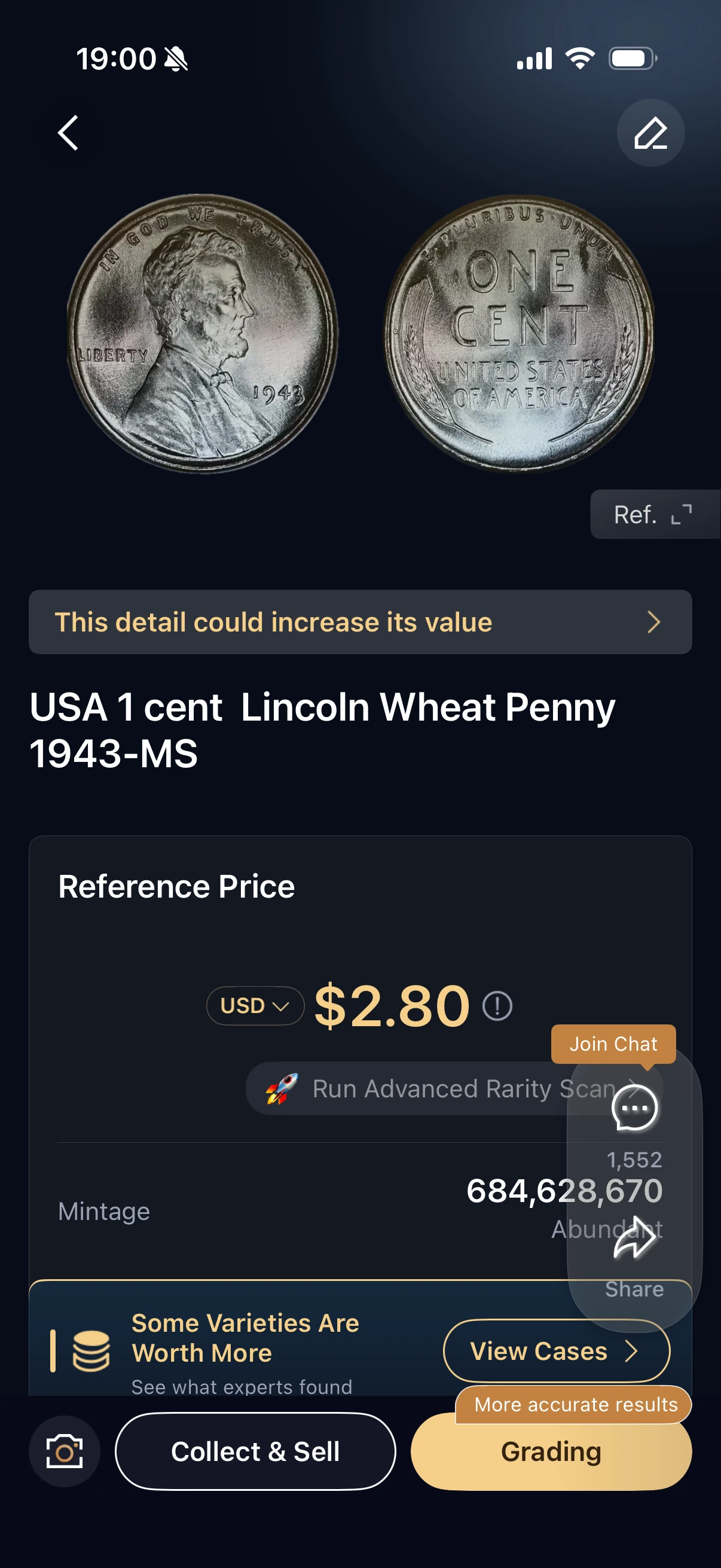
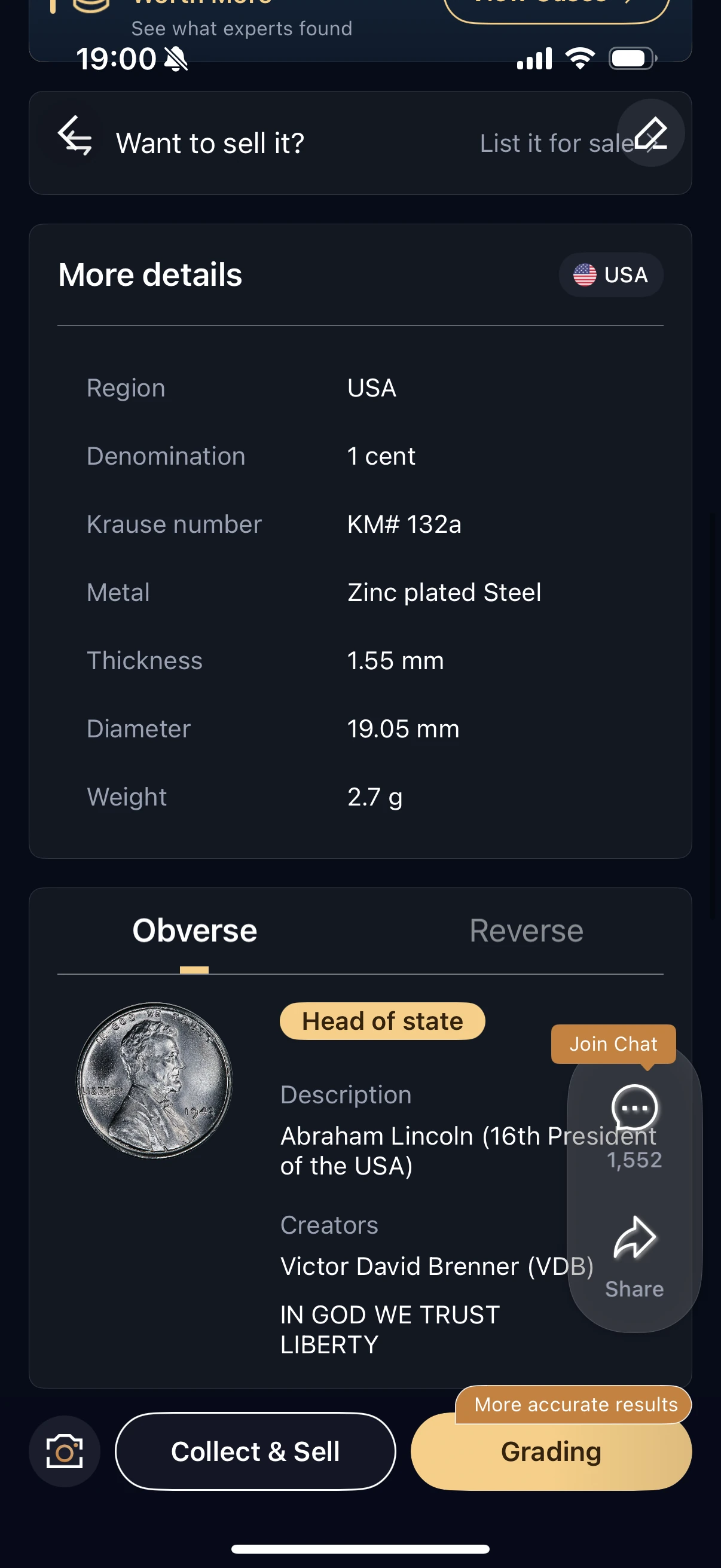
Read these fields together
- Suggested issue: 1943 Lincoln Wheat penny, labeled MS.
- Reference price: USD $2.80 in this supplied record.
- Listed composition: zinc-plated steel.
- Listed specifications: 2.7 g; 19.05 mm diameter; KM# 132a.
- Listed mintage: 684,628,670.
1. Check the identification against the coin
Confirm the 1943 date, mint-mark area and Wheat reverse. The listed zinc-plated steel composition is consistent with the ordinary 1943 issue discussed above. The app’s weight and diameter are catalog specifications, not measurements of your physical coin. Compare them with actual measurements when composition is in doubt.
2. Decide whether the reference price fits
The $2.80 figure belongs to this app result, which carries an MS label. The screenshot does not provide a certified numerical grade, the underlying price records or their dates. A worn, corroded or differently attributed penny needs a different comparison. The rare 1943 bronze category and the 1909 VDB auction prices elsewhere in this guide do not establish the value of this steel cent.
Case outcome: the scan provides a clear starting reference—$2.80 for the displayed 1943-MS entry—but it does not establish a confirmed selling price for the physical coin. Check the full price details and comparable condition before using the estimate. No matched completed sale is supplied for this record.
3. Resolve a price disagreement
If the reference price seems inconsistent with your coin, send both-side photos and the saved result to platform support, or request an in-app human appraisal after checking its fee and scope. Ask: “Does my coin match the 1943 steel issue and the condition assumed here, and what supports the reference price?” If authenticity or composition remains unresolved from photos, consider physical examination.
The two screenshots were supplied for this article. They document one app result, not a new accuracy test or a completed human appraisal. Mintage is a production figure, not a count of surviving coins.
HeriBase identification steps · Human appraisal scope and fees
Penny value checker questions
Can I check a penny’s value from a photo?
A photo can help identify the issue and visible details. Start with an app scan, then verify the date, mint and variety and compare condition-matched sales. Photographs alone may not resolve composition, altered mint marks or subtle surface problems.
Is a penny with no mint mark valuable?
The missing letter alone does not establish rarity. Identify the date and expected issue first. For example, a 1909 VDB without an S is not the same issue as the 1909-S VDB.
Is every Wheat penny worth a lot?
No. The Wheat reverse identifies a series, not a price. Check the particular date, mint, variety and condition. Use matching sales rather than the record price for an exceptional example.
Is a 1982 penny weighing about 3.1 grams rare?
Weight alone is not enough: ordinary bronze varieties exist. The candidate discussed here needs the 1982 date, D mint mark, Small Date diagnostics and bronze composition together, followed by authentication.
Can I check my penny for free?
You can use free reference pages to research the date and mint. HeriBase offers three free scans each day; watch ads for additional scans without subscribing, or subscribe for unlimited identification. Photograph both sides, review the proposed identity and use the displayed reference value as a starting point. Begin at Home → Identify for Free (or Identify); see the illustrated identification steps. A subscription trial is a separate offer with its own billing terms; see free access and subscriptions. Human appraisal and physical grading carry separate fees; free identification does not include certification.
Should I clean my penny before scanning or selling it?
No. Improve lighting and focus instead. Cleaning can alter the surface and make the coin harder to compare with original examples.
Identify the penny first. Use a price only when the details match.
- The year alone does not set value. Mint mark and variety separate issues such as 1909 VDB and 1909-S VDB. Mintage adds context; it is not a price.
- Condition determines which comparisons are useful. Grade, copper color and cleaning can change the price group. Use matched completed sales with their dates and fees.
- An unexplained price needs review. Keep the app result, identify the disputed detail and ask for its basis before using the estimate to buy or sell.
Your next step: scan both sides in HeriBase and check the reference price. If it remains unclear, contact platform support or request a paid human appraisal. Keep the coin uncleaned for any further examination.
References, evidence and editorial scope
Prepared by the Heritcoin Team, which provides HeriBase coin-identification services. Sources checked September 21, 2026. This guide synthesizes official coin references and reported auction records; it is not an independent authentication of a reader’s coin or a live price feed. No individual expert review is claimed.
PCGS supports the issue descriptions and variety diagnostics; NGC supports the discovery report, grading terminology and stated auction records. Historical sales retain their dates and full labels. The 2017 discovery report is not used to assert how many examples exist today.
The reference list below supports the issue descriptions, grading terminology and historical sale table. For broader research, see what makes a coin valuable and when an appraisal or physical examination helps.