

In this article
How do I start my first coin collection?
Pick one theme you enjoy and aim for a small first set—such as five different designs from your change or coins from one trip. Start with coins you already own and set a spending limit before buying more. For each coin, identify the date and mint mark, photograph both sides, record its source and cost, and place it in a labeled coin-safe holder without cleaning it. Keep a digital record with an album number, page and slot so you can open its saved record and locate the physical piece when you want to examine or sell it.
You have a working first collection when you can match every coin to its record and explain why it belongs. Start with one coin today and build toward your chosen goal; completing an entire official series can wait.
1. Choose a collection you can explain in one sentence
“I collect coins” leaves almost every purchase open. “I’m collecting one example of each national park quarter design I find in change” gives you a clear way to decide what fits. A useful beginner theme has a subject you enjoy and a stopping point you can recognize.
| Starting direction | A manageable first goal | What you learn |
|---|---|---|
| Coins from circulation | Keep five different designs from your change. | Recognizing designs, dates and denominations. |
| A birth year or family year | Find a few denominations dated to that year. | Matching dates while comparing coin types. |
| A country or travel memory | Identify and label the coins from one trip. | Countries, languages and monetary units. |
| A design theme | Choose five coins showing animals, buildings or places. | Researching designs without chasing a complete series. |
| One coin series | Collect a short date range before attempting every date and mint. | Mint marks, varieties and differences in availability. |
These are starting exercises, not recommended investments. Pick the direction you would still enjoy if the coins never increased in value. You can change the theme after learning more.
For a design-based U.S. example, our national park quarters guide shows how designs, dates, mint marks and collector finishes fit together. There is no need to complete every version at the beginning.
2. Set a budget for the whole hobby
Decide how much you are comfortable spending over a month, including supplies and delivery—not just the advertised coin price. Keeping an interesting coin from change ties up its face value, while buying from a seller can add postage, taxes or other charges.
An illustrative first-month budget
If you choose a $30 limit, you might reserve $15 for coins, $10 for holders or an album and $5 for delivery or unexpected costs. This is a planning example, not a quote for supplies or a minimum amount needed to collect. If the total does not fit, reduce the purchase rather than stretching the budget.
Write down your limit and a short want list before browsing. A low-priced coin outside your theme can still become an unnecessary expense, especially when repeated across many purchases. Leaving a space empty is a valid collecting decision.
Keep three amounts separate: what you paid, a dated reference estimate, and any actual offer to buy. A collection dashboard can help organize estimates, but a rising displayed total is not cash you have received.
3. Find your first coins without rushing into expensive purchases
Begin with change, coins kept from travel or items already in your family. Ask permission before moving coins out of someone else’s collection, and keep any original labels or packaging with them. A label can preserve information that is difficult to recover later.
When you are ready to buy, choose a channel that lets you understand the individual coin and the total cost:
- A coin shop or show: ask to see both sides, clarify the stated condition and ask about returns before purchasing. This can also be a chance to learn the terminology used for your chosen series.
- An online seller: look for clear photographs of the actual item, a complete description and understandable delivery and return terms. A stock photo is not evidence of the condition of the coin you will receive.
- A mint-issued collector set: read what is included and how it was made. Proof and uncirculated products are different categories; neither label guarantees a future profit.
For a first purchase, an ordinary, well-described example can teach more than a supposed bargain you cannot identify. If the price depends on a rare variety, an exceptional grade or a story about authenticity, resolve that claim before paying for it.
4. Learn what to record before looking up a price
Turn the coin over. The portrait or main design is only part of the identification. The reverse, date, denomination and any mint mark help determine which issue you have. Photograph the edge separately if it carries lettering or another useful feature.
Use even light, a plain background and a sharp view of each side. Keep the whole coin in frame. If you see a small mint mark or an unusual detail, take an additional close-up without replacing the full photographs.
HeriBase can help you begin with a suggested identity and reference information. Compare that result with the coin in front of you, especially its date and mint mark. Save a detail as unconfirmed if the photograph cannot resolve it.
The coin I used for this walkthrough
I used this 1942-S Lincoln wheat cent to start my collection. Before identifying it, I checked both sides: Lincoln on the obverse, the 1942 date with an S mint mark below it, and the wheat-ear reverse. I used these details to check the identification and the record I saved.
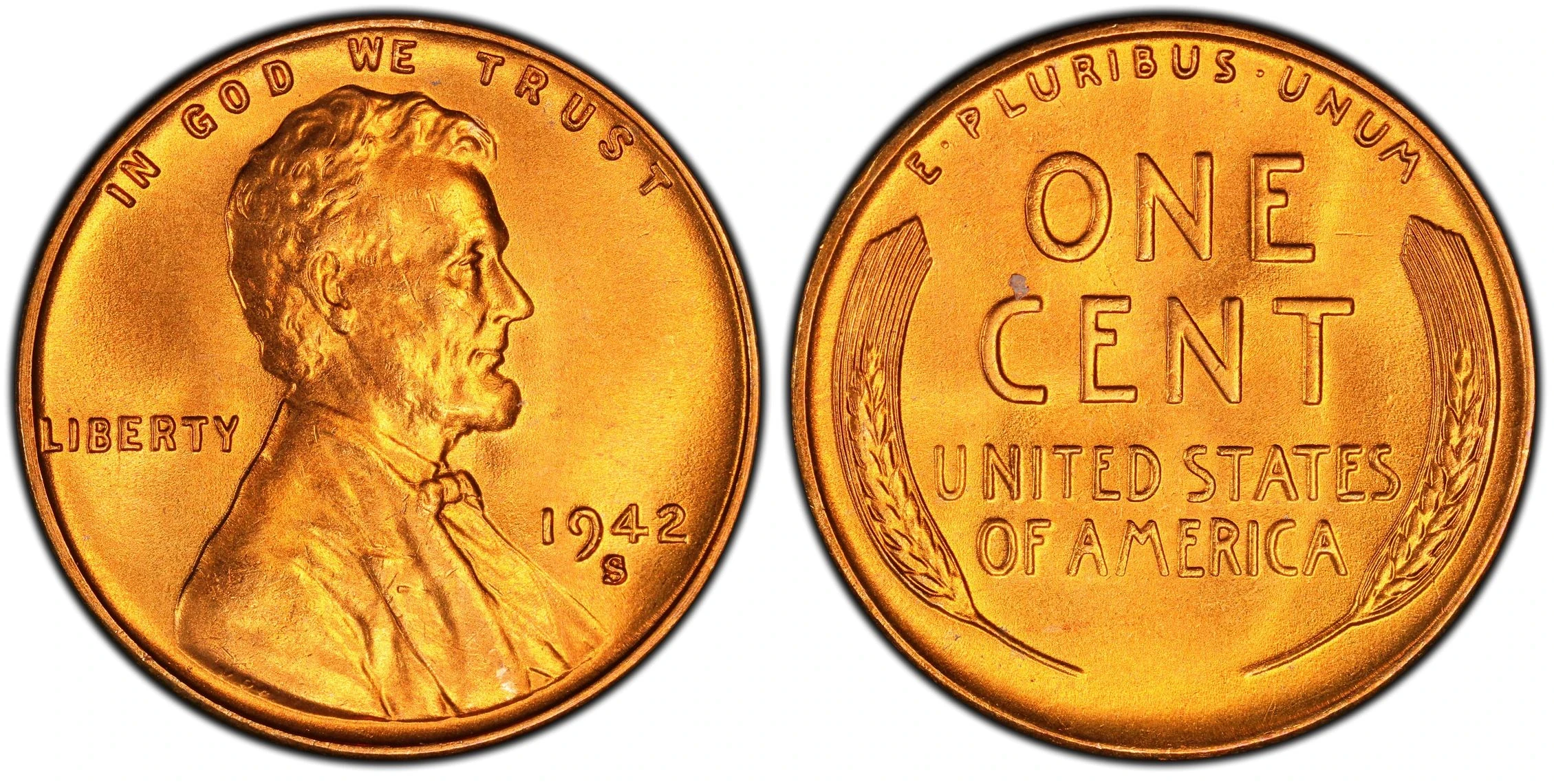
The next section follows that same coin through HeriBase. For mint-by-grade value comparisons, see our 1942 penny guide.
Learn the broad condition groups before attempting an exact grade. Our coin grading scale guide explains circulation wear, Mint State and why a shiny surface alone does not establish a high grade.
5. Connect your digital collection to your physical album
A coin album gives each physical coin a place. A digital collection helps you identify, organize and review those coins without turning through every physical page. Use them together: save the coin’s identity and photographs online, then record exactly where you put the physical piece.
| Record | What to write |
|---|---|
| Identity | Country, denomination, date, mint mark and any confirmed variety. |
| Condition | Visible wear or damage; the complete certified grade only if one is actually present. |
| Acquisition | Date acquired, source and total cost. For a gift, write “gift” instead of inventing a purchase price. |
| Photographs | Both sides, plus relevant details or holder labels. |
| Value research | Reference amount, source and date; keep these separate from your cost. |
| Location and purpose | Album number, page and slot, plus a unique coin ID and why the coin fits your theme. |
What does each kind of collection help you do?
| Task | Physical album | Digital record linked to the album |
|---|---|---|
| Store and view coins | Keeps coins in designated positions and lets you examine the actual pieces. | Holds photographs and identity information you can review before taking a coin out. |
| Find a particular coin | Labels help, but a growing collection can mean searching through several albums. | Open the named collection, find the saved coin and use its recorded album, page and slot to retrieve it. |
| Compare similar coins | Bring the relevant pages or holders together to inspect differences. | Review dates, mint marks, photographs and notes to narrow down which physical coins to compare. |
| Prepare to sell | Retrieve the correct piece and check its present condition. | Use the saved identity and photographs to prepare a listing, then match the listed coin to its physical location. |
A simple location note: album → page → slot
Give each album a number and each coin a unique ID. Put the same ID on its holder label or album label and in the digital record. HeriBase collection notes can hold the physical location so the saved entry points you back to the right piece.
Example location note: Album A01 · Page 1 · Slot 03 · Coin C001 — 1942-S Lincoln wheat cent.
I would use a note like this to link the digital record to its physical album position.
Save the album location in Remarks
To apply this numbering system, use the saved coin’s editor:
- Open the coin’s personal set in Collection, tap its three-dot menu and choose Edit.
- Find Remarks and enter the album number, page, slot and unique coin ID. For example: A01 / Page 1 / Slot 03 / C001.
- Tap Update Collection to save the note.
- Reopen the record and check the note against the label on the physical album or holder.
The record-editing steps in the HeriBase user guide show Remarks and Update Collection. The numbering above is a suggested setup; the coin-saving walkthrough below does not include a completed album-location note.
When you want to examine that coin, open its named collection, find the saved coin card and read its location note: take album A01, turn to page 1 and find slot 03. Check the physical coin against the saved photographs and mint mark. If you move it to another album, update the note at the same time.
When you decide to sell, retrieve the coin using the same note and check its current condition before using HeriBase’s selling entry to prepare the listing. After a completed sale, update your inventory so the digital collection continues to match what you physically hold. The screenshots below show the collection workflow and a selling entry; they do not document a completed transaction.
A hands-on example: from one coin to a saved collection
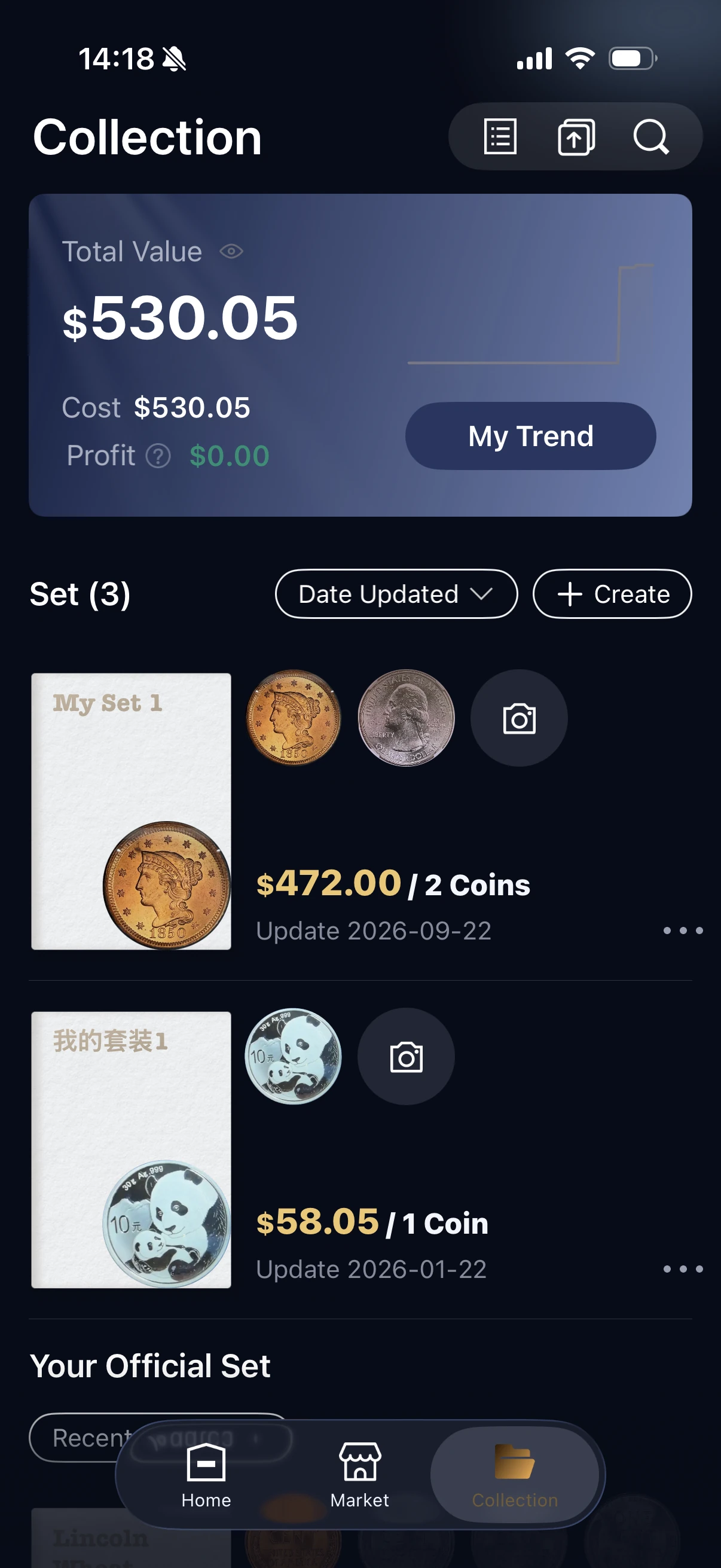
I started with one 1942-S cent and a folder named First coin collection. I identified the coin, added it to that folder, then reopened the record to check its details. Here is how I created a collection I could return to and manage.
Step 1. Create and name my collection
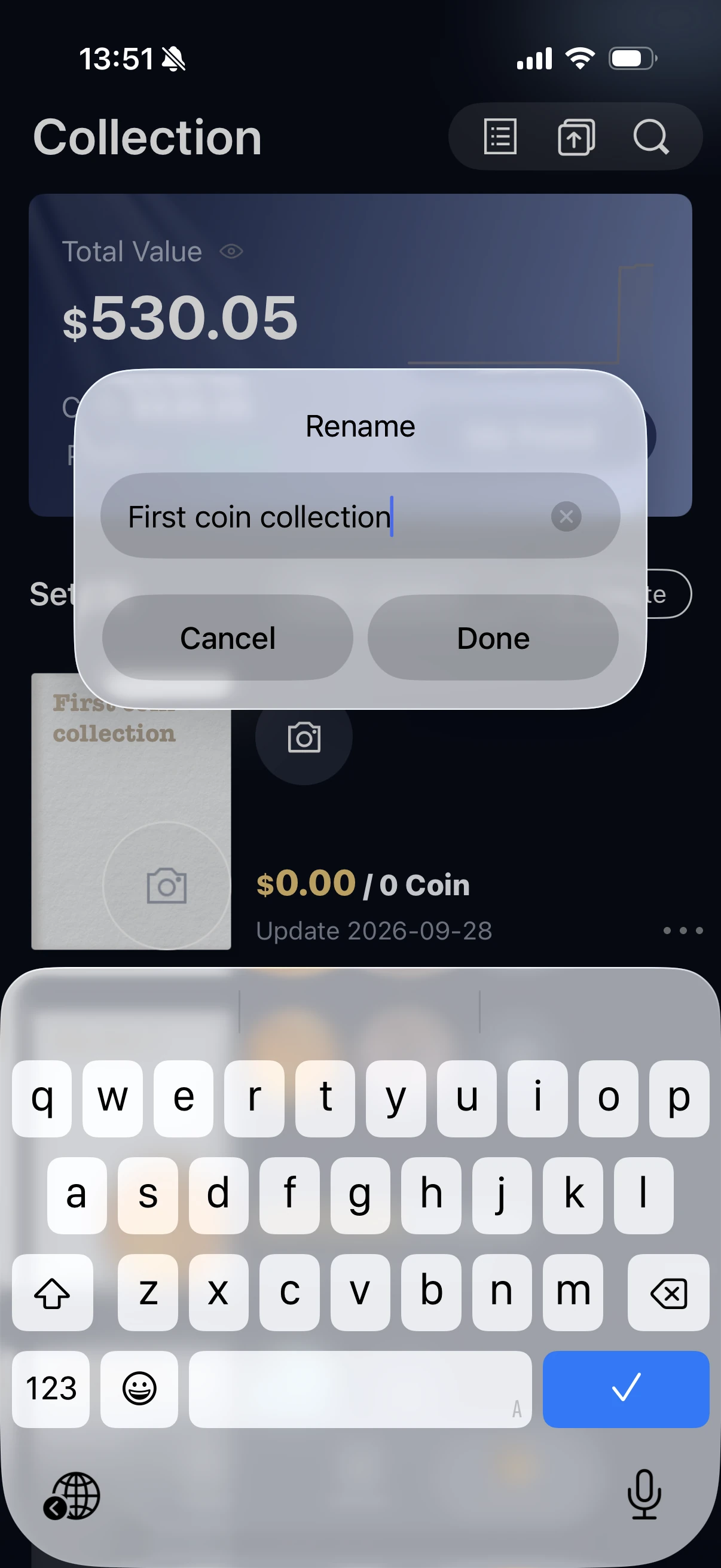
I opened Collection and tapped + Create to start a personal set. To give it the name shown below, I opened the set’s three-dot menu and chose Rename, entered First coin collection, then tapped Done. I chose a name I could remember and distinguish from my other sets. A more specific name, such as “Travel Coins” or “Lincoln Wheat Cents,” can make separate groups easier to find as the collection grows.
Step 2. Identify my coin and check its details
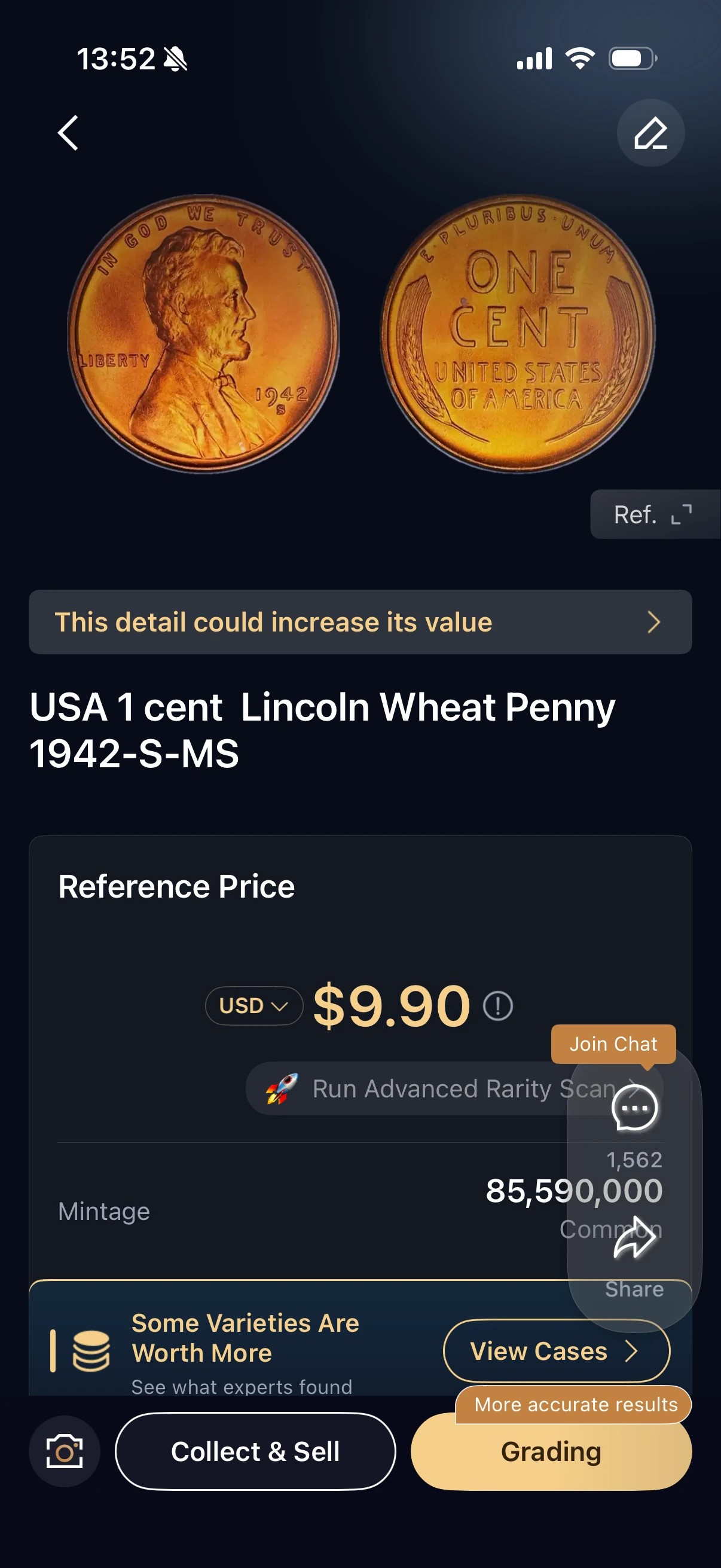
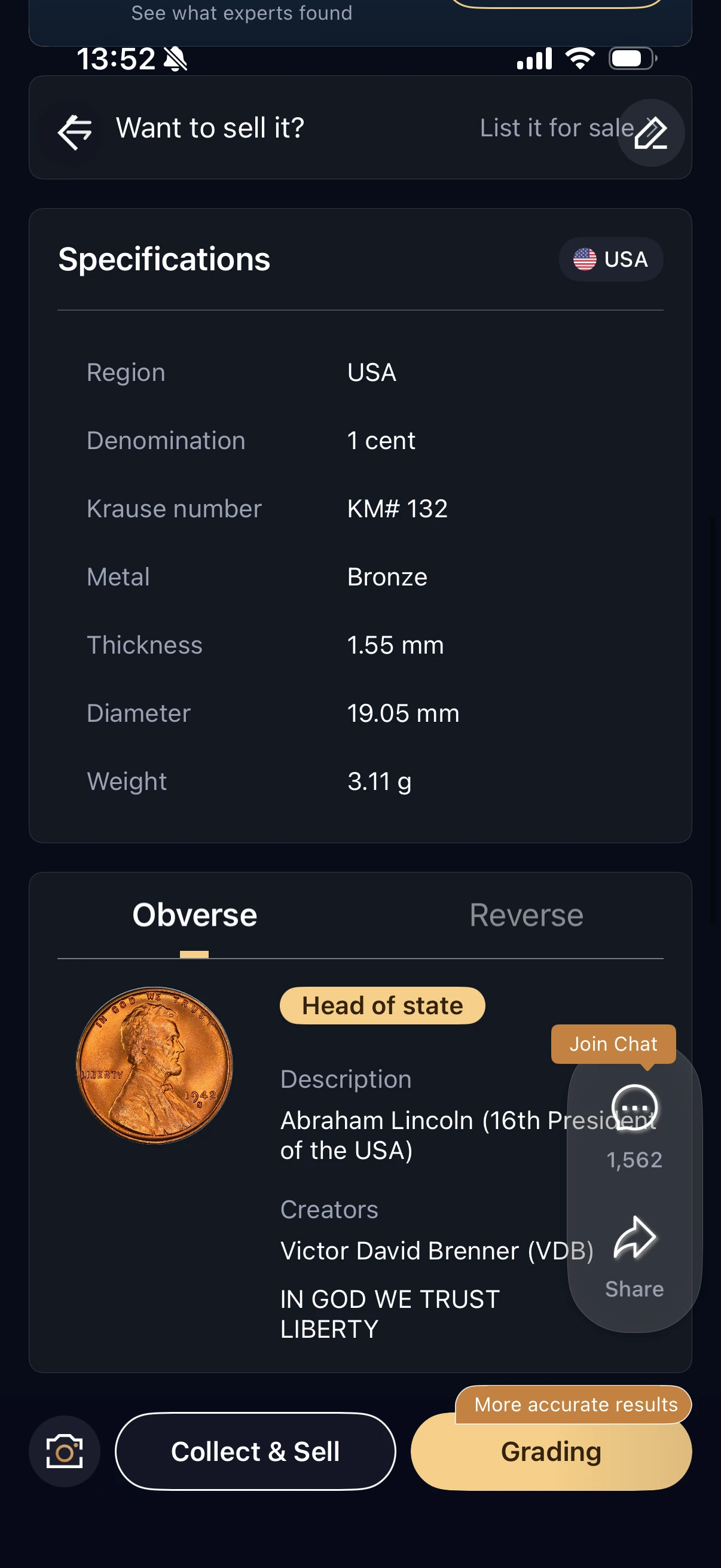
I identified the coin in HeriBase and received USA 1 cent Lincoln Wheat Penny 1942-S-MS with a $9.90 reference price. I checked the date, S mint mark and design against my coin, then opened the specifications: bronze, 19.05 mm diameter and 3.11 g weight.
I kept the $9.90 as the app’s reference estimate. The MS label gave me a broad condition category; a numerical grade and RD/RB/BN color designation would still be needed for a more specific value comparison.
Step 3. Add the coin to my named collection
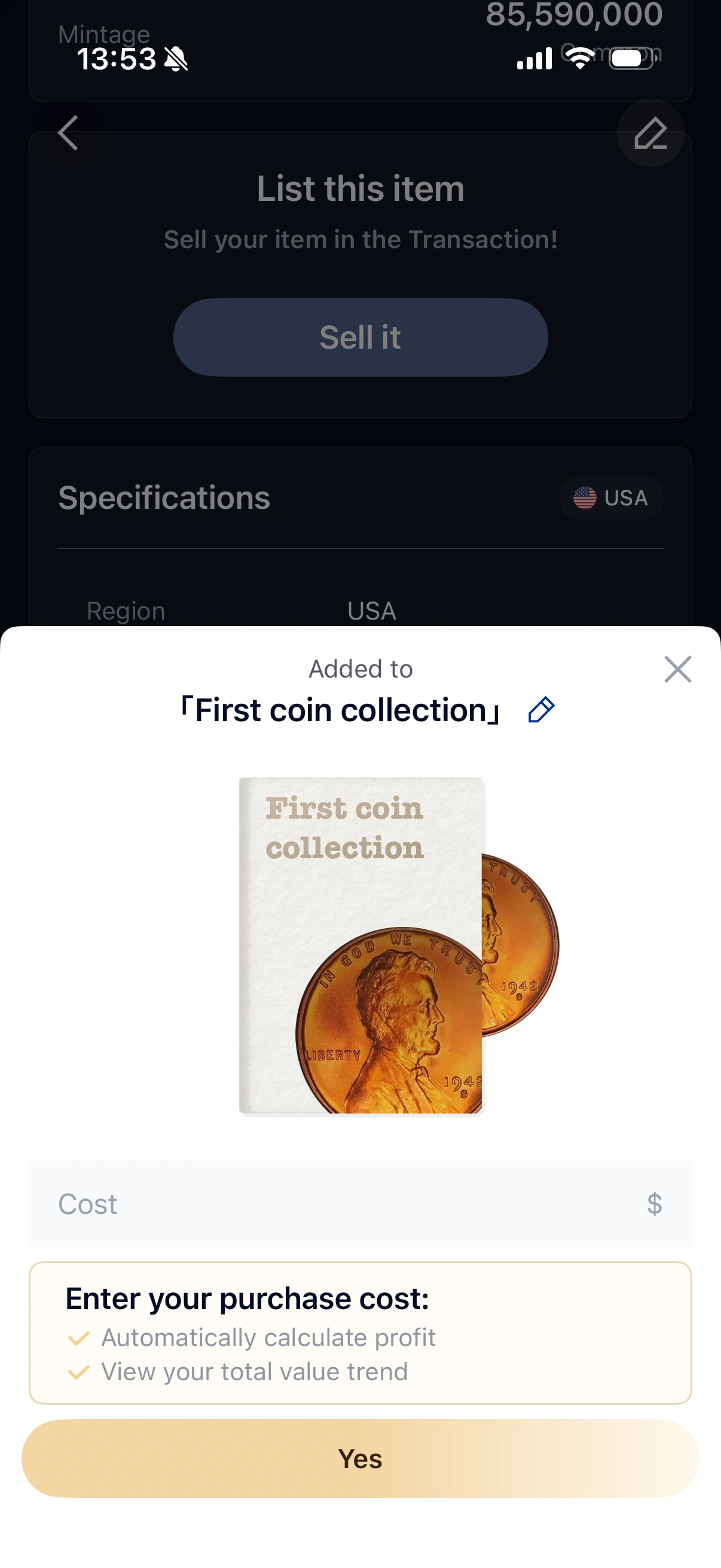
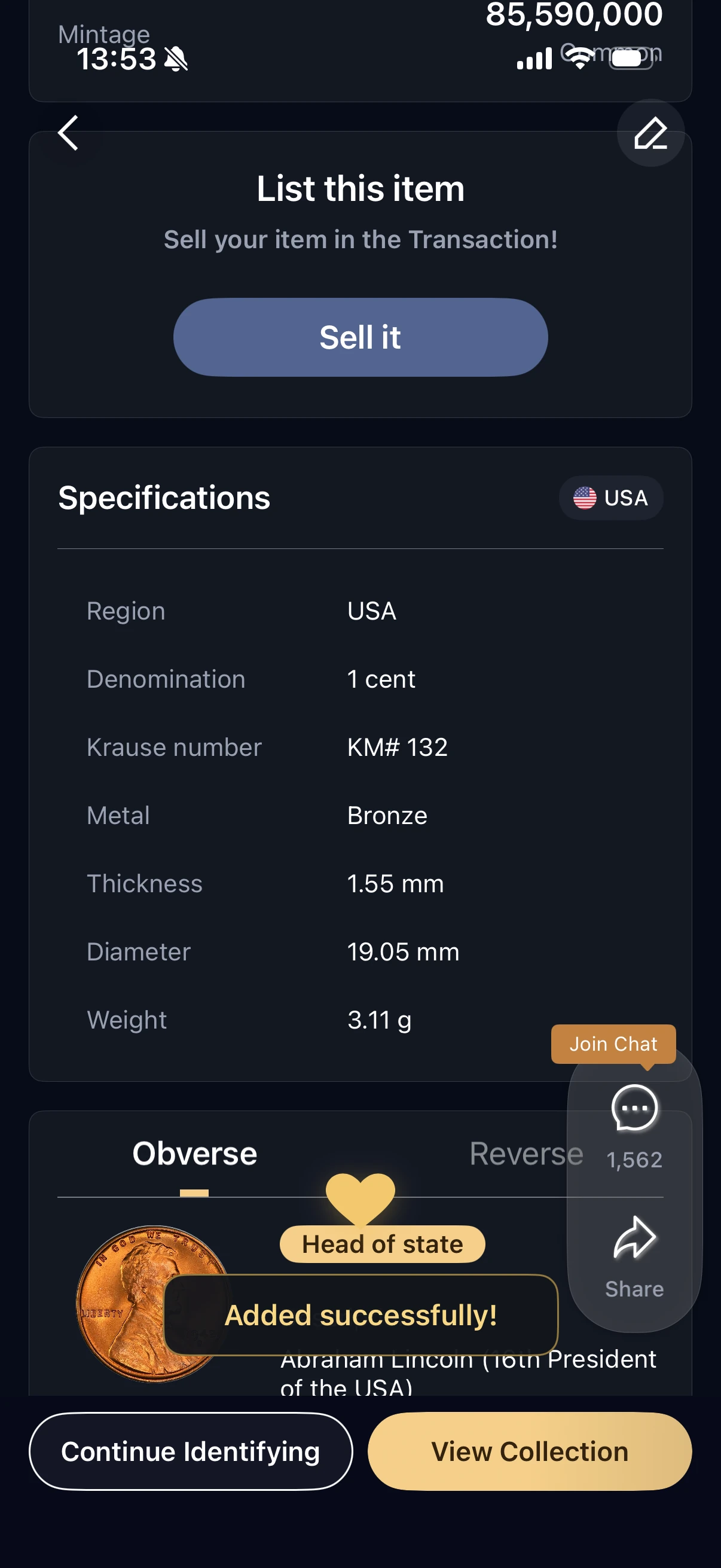
I tapped Collect & Sell and chose the collection option. I checked that the panel named First coin collection as the destination, manually entered 9.9 in Cost, and confirmed with Yes. The app displayed Added successfully!, so I tapped View Collection to find the saved coin.
Step 4. Reopen my saved coin and check the record
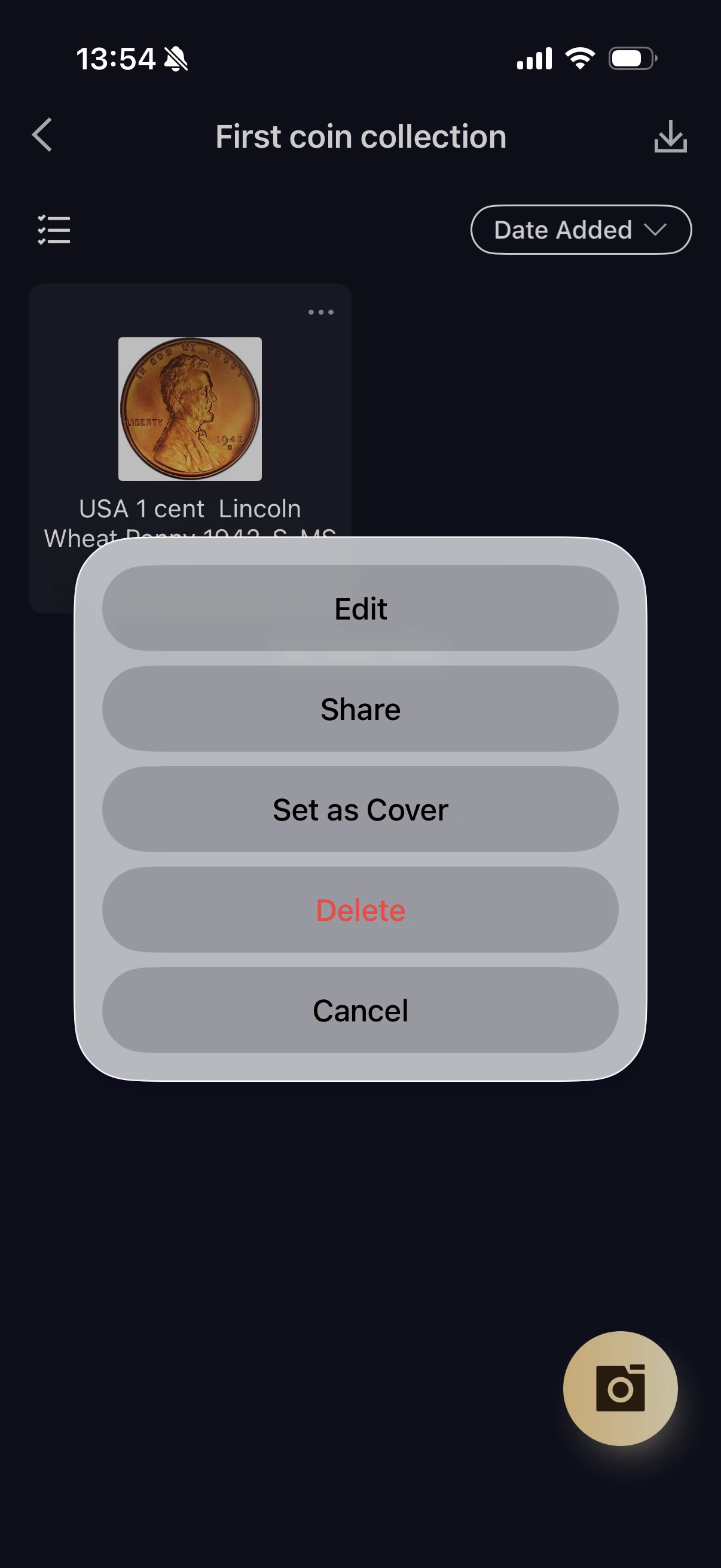
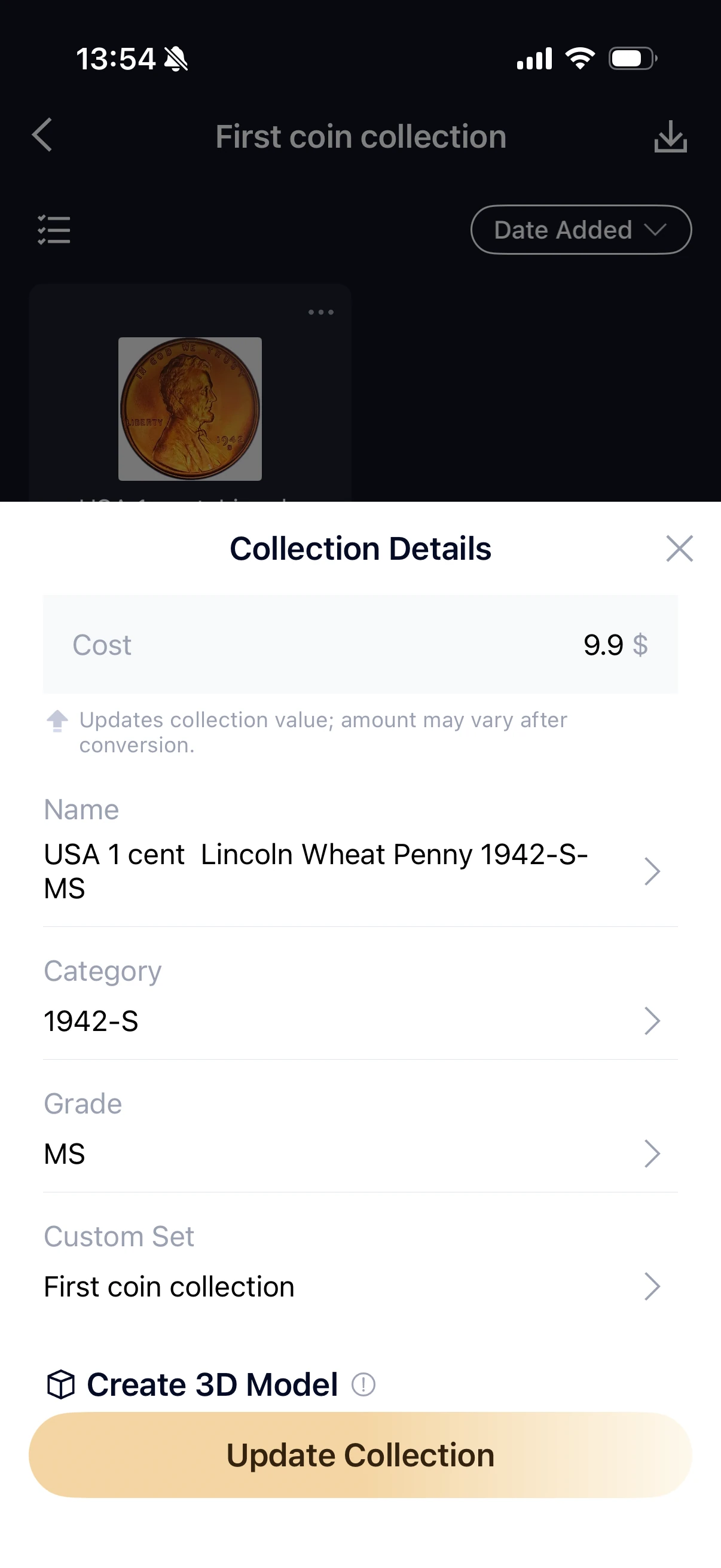
Inside First coin collection, I found the saved coin card and opened its three-dot menu. Alongside Share, Set as Cover and Delete, I could choose Edit. I opened it and checked Collection Details: the same coin name, category 1942-S, grade MS and Custom Set: First coin collection.
If the coin is in a different set: open its three-dot menu, choose Edit, tap Custom Set and select the intended folder. Tap Update Collection, then reopen that folder to check the coin is there. This is also how to organize an already-saved coin into a new collection.
The reopened record retained the $9.90 I had manually entered in Cost and the collection I had chosen. That confirmed I could return to the saved information. My Cost entry and the app’s reference price are separate fields, even though both show $9.90 in this example.
Step 5. Find my coin in the official set
An Official Set is an app-defined checklist for a coin series. It is different from a physical collector set issued by a mint. Its progress count shows entries recorded in that checklist; it does not certify the coins or mean I bought a complete mint-issued set.
I returned to Collection and found Lincoln Wheat Penny under Your Official Set. I opened that album and saw progress of 1/162: the 1942-S slot was in color, while the surrounding missing entries were faded. My personal set organized the coin under my own name; the official album showed where it belonged in the series. I could use those gaps to explore future additions at my own pace.
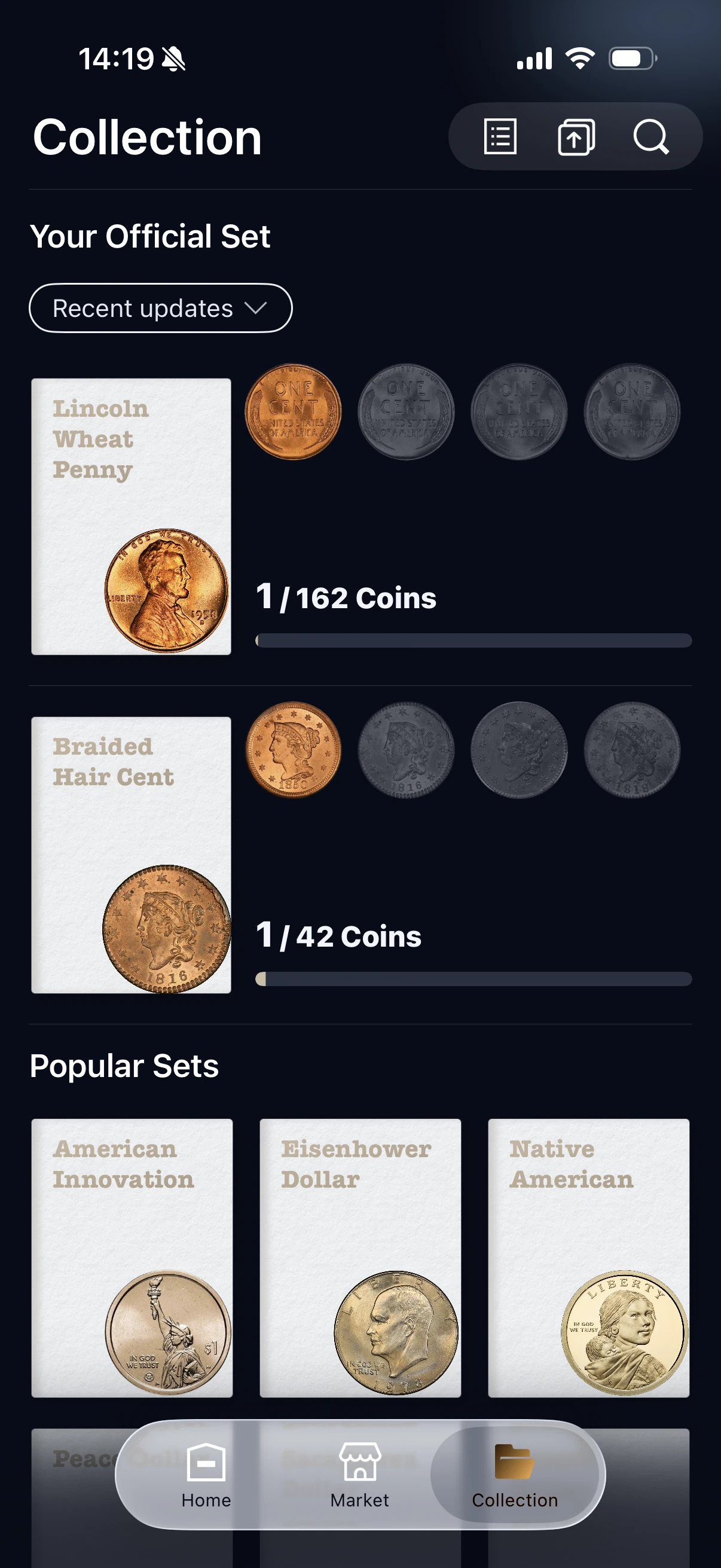
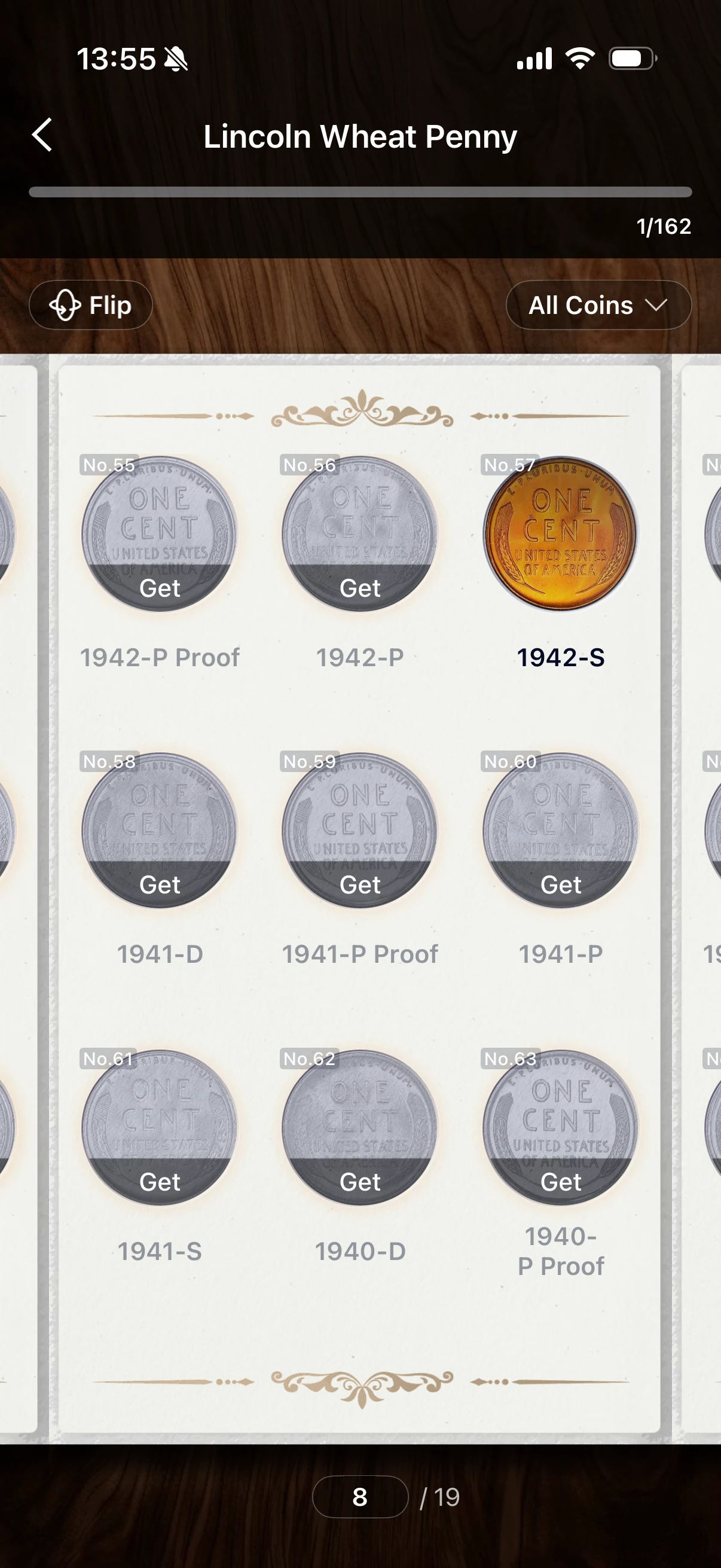
My first coin was now organized: I could reopen its identification, review the Cost I entered, find it in my named collection and see its place in the official album. To connect a record like this with physical storage, I would add the album, page and slot to its location note.
Our HeriBase user guide covers the other collection controls. Keep information in a separate note or spreadsheet if the editor does not provide the field you need.
If you already have records, the documented batch-import screen offers photos, an online spreadsheet and a local spreadsheet. Check the current format and inspect the imported results before moving a large collection. For a few starter coins, entering them individually gives you a chance to understand each record. The collection app comparison covers organization tools in more detail.
6. Choose physical storage and label it to match
If you want to keep the collection in an album, include a coin-safe album and any suitable holders in your supplies budget. Check that its pockets or openings fit your coins. An album gives you a physical browsing order; numbering its pages and positions makes that order usable in your digital records. Individual holders are also a practical starting option for a few coins.
Handle a coin by its edge over a soft surface, keeping fingers off the design. Avoid cleaning or polishing it to make it look newer. Surface alteration can remove evidence you need for assessment and reduce collector appeal.
Choose holders intended for coins: acid-free materials and PVC-free plastics. Use a suitable size so the coin is protected without being forced into place. Keep original mint packaging and certified holders when present, and store your collection in a stable, dry location.
Start with a few appropriate holders rather than a large display system. Label them so you can match each coin to its record, and avoid loose storage where coins rub against one another. Ask a knowledgeable specialist about an existing residue or corrosion problem rather than experimenting with household cleaning products.
Our guide to recognizing possible cleaning damage explains which surface clues to inspect. Learning to notice a problem is different from trying to repair it yourself.
Common beginner mistakes—and a better next step
- Buying because a coin is old. Identify the issue and check comparable examples. Age is one part of its story, not a price calculation.
- Using the highest online listing as its value. Look for completed sales with the same mint, condition and relevant designation.
- Calling every unusual feature an error. Compare the feature with a recognized reference; wear and damage can also look unusual.
- Trying to finish a large set immediately. Complete a small learning goal first, then decide whether the expensive gaps still interest you.
- Paying for grading before understanding the coin. Compare the likely benefit with the full cost. Seek advice first when an uncertain attribute could materially affect value.
- Saving an app result and forgetting the physical coin. Match the record to a holder or album position and check the identity before adding more entries.
For the broader reasoning behind price differences, see what makes a coin valuable to collectors. For an unresolved identification or value question, the coin appraisal guide explains how to choose the type of assessment you need.
A simple first-week plan
First session: gather a small group of coins you own and choose one theme. Write down your spending limit and what counts as a first milestone.
Second session: identify and photograph three to five coins. Record uncertain details as questions instead of filling them with guesses.
Third session: give each coin a holder identifier, create its record and put the group in a named set. Reopen one record and confirm you can find the matching physical coin.
End of the week: decide what you enjoyed, which question you still need to answer and whether you want to buy anything at all. A small, understandable collection is a successful first result.
Coin collecting for beginners: common questions
How much money do I need to start?
You can start by examining coins you already own. New spending depends on the theme, supplies and purchases you choose. Set a limit you are comfortable with; no expensive coin or paid subscription is necessary to begin learning.
What are good coins for a beginner to collect?
Choose a group you can recognize and obtain within your budget, such as circulating designs, travel coins or a short date range. There is no single best series for everyone. Interest and manageable scope matter more than a promise of rarity.
Should I buy the highest grade I can afford?
First learn what the grade means for your chosen issue. An affordable example with clearly understood condition may fit your learning goal better than a costly upgrade. You can refine your preferences as you gain experience.
Can I collect without an app?
Yes. A notebook or spreadsheet can hold the essential record. Use an app when its identification, photographs or collection tools make your process easier, and keep a backup of information you would not want to lose.
How do I know when a coin needs expert help?
Seek advice when uncertainty about authenticity, a variety or condition could change an important buying or selling decision. Send clear photographs and a specific question. Some questions require examination of the physical coin.
Your first collection starts with one well-recorded coin
Choose a small goal, stay within your budget and give each coin an identity, a record and a safe place. The 1942-S walkthrough shows the digital part in practice: name a set, identify the coin, add it, then reopen the saved details to check its place and the manually entered Cost. Add an album, page and slot note to connect that saved entry with the physical coin.
The album stores the coin; the digital record helps you find and manage it. With both connected, you can open the saved record, go straight to the right album page and retrieve the correct piece for comparison or a sale. Keep location notes current as the collection grows, and choose each new addition to fit your interests and budget.